
Crete Spiny Mouse
Acomys minous
Red List assessment
Data Deficienton the IUCN Red List
- EXExtinct
- EWExtinct in the Wild
- CRCritically Endangered
- ENEndangered
- VUVulnerable
- NTNear Threatened
- LCLeast Concern
Data Deficient has no position on the scale above — it records the absence of an assessment, not a degree of risk.
The Crete Spiny Mouse is recorded in one country, Greece across Europe. The IUCN Red List records the Crete Spiny Mouse as Data Deficient. Unknown. No reliable global or regional population estimate has been published, which is the primary reason for its Data Deficient classification.
- Family
- Muridae
- Order
- Rodentia
- Genus
- Acomys
- Countries recorded
- 1
- Continents
- Europe
- Red List category
- Data Deficient
- Data updated
- August 9, 2026
What is the Crete Spiny Mouse?
The Crete Spiny Mouse (Acomys minous) is a small murid rodent entirely endemic to Crete, making it the only established European representative of the predominantly African and Middle Eastern genus Acomys. It is distinguished by its characteristic stiff, spine-like dorsal guard hairs, large eyes, and precocial young. It inhabits rocky Mediterranean scrubland, ancient ruins, and dry stone walls across the island. Its isolated biogeographic position on Crete, far from the genus's African heartland, makes it a remarkable subject for evolutionary and island biogeography research.
Where does the Crete Spiny Mouse live?
Endemic to the island of Crete, Greece (Eastern Mediterranean), with possible presence on a few small adjacent islets.
Restricted to Crete, the largest Greek island, in the Eastern Mediterranean Sea. Occasionally reported on small islets surrounding Crete. It is the only Acomys species with a presence within European territory.
Altitude and depth
Occurs from sea level up to approximately 1,500–2,000 m in the Cretan mountain ranges, though most commonly recorded in lowland, coastal, and sub-montane rocky habitats.
Seasonal movements
No documented hibernation or seasonal migration. The species remains active year-round, though foraging activity may decrease during the harshest summer heat or cold winter spells.
Habitat of the Crete Spiny Mouse
Rocky terrain, Mediterranean maquis and phrygana (garrigue), dry scrubland, stone walls, and ancient ruins. It strongly favors areas with crevices, rocky outcrops, and rubble that provide shelter and nesting opportunities.
Adaptations to its environment
Its spiny dorsal pelage may deter predators and reduce ectoparasite load. Large eyes are well-adapted for nocturnal foraging in dim conditions. Its ability to exploit rock crevices, ruins, and human-modified stone structures provides thermal refuge and predator protection in the Mediterranean climate.
Conservation status and numbers
Listed as Data Deficient (DD) on the IUCN Red List, indicating insufficient data to determine extinction risk. Its narrow endemic range on a single island means it is inherently vulnerable, but population size, density, and trends have not been rigorously assessed.
Estimated population
Unknown. No reliable global or regional population estimate has been published, which is the primary reason for its Data Deficient classification. Population trend is also unknown.
What threatens the Crete Spiny Mouse?
Habitat degradation from agricultural expansion, urban development, and tourism infrastructure across Crete. Introduced predators (feral cats, Rattus rattus) and competition with commensal rodents (Mus musculus) represent additional pressures. Long-term climate change driving increased drought and habitat alteration in the Mediterranean is a growing concern.
Diseases and parasites
Likely hosts ectoparasites (Siphonaptera, Acari) and helminth endoparasites typical of Mediterranean rodents. May serve as a reservoir for zoonotic pathogens common to the region, though specific published data for A. minous is lacking.
What is being done to protect it?
Protected indirectly by Greek national wildlife legislation and the EU Habitats Directive. Protected areas on Crete, including Samaria National Park, provide some habitat refuge. No species-specific conservation program is known to exist for A. minous.
Recommended actions
Systematic field surveys across Crete to map abundance and distribution. Molecular and genetic studies to clarify population structure and connectivity. Assessment of invasive species impacts. Integration of the species into Cretan protected area management plans and species monitoring programs.
What the Crete Spiny Mouse looks like
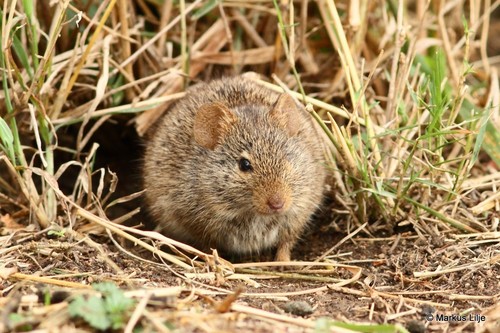
Dorsal fur is grayish-brown to reddish-brown and interspersed with stiff, rib-like spine-tipped guard hairs that give a rough, bristled texture. The ventral surface is white to pale gray. The face is rounded with notably large, dark eyes, prominent rounded ears, and long sensitive vibrissae. The tail is scaly and only lightly furred.
Size
Head-body length approximately 7–12 cm; tail length roughly 7–11 cm, often equal to or slightly shorter than body length.
Weight
Typically 20–50 g. No significant published data on sexual size dimorphism specific to this species.
Distinctive features
The spiny dorsal pelage immediately distinguishes Acomys from common soft-furred mice. Compared to the similar A. cahirinus of North Africa and the Middle East, A. minous is slightly smaller, genetically distinct, and geographically isolated on Crete. Its European endemicity is unique within the genus.
Differences between males and females
Minimal; males and females are similar in size and coloration. Females possess multiple pairs of mammary glands consistent with their reproductive biology.
Behaviour and diet of the Crete Spiny Mouse
Semi-social; may live in small loose groups or colonies sharing rocky crevices and sheltered sites, particularly where suitable habitat is limited. Dominance hierarchies likely exist but are poorly documented for this species specifically.
When it is active
Primarily nocturnal to crepuscular, becoming active at dusk and most active during the night. Retreats to rock crevices or burrows during the heat of the day, a behavioral adaptation to the Mediterranean climate.
Diet
Omnivorous; diet consists primarily of seeds, dry plant material, and invertebrates (insects, small arthropods). May also consume fruits, green vegetation, fungi, and occasionally small vertebrates or carrion when available.
How it feeds and hunts
Opportunistic ground-level foraging among rocks and vegetation, using large eyes and long vibrissae to detect seeds and invertebrates in low-light conditions. Gleans insects from rock surfaces and vegetation rather than actively pursuing prey.
Communication
Communicates via ultrasonic vocalizations, audible squeaks, and scent marking using urine and glandular secretions. Vibrissae play a critical role in tactile sensing and close-range social communication.
Interactions with other species
Predated upon by barn owls (Tyto alba), other raptors, snakes, and small carnivores present on Crete. May compete with introduced house mice (Mus musculus) and black rats (Rattus rattus) in human-modified habitats. Likely hosts ectoparasites (fleas, mites, ticks) and various endoparasites.
Role in its ecosystem
Serves as prey for multiple predator species, contributing to the food web of Cretan rocky ecosystems. Acts as a secondary seed disperser and invertebrate regulator. Its role as an island endemic makes it a component of Crete's unique biodiversity.
Reproduction and lifecycle
Breeding can occur year-round under favorable conditions, with likely peaks in spring and autumn. Gestation lasts approximately 5–6 weeks, which is notably long for a murid rodent. Litter sizes range from 1 to 5 young.
Raising the young
Young are highly precocial—born with eyes open, fully furred, and mobile within hours of birth. Maternal care is primary; communal or cooperative nursing (alloparenting) has been observed in related Acomys species and may occur in A. minous. Weaning occurs within 3–4 weeks.
Maturity and lifespan
Sexual maturity is reached at approximately 2–3 months of age, typical for small murids. Wild lifespan is estimated at 1–3 years; captive individuals of closely related Acomys species can live 5–7 years.
Taxonomy and naming of the Crete Spiny Mouse
Classification
Mammalia > Rodentia > Muridae > Acomys > Acomys minous
Scientific synonyms
Formerly treated by some authorities as a subspecies of Acomys cahirinus (as Acomys cahirinus minous). Originally described by Bate in 1906 from Cretan specimens.
What research says
Recent studies
Phylogeographic and molecular studies have reinforced the specific status of A. minous, distinguishing it genetically from North African and Levantine Acomys populations. Its colonization history on Crete remains an active area of biogeographic inquiry. Detailed ecological field studies specific to the species remain scarce.
Genome and DNA
Specific karyotype data for A. minous is limited; related Acomys species typically have diploid chromosome numbers ranging from 2n=36 to 2n=68 depending on the species. Phylogenetic molecular studies have confirmed A. minous as a distinct lineage, likely colonizing Crete during Pleistocene land-bridge or dispersal events.
Compared with similar species
Most closely related to A. cahirinus (Cairo Spiny Mouse) and other Old World spiny mice. Unlike the widely distributed A. cahirinus, A. minous is geographically isolated and genetically divergent. It shares the hallmark spiny pelage and precocial neonates with all Acomys species, but its European island endemicity is unique within the genus.
The Crete Spiny Mouse and people
1) The genus Acomys is famous for remarkable skin autotomy: the skin tears away easily under predator pressure and then regenerates rapidly—one of the most extraordinary wound-healing abilities documented among mammals. 2) Crete Spiny Mouse newborns are born with eyes open, fully furred, and walking within hours—making Acomys among the most precocial of all rodents, far more developed at birth than typical mice. 3) As the only Acomys species established in Europe, the Crete Spiny Mouse is a living reminder of ancient biogeographic connections between Europe and Africa during the Pleistocene.
Where and how to see it
Best observed at dusk or night in rocky scrubland, near ancient ruins, or along dry stone walls in lowland Crete. The Heraklion region, Lasithi Plateau, and areas around ancient Minoan sites offer suitable habitat. A dim red-light torch is recommended to avoid disturbing natural behavior. Spring and autumn evenings typically yield the highest activity.
Risks to humans
No notable risk to humans. May bite if handled roughly. As a wild rodent, it could theoretically carry ectoparasites or zoonotic pathogens common to Mediterranean rodents, but it poses no significant direct danger to people.
Human uses
No documented use in traditional medicine, commercial trade, or agriculture. Occasionally kept by specialist rodent enthusiasts, but it is not a widely traded or farmed species.
Myths and legends
No specific myths or legends are documented for Acomys minous in Cretan folklore. While mice feature broadly in ancient Greek symbolism and literature (associated with Apollo Smintheus, the mouse-god), no specific cultural lore is attributed to the spiny mouse of Crete.
Countries where the Crete Spiny Mouse is recorded
The 1 countries named in the range description of its IUCN Red List assessment.
Questions about the Crete Spiny Mouse
Where does the Crete Spiny Mouse live?
The Crete Spiny Mouse is recorded in Greece across Europe. These countries come from the range description of its IUCN Red List assessment, and they are what place the species on the interactive map.
Is the Crete Spiny Mouse endangered?
The IUCN Red List assesses the Crete Spiny Mouse as Data Deficient. There is not enough information to judge the risk of extinction, usually because the species is rarely seen or has never been surveyed. It is not a reassuring category: several species were Data Deficient right up to the point they were found to be Critically Endangered.
How many are left in the wild?
Unknown. No reliable global or regional population estimate has been published, which is the primary reason for its Data Deficient classification. This figure comes from the species assessment on the IUCN Red List; population estimates for wild mammals are ranges, not counts, and are revised at each assessment.
What habitat does the Crete Spiny Mouse live in?
Rocky terrain, Mediterranean maquis and phrygana (garrigue), dry scrubland, stone walls, and ancient ruins.
What is the scientific name of the Crete Spiny Mouse?
The Crete Spiny Mouse is Acomys minous, in the family Muridae, order Rodentia.
Other species in the genus Acomys
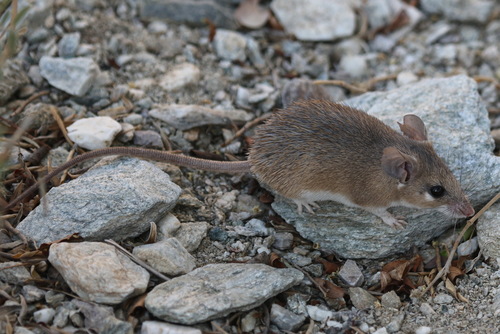
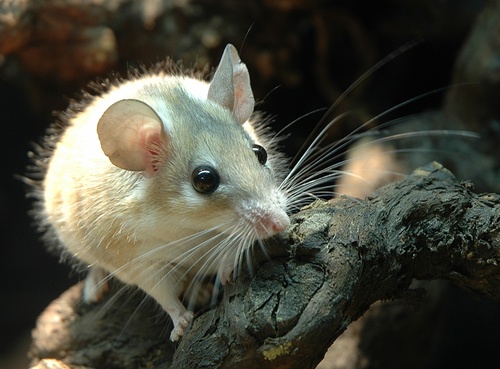
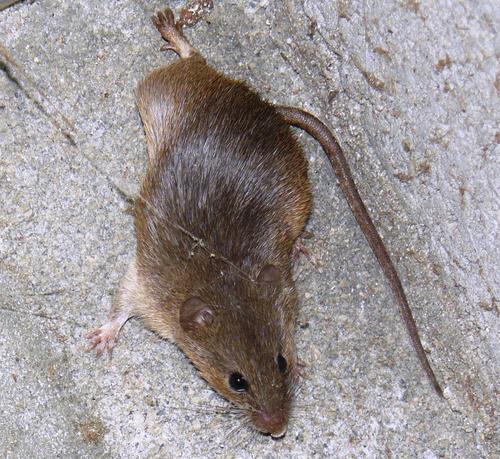
Other species in the family Muridae
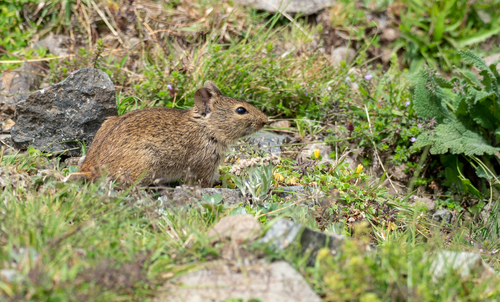
Sources
Conservation status, range description and population estimate come from the IUCN Red List assessment for Acomys minous. Countries are derived from that range description, not from a mapped country list. Last refreshed on .
The distribution map is drawn from the IUCN Red List spatial data compiled in 2023. IUCN SSC Small Mammal Specialist Group