
Cape Spiny Mouse
Acomys subspinosus
Red List assessment
Least Concernon the IUCN Red List
- EXExtinct
- EWExtinct in the Wild
- CRCritically Endangered
- ENEndangered
- VUVulnerable
- NTNear Threatened
- LCLeast Concern
The Cape Spiny Mouse is recorded in one country, South Africa across Africa. The IUCN Red List assesses the Cape Spiny Mouse as Least Concern. No precise global population estimate is available.
- Family
- Muridae
- Order
- Rodentia
- Genus
- Acomys
- Countries recorded
- 1
- Continents
- Africa
- Red List category
- Least Concern
- Data updated
- August 9, 2026
What is the Cape Spiny Mouse?
The Cape Spiny Mouse is a small murid rodent endemic to South Africa's southwestern Cape, one of the most biodiverse regions on Earth. It is characterized by stiff, spine-like modified guard hairs on its dorsum, a trait shared across the genus Acomys. It is strongly associated with rocky outcrops and fynbos scrubland within the Cape Floristic Region, making it one of the few Acomys species restricted to a temperate, fire-adapted biome rather than an arid or semi-arid one. Its restricted range and ecological specialization make it a notable representative of the Cape's unique endemic fauna.
Where does the Cape Spiny Mouse live?
Endemic to the southwestern tip of South Africa, primarily the Western Cape Province within the Cape Floristic Region.
Endemic to South Africa; range largely confined to the Western Cape Province, extending from the Cape Peninsula northward along the west coast and eastward into the Overberg and parts of the Little Karoo. It does not extend significantly beyond the Cape Floristic Region.
Altitude and depth
Mainly found from sea level to approximately 1200m, depending on the presence of suitable rocky fynbos habitat.
Seasonal movements
No significant seasonal migration is known. Activity patterns may shift modestly with seasonal temperature changes, but the species is active year-round and does not hibernate.
Habitat of the Cape Spiny Mouse
Primarily rocky fynbos and renosterveld shrublands, favouring crevices and boulder fields that provide shelter from predators and temperature extremes. It also occurs in transitional scrub zones and occasionally in degraded habitats with sufficient rocky cover. The fynbos biome, characterized by nutrient-poor soils, frequent fires, and high plant diversity, is its core habitat.
Adaptations to its environment
The spine-like dorsal hairs likely provide some protection against predators and abrasion in rocky terrain. Large eyes are adapted for nocturnal vision. Like other Acomys species, it may possess enhanced skin autotomy (easy skin shedding) and regenerative wound-healing capacity, a trait documented in close relatives. Its compact body shape allows it to exploit narrow rock crevices for refuge.
Conservation status and numbers
Least Concern (LC) on the IUCN Red List. The species has a relatively stable population with no evidence of rapid decline, though it is naturally restricted to the Cape Floristic Region, which is itself threatened by habitat transformation.
Estimated population
No precise global population estimate is available. The population is presumed stable but naturally limited by the restricted endemic range. Trend is considered stable under current conditions.
What threatens the Cape Spiny Mouse?
Habitat loss and degradation due to agricultural expansion, urban development, and invasive alien plants (e.g., Acacia and Hakea species) that transform fynbos. Fire management changes affecting fynbos structure are also a concern. Climate change may contract suitable habitat over the long term.
Diseases and parasites
Like most small rodents, it likely hosts ectoparasites including fleas (Siphonaptera) and ticks (Ixodidae), as well as intestinal helminths. Specific documented pathogens for this species are not well studied, but members of the genus Acomys have been found to carry various arboviruses and bacteria in other regions.
What is being done to protect it?
The species benefits from protected areas within the Cape Floristic Region, including Table Mountain National Park, De Hoop Nature Reserve, and various other Western Cape reserves. South African National Biodiversity Institute (SANBI) monitors the fynbos biome broadly. No species-specific conservation program is known.
Recommended actions
Continued monitoring of population trends within and outside protected areas; management of invasive alien vegetation; ensuring fire management regimes maintain open, rocky fynbos structure; inclusion in broader fynbos biodiversity assessments.
What the Cape Spiny Mouse looks like
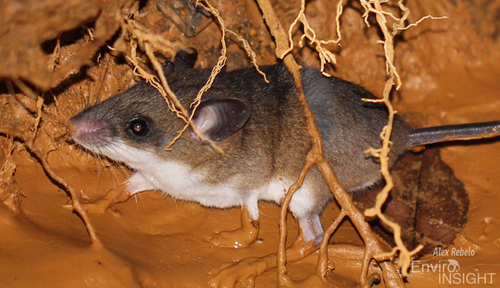
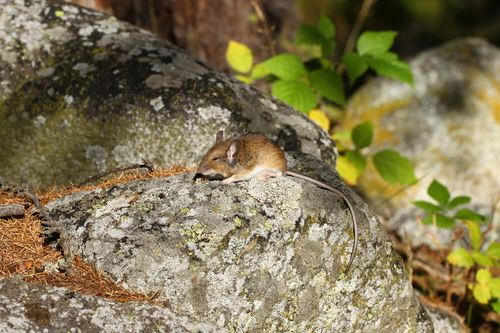
Dorsal fur is brownish-grey to tawny, interspersed with flattened, spine-like guard hairs giving the back a rough, bristly texture. The ventral surface is white to cream. The tail is thinly furred and scaly in appearance. Eyes are relatively large and prominent, and ears are moderately sized.
Size
Head-body length approximately 75–105mm; tail length approximately 60–90mm. A small, compact mouse.
Weight
Typically 20–40g; no strong evidence of significant mass difference between sexes.
Distinctive features
Distinguished from sympatric rodents by its distinctly spiny dorsal pelage. Within the genus Acomys, A. subspinosus is geographically isolated at the southwestern Cape, whereas the only other southern African congener, A. spinosissimus, occurs in the northeastern parts of South Africa and is generally larger and more spinose. The Cape Spiny Mouse's restricted fynbos range is its most defining ecological characteristic.
Differences between males and females
Sexual dimorphism is minimal; males and females are similar in size and coloration.
Behaviour and diet of the Cape Spiny Mouse
Tends to be semi-social; individuals may share rock crevices and shelters, and loose aggregations have been observed. Not strictly territorial but uses communal refuges. Social tolerance is higher than in many other small rodents.
When it is active
Primarily nocturnal, with peak foraging activity shortly after dusk and before dawn. Spends daylight hours sheltering in rock crevices or dense vegetation.
Diet
Omnivorous; diet includes seeds, fleshy fruits, invertebrates (insects, spiders), and plant material such as leaves and stems. Dietary composition shifts seasonally with resource availability in the fynbos.
How it feeds and hunts
Forages opportunistically on the ground and among rocks, using its sensitive vibrissae and olfaction to locate food. Invertebrates are detected and captured with quick pounces; seeds and fruits are gathered and may be briefly cached.
Communication
Uses ultrasonic vocalizations for close-range communication, particularly between mothers and young. Scent marking with urine and glandular secretions is used for social and territorial signalling. Tactile contact plays a role in social bonding within shared refuges.
Interactions with other species
Predated upon by small owls (e.g., Barn Owl, Tyto alba), diurnal raptors, snakes (e.g., mole snakes, night adders), and small carnivorous mammals such as genets and mongooses. Competes with other small rodents (e.g., Mus species, Rhabdomys pumilio) for food and shelter. May serve as a seed disperser for fynbos plants.
Role in its ecosystem
Functions as a secondary consumer and prey item, contributing to energy transfer in the fynbos food web. Acts as a seed disperser and may assist in local plant regeneration post-fire. Its use of rocky microhabitats makes it an important link between ground-level invertebrate communities and mesopredators.
Reproduction and lifecycle
Breeding can occur throughout the year, though peaks may align with seasons of higher food availability. Gestation is approximately 38–42 days, longer than typical murids, reflecting the production of precocial young. Litter size is typically 1–5 pups.
Raising the young
Young are born with eyes open, fully furred, and mobile — a high degree of precociality unusual among murid rodents. The female provides nursing and protection; pups develop rapidly and reach independence within a few weeks. Both parents may share the shelter site during early rearing.
Maturity and lifespan
Sexual maturity is reached at approximately 6–8 weeks of age. Lifespan in the wild is estimated at 1–2 years; captive individuals may live up to 3–5 years under optimal conditions.
Taxonomy and naming of the Cape Spiny Mouse
Classification
Mammalia > Rodentia > Muridae > Acomys > Acomys subspinosus (Waterhouse, 1838)
Scientific synonyms
Has historically been conflated with Acomys cahirinus in older literature; some earlier records from the Cape were attributed to broader Acomys groupings before taxonomic revision confirmed its distinct status.
What research says
Recent studies
Phylogeographic and molecular studies of southern African Acomys have helped confirm the distinct species status of A. subspinosus relative to A. spinosissimus and other congeners. The genus has attracted broad scientific interest due to the discovery of scar-free skin regeneration in A. cahirinus and A. percivali, and whether A. subspinosus shares this capacity remains an open research question.
Genome and DNA
The genus Acomys has received considerable genomic attention due to its regenerative abilities. Chromosome counts in Acomys species range from 2n=36 to 2n=66; the specific karyotype of A. subspinosus has not been widely published, and precise data remains limited.
Compared with similar species
Closely related to Acomys spinosissimus (Southern African Spiny Mouse) of northeastern South Africa and surrounding countries, which is generally larger and occupies drier savanna and rocky habitats. Both differ from A. cahirinus (Cairo Spiny Mouse) of North Africa and the Middle East, which is the most-studied member of the genus. A. subspinosus is unique in being restricted to the fynbos biome, a temperate Mediterranean-type shrubland, unlike most Acomys which inhabit arid or semi-arid zones.
The Cape Spiny Mouse and people
Members of the genus Acomys are among the only mammals known to regenerate complex tissue — including hair follicles, sweat glands, and cartilage — after wounds, a feat more reminiscent of salamanders than mammals. The Cape Spiny Mouse's 'spines' are not true spines like a hedgehog's but are specialized, flattened guard hairs that give the fur a bristly texture. It is one of the very few endemic small mammals tied almost exclusively to the Cape Floristic Region, one of the world's six floral kingdoms packed into a tiny area at the tip of Africa.
Where and how to see it
Best observed at night in rocky fynbos habitats within the Western Cape, particularly in reserves such as Table Mountain National Park, De Hoop Nature Reserve, or the Kogelberg Biosphere Reserve. Using a red-filtered torch minimizes disturbance. Scanning rock crevices and boulders after dusk offers the best chance of sighting.
Risks to humans
No notable risk to humans. May bite if handled roughly, as with any wild rodent. Standard precautions apply when handling due to potential ectoparasites.
Human uses
No significant commercial or traditional use documented. Occasionally kept in captivity by specialist small mammal keepers. The genus Acomys is used in biomedical research, particularly for studies on wound healing and tissue regeneration, though laboratory work typically involves A. cahirinus rather than A. subspinosus.
Countries where the Cape Spiny Mouse is recorded
The 1 countries named in the range description of its IUCN Red List assessment.
Questions about the Cape Spiny Mouse
Where does the Cape Spiny Mouse live?
The Cape Spiny Mouse is recorded in South Africa across Africa. These countries come from the range description of its IUCN Red List assessment, and they are what place the species on the interactive map.
Is the Cape Spiny Mouse endangered?
The IUCN Red List assesses the Cape Spiny Mouse as Least Concern. The species is widespread and abundant enough not to qualify for any threatened category. It does not mean the species is safe forever, only that nothing in the current data raises an alarm.
How many are left in the wild?
No precise global population estimate is available. This figure comes from the species assessment on the IUCN Red List; population estimates for wild mammals are ranges, not counts, and are revised at each assessment.
What habitat does the Cape Spiny Mouse live in?
Primarily rocky fynbos and renosterveld shrublands, favouring crevices and boulder fields that provide shelter from predators and temperature extremes.
What is the scientific name of the Cape Spiny Mouse?
The Cape Spiny Mouse is Acomys subspinosus, in the family Muridae, order Rodentia.
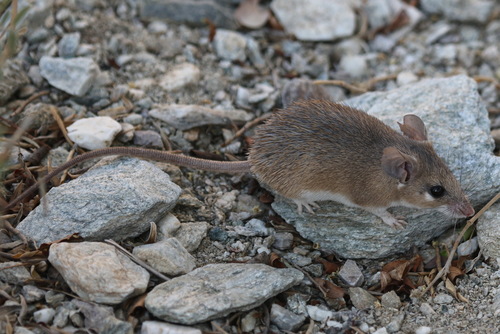
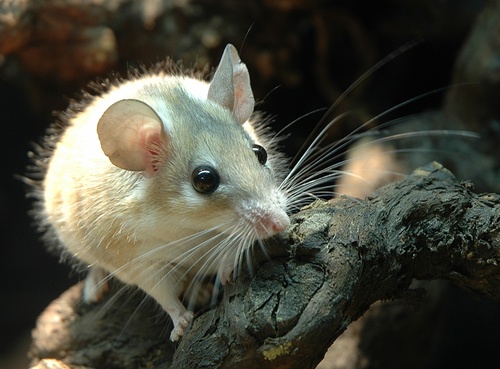
Other species in the genus Acomys
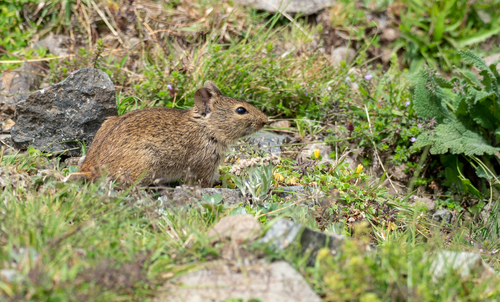
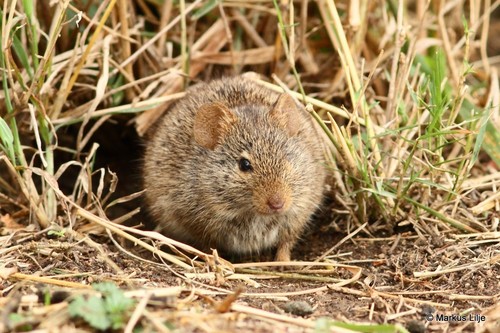
Other species in the family Muridae
Sources
Conservation status, range description and population estimate come from the IUCN Red List assessment for Acomys subspinosus. Countries are derived from that range description, not from a mapped country list. Last refreshed on .
The distribution map is drawn from the IUCN Red List spatial data compiled in 2017. IUCN (International Union for Conservation of Nature)