
White-tailed Tree Rat
Brachytarsomys albicauda
Red List assessment
Least Concernon the IUCN Red List
- EXExtinct
- EWExtinct in the Wild
- CRCritically Endangered
- ENEndangered
- VUVulnerable
- NTNear Threatened
- LCLeast Concern
The White-tailed Tree Rat is recorded in one country, Madagascar across Africa. The IUCN Red List assesses the White-tailed Tree Rat as Least Concern. No precise population estimate exists; the species is considered relatively common within suitable habitat but is presumed to be declining in parallel with Madagascar's forest loss.
- Family
- Nesomyidae
- Order
- Rodentia
- Genus
- Brachytarsomys
- Countries recorded
- 1
- Continents
- Africa
- Red List category
- Least Concern
- Data updated
- August 9, 2026
What is the White-tailed Tree Rat?
The White-tailed Tree Rat is a large arboreal rodent endemic to Madagascar's rainforests, notable for its long white-tipped tail which gives the species its common name. It belongs to the endemic Malagasy rodent family Nesomyidae and is one of the largest rodents on the island. Its nocturnal, tree-dwelling lifestyle and specialized diet make it an interesting example of Madagascar's unique rodent radiation. It remains relatively understudied due to its secretive habits and remote habitat.
Where does the White-tailed Tree Rat live?
Endemic to Madagascar, primarily found in the eastern and northern rainforests of the island.
Found in eastern and northern Madagascar, including rainforest regions such as Masoala, Marojejy, and parts of the eastern escarpment forests. Its range is patchy and tied to remaining forest fragments.
Altitude and depth
Typically found from sea level up to around 1500 meters elevation in humid forest zones.
Seasonal movements
No strong evidence of migration; activity may fluctuate seasonally with fruiting patterns of forest trees, but detailed seasonal behavioral data is limited.
Habitat of the White-tailed Tree Rat
Primarily inhabits humid tropical rainforest and montane forest, favoring intact primary forest with dense canopy cover. It is closely associated with tree cavities and epiphyte-rich vegetation used for nesting and foraging.
Adaptations to its environment
Possesses strong, semi-prehensile-like grip and sharp claws for climbing trees, and a long tail aiding balance in the canopy. Nocturnal habits reduce competition with diurnal lemurs and predators, while its diet flexibility helps it exploit available forest resources.
Conservation status and numbers
Listed as Least Concern (LC) by IUCN, though populations are believed to be declining due to ongoing habitat loss; the species still occupies a relatively wide range within Madagascar's forests.
Estimated population
No precise population estimate exists; the species is considered relatively common within suitable habitat but is presumed to be declining in parallel with Madagascar's forest loss.
What threatens the White-tailed Tree Rat?
Main threats include deforestation from slash-and-burn agriculture (tavy), logging, and forest fragmentation reducing connected canopy habitat necessary for arboreal movement.
What is being done to protect it?
Benefits indirectly from protected areas such as Masoala National Park and Marojejy National Park, which conserve its rainforest habitat, though no species-specific conservation programs exist.
Recommended actions
Priority actions include maintaining and expanding forest protected areas, curbing deforestation and fragmentation, and conducting more field studies to better understand population status and ecology.
What the White-tailed Tree Rat looks like
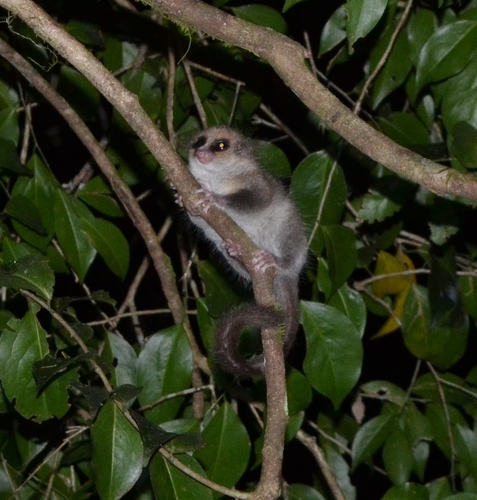
The species has soft, dense brownish-gray fur on the body with a distinctly white-tipped or white tail that contrasts sharply with the darker body fur. It has large eyes adapted for nocturnal vision and a robust rodent body form suited to climbing.
Size
Body length is approximately 24-30 cm, with a tail of similar or greater length, often around 24-28 cm, giving a total length of roughly 50-58 cm.
Weight
Adults typically weigh between 200-350 grams.
Distinctive features
Its most distinguishing feature is the strikingly white tail tip against an otherwise brown body, which distinguishes it from other Malagasy rodents like Eliurus species that lack this coloration pattern.
Differences between males and females
No significant sexual dimorphism has been documented; males and females are similar in size and coloration.
Behaviour and diet of the White-tailed Tree Rat
Generally considered solitary or living in small family groups, with limited social interaction outside of breeding pairs and mother-offspring units.
When it is active
Strictly nocturnal, becoming active after dusk to forage in the forest canopy and returning to tree hollows or nests during the day.
Diet
Omnivorous diet consisting mainly of fruits, seeds, and plant material, supplemented occasionally with insects and other small invertebrates found while foraging in trees.
Communication
Likely relies on vocalizations, scent marking, and tactile communication typical of nocturnal rodents, though specific studies on this species' communication are lacking.
Interactions with other species
Preyed upon by nocturnal predators such as the fossa and various birds of prey; may compete with other arboreal rodents and small mammals for fruit resources in the forest canopy.
Role in its ecosystem
Plays a role in seed dispersal and possibly seed predation within Madagascar's rainforest ecosystems, contributing to forest regeneration dynamics as a frugivorous rodent.
Reproduction and lifecycle
Breeding details are not well documented, but litters are believed to be small, typical of similar-sized nesomyid rodents, with gestation lasting several weeks.
Raising the young
Presumed that females provide primary care to altricial young in tree cavity nests, though specific parental behaviors have not been extensively studied.
Maturity and lifespan
Specific data on age of sexual maturity and lifespan is limited, but related nesomyid rodents typically live 2-4 years in the wild.
Taxonomy and naming of the White-tailed Tree Rat
Classification
Class Mammalia > Order Rodentia > Family Nesomyidae > Genus Brachytarsomys > Species Brachytarsomys albicauda
Scientific synonyms
Brachytarsomys villosa (sometimes considered synonymous or a closely related taxon in older literature)
What research says
Recent studies
Recent taxonomic and phylogenetic studies on Nesomyidae have helped clarify the evolutionary relationships of Brachytarsomys within Madagascar's endemic rodent radiation, though species-specific ecological research remains sparse.
Compared with similar species
Compared to the related Brachytarsomys villosa, B. albicauda is distinguished by its more prominently white-tipped tail and slightly different body proportions; it is also larger than most Eliurus tree rats found in similar habitats.
The White-tailed Tree Rat and people
This rodent's tail can be almost as long as its body, aiding balance during acrobatic movement through tree branches. It is one of the few Malagasy rodents with such a strikingly bicolored tail. Despite being relatively large for a rodent, it remains elusive and rarely observed due to its nocturnal, canopy-dwelling lifestyle.
Where and how to see it
Best observed during nighttime forest walks with a spotlight in protected rainforests like Masoala or Marojejy National Parks, particularly during the fruiting season when foraging activity increases.
Risks to humans
No notable risk to humans.
Countries where the White-tailed Tree Rat is recorded
The 1 countries named in the range description of its IUCN Red List assessment.
Questions about the White-tailed Tree Rat
Where does the White-tailed Tree Rat live?
The White-tailed Tree Rat is recorded in Madagascar across Africa. These countries come from the range description of its IUCN Red List assessment, and they are what place the species on the interactive map.
Is the White-tailed Tree Rat endangered?
The IUCN Red List assesses the White-tailed Tree Rat as Least Concern. The species is widespread and abundant enough not to qualify for any threatened category. It does not mean the species is safe forever, only that nothing in the current data raises an alarm.
How many are left in the wild?
No precise population estimate exists; the species is considered relatively common within suitable habitat but is presumed to be declining in parallel with Madagascar's forest loss. This figure comes from the species assessment on the IUCN Red List; population estimates for wild mammals are ranges, not counts, and are revised at each assessment.
What habitat does the White-tailed Tree Rat live in?
Primarily inhabits humid tropical rainforest and montane forest, favoring intact primary forest with dense canopy cover.
What is the scientific name of the White-tailed Tree Rat?
The White-tailed Tree Rat is Brachytarsomys albicauda, in the family Nesomyidae, order Rodentia.
Other species in the genus Brachytarsomys

Other species in the family Nesomyidae


Species that share its range

Sources
Conservation status, range description and population estimate come from the IUCN Red List assessment for Brachytarsomys albicauda. Countries are derived from that range description, not from a mapped country list. Last refreshed on .
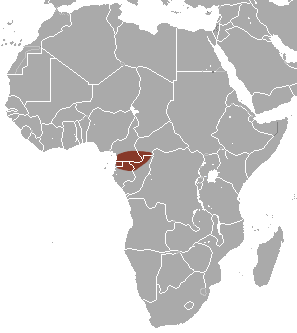
The distribution map is drawn from the IUCN Red List spatial data compiled in 2008. IUCN (International Union for Conservation of Nature)