
Long-tailed Pouched Rat
Beamys hindei
Red List assessment
Least Concernon the IUCN Red List
- EXExtinct
- EWExtinct in the Wild
- CRCritically Endangered
- ENEndangered
- VUVulnerable
- NTNear Threatened
- LCLeast Concern
The Long-tailed Pouched Rat is recorded in 3 countries across Africa. The IUCN Red List assesses the Long-tailed Pouched Rat as Least Concern. No precise global population estimate exists; the species is considered locally common in suitable habitat but with a patchy overall distribution.
- Family
- Nesomyidae
- Order
- Rodentia
- Genus
- Beamys
- Countries recorded
- 3
- Continents
- Africa
- Red List category
- Least Concern
- Data updated
- August 9, 2026
What is the Long-tailed Pouched Rat?
Beamys hindei is a nocturnal, pouched rodent native to the coastal lowland forests of East Africa. It is notable for its cheek pouches, used to transport food, and its relatively long tail compared to body size. This species plays an important ecological role in seed dispersal within its fragmented forest habitat. It is one of only two species in the genus Beamys, both restricted to East African forest patches.
Where does the Long-tailed Pouched Rat live?
Coastal East Africa, primarily Tanzania, Mozambique, and Malawi
Distributed in a fragmented range along the coastal belt of East Africa, including parts of southeastern Tanzania, northern Mozambique, and possibly southern Malawi. Populations are patchily distributed due to habitat fragmentation.
Altitude and depth
Typically found at low elevations, from sea level up to around 600 meters
Seasonal movements
No known long-distance migration; breeding activity may be linked to rainy seasons when food availability increases
Habitat of the Long-tailed Pouched Rat
Found in lowland coastal forests, riverine forests, and thicket vegetation, often in areas with dense leaf litter and fallen logs. It prefers habitats with abundant ground cover for burrowing and foraging.
Adaptations to its environment
Possesses external cheek pouches for efficient food transport and caching, an adaptation for exploiting scattered food resources. Its nocturnal habits and burrowing behavior help avoid predators and extreme daytime temperatures.
Conservation status and numbers
Listed as Least Concern by IUCN, though populations are fragmented and habitat loss is a growing concern in parts of its range. The species remains relatively poorly studied, and local declines may go undetected.
Estimated population
No precise global population estimate exists; the species is considered locally common in suitable habitat but with a patchy overall distribution. Population trend is presumed stable to slightly declining due to habitat loss.
What threatens the Long-tailed Pouched Rat?
Habitat destruction due to agricultural expansion, logging, and coastal development represents the primary threat. Fragmentation of forest patches isolates populations and reduces genetic connectivity.
Diseases and parasites
Specific disease and parasite data are limited, though like many rodents it may host ectoparasites such as fleas and mites.
What is being done to protect it?
Some populations occur within protected coastal forest reserves in Tanzania and Mozambique. Broader conservation of East African coastal forest ecosystems indirectly benefits this species.
Recommended actions
Increased habitat protection and connectivity between forest fragments are priority actions. Further field studies are needed to better assess population status and ecological requirements.
What the Long-tailed Pouched Rat looks like
Soft grayish-brown to reddish-brown fur dorsally, with paler underparts. It has large eyes and ears adapted for nocturnal activity, along with a notably long, sparsely-haired tail.
Size
Head-body length approximately 12-16 cm, with a tail often longer than the body, around 15-20 cm
Weight
Approximately 60-100 grams
Distinctive features
Distinguished from related species by its cheek pouches, long tail relative to body size, and specific dental characteristics used in taxonomic identification. Its coastal forest habitat also helps differentiate it ecologically from other nesomyid rodents.
Differences between males and females
Minimal sexual dimorphism reported; males and females are similar in size and coloration
Behaviour and diet of the Long-tailed Pouched Rat
Generally considered solitary or living in small family groups, though detailed social structure remains poorly documented. Burrows may be shared briefly during breeding.
When it is active
Primarily nocturnal, foraging on the forest floor at night and resting in burrows during the day
Diet
Omnivorous diet consisting mainly of seeds, fruits, and possibly invertebrates. Cheek pouches allow it to collect and cache food for later consumption.
Communication
Likely relies on scent marking and tactile communication typical of burrowing rodents, along with possible vocalizations for social interaction. Specific studies on communication are lacking.
Interactions with other species
Preyed upon by small carnivores, owls, and snakes within its forest habitat. It may compete with other small rodents for food resources in the same ecological niche.
Role in its ecosystem
Plays a role in seed dispersal and possibly soil aeration through its burrowing activity, contributing to forest regeneration. As prey, it also supports local predator populations.
Reproduction and lifecycle
Breeding likely occurs seasonally with peaks during wetter periods when food is abundant. Litter sizes are typically small, though exact gestation length is not well documented.
Raising the young
Females likely provide primary care for altricial young in burrows, similar to related rodent species. Detailed parental behavior has not been extensively studied in the wild.
Maturity and lifespan
Age of sexual maturity is not precisely documented but is likely reached within a few months, typical for small rodents. Lifespan in the wild is estimated at 2-3 years, possibly longer in captivity.
Taxonomy and naming of the Long-tailed Pouched Rat
Classification
Class Mammalia > Order Rodentia > Family Nesomyidae > Genus Beamys > Species Beamys hindei
Scientific synonyms
Beamys major (sometimes considered synonymous or a subspecies in older literature)
What research says
Recent studies
Recent taxonomic and phylogenetic studies have helped clarify relationships within the Nesomyidae family, including the placement of Beamys species. Genetic studies remain limited compared to more well-known rodent genera.
Compared with similar species
Similar to its congener Beamys major, but generally distinguished by subtle morphological and range differences. Both species share the distinctive cheek pouch adaptation uncommon among African muroid rodents.
The Long-tailed Pouched Rat and people
This rodent has cheek pouches similar to those of hamsters, an unusual trait among African rodents. Its long tail, which can exceed its body length, aids in balance while navigating forest floor debris.
Where and how to see it
Best observed at night in coastal forest reserves of Tanzania and Mozambique using red-light spotting techniques to avoid disturbing nocturnal behavior. Patience is required as the species is secretive and rarely seen during the day.
Risks to humans
No notable risk to humans
Countries where the Long-tailed Pouched Rat is recorded
The 3 countries named in the range description of its IUCN Red List assessment.
Questions about the Long-tailed Pouched Rat
Where does the Long-tailed Pouched Rat live?
The Long-tailed Pouched Rat is recorded in Malawi, Mozambique and Tanzania across Africa. These countries come from the range description of its IUCN Red List assessment, and they are what place the species on the interactive map.
Is the Long-tailed Pouched Rat endangered?
The IUCN Red List assesses the Long-tailed Pouched Rat as Least Concern. The species is widespread and abundant enough not to qualify for any threatened category. It does not mean the species is safe forever, only that nothing in the current data raises an alarm.
How many are left in the wild?
No precise global population estimate exists; the species is considered locally common in suitable habitat but with a patchy overall distribution. This figure comes from the species assessment on the IUCN Red List; population estimates for wild mammals are ranges, not counts, and are revised at each assessment.
What habitat does the Long-tailed Pouched Rat live in?
Found in lowland coastal forests, riverine forests, and thicket vegetation, often in areas with dense leaf litter and fallen logs.
What is the scientific name of the Long-tailed Pouched Rat?
The Long-tailed Pouched Rat is Beamys hindei, in the family Nesomyidae, order Rodentia.
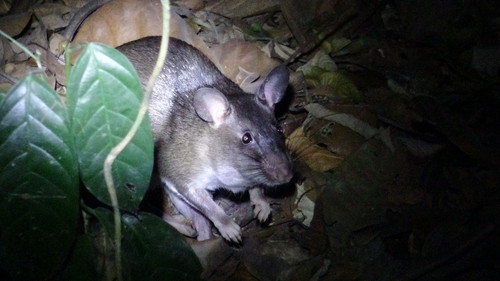
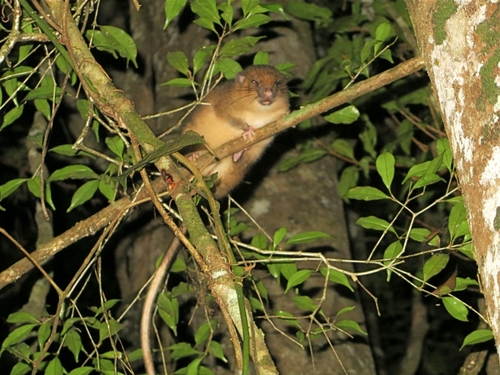
Other species in the family Nesomyidae


Species that share its range
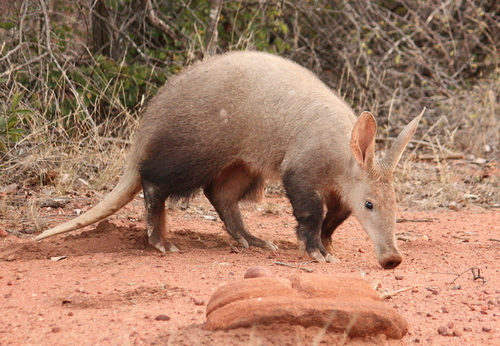
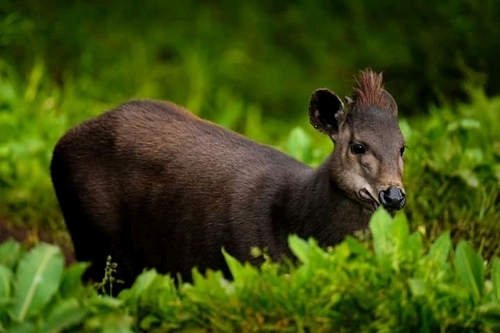

Sources
Conservation status, range description and population estimate come from the IUCN Red List assessment for Beamys hindei. Countries are derived from that range description, not from a mapped country list. Last refreshed on .
The distribution map is drawn from the IUCN Red List spatial data compiled in 2008. IUCN (International Union for Conservation of Nature)