
Betsileo Short-tailed Rat
Brachyuromys betsileoensis
Red List assessment
Least Concernon the IUCN Red List
- EXExtinct
- EWExtinct in the Wild
- CRCritically Endangered
- ENEndangered
- VUVulnerable
- NTNear Threatened
- LCLeast Concern
The Betsileo Short-tailed Rat is recorded in one country, Madagascar across Africa. The IUCN Red List assesses the Betsileo Short-tailed Rat as Least Concern. No precise population estimate exists; considered locally common in suitable habitat but with an inferred gradual decline due to habitat degradation.
- Family
- Nesomyidae
- Order
- Rodentia
- Genus
- Brachyuromys
- Countries recorded
- 1
- Continents
- Africa
- Red List category
- Least Concern
- Data updated
- August 9, 2026
What is the Betsileo Short-tailed Rat?
The Betsileo Short-tailed Rat is a small nesomyine rodent endemic to the highland forests of Madagascar, notable for its short tail relative to other Malagasy rodents. It inhabits humid montane forests and marshy grasslands, often near streams or swampy areas. As one of only two species in the genus Brachyuromys, it represents a distinctive lineage of Madagascar's unique rodent radiation. Despite limited study, it is considered relatively widespread and stable within its range.
Where does the Betsileo Short-tailed Rat live?
Endemic to Madagascar, primarily found in the central and southeastern highlands including the Betsileo region around Fianarantsoa.
Endemic to Madagascar, distributed across the central highlands and eastern escarpment, particularly in the historic Betsileo region near Fianarantsoa and extending into nearby highland forest fragments.
Altitude and depth
Approximately 800 to 2000 meters above sea level.
Seasonal movements
No documented migration; activity may fluctuate seasonally with Madagascar's wet and dry seasons, with breeding likely concentrated in the warmer wet season.
Habitat of the Betsileo Short-tailed Rat
Found in humid montane forest, marshy grasslands, and swampy areas within or bordering forest, often in association with dense herbaceous vegetation near water sources.
Adaptations to its environment
Possesses a short tail and compact body suited to moving through dense marshy vegetation, along with dense fur for insulation in cooler highland climates. Semi-aquatic tendencies allow it to exploit swampy habitat niches avoided by many other rodents.
Conservation status and numbers
Listed as Least Concern by the IUCN due to a relatively wide distribution across highland Madagascar and presumed stable population, despite ongoing habitat degradation.
Estimated population
No precise population estimate exists; considered locally common in suitable habitat but with an inferred gradual decline due to habitat degradation.
What threatens the Betsileo Short-tailed Rat?
Habitat loss from deforestation, agricultural conversion (especially rice paddy expansion into marshes), and burning of highland grasslands for cattle grazing.
What is being done to protect it?
Occurs in some protected areas within its range, including forest fragments under Madagascar's national protected area network, though no species-specific conservation programs exist.
Recommended actions
Protection of remaining highland marsh and forest habitat, monitoring of population trends, and further ecological research to clarify distribution and habitat requirements.
What the Betsileo Short-tailed Rat looks like
Soft, dense grayish-brown to reddish-brown dorsal fur with paler grayish underparts, a robust body, and small rounded ears. The tail is notably shorter than the body length, a distinguishing feature of the genus.
Size
Head-body length approximately 100-140 mm, with a notably short tail around 60-80 mm.
Weight
Estimated body weight around 50-80 grams.
Distinctive features
Distinguished from its sister species Brachyuromys ramirohitra by subtle differences in cranial morphology, fur coloration, and tail length proportions, as well as differing habitat preferences.
Differences between males and females
Minimal sexual dimorphism reported; males and females are similar in size and coloration.
Behaviour and diet of the Betsileo Short-tailed Rat
Believed to be largely solitary or living in loose small groups, with limited direct behavioral observation available in the wild.
When it is active
Likely nocturnal to crepuscular, consistent with most small Malagasy rodents, though detailed activity studies are lacking.
Diet
Herbivorous, feeding primarily on grasses, herbaceous vegetation, and possibly roots or seeds found in marshy grassland habitats.
Communication
Likely relies on scent marking and simple vocalizations typical of small rodents, though no detailed studies of communication exist for this species.
Interactions with other species
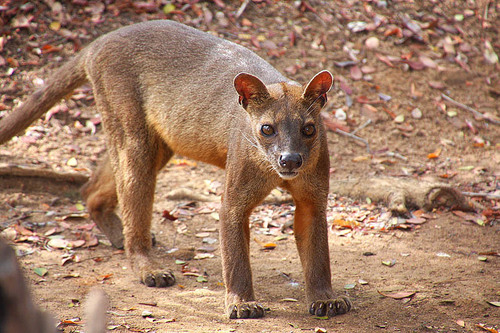
Potential prey for native Malagasy carnivores such as the fossa and various raptors, and shares habitat with other endemic rodents and tenrecs.
Role in its ecosystem
Plays a role in highland forest and marsh ecosystems as a seed disperser and prey species, contributing to nutrient cycling in wetland vegetation.
Reproduction and lifecycle
Reproductive biology is poorly documented, but likely includes multiple litters per year with small litter sizes typical of similar-sized nesomyine rodents, timed with the wet season.
Raising the young
Presumed maternal care typical of small rodents, with young remaining in a nest until weaned, though specific data for this species is lacking.
Maturity and lifespan
Sexual maturity likely reached within a few months, as in related small rodents; lifespan in the wild probably 1-3 years, with limited data from captivity.
Taxonomy and naming of the Betsileo Short-tailed Rat
Classification
Class Mammalia > Order Rodentia > Family Nesomyidae > Genus Brachyuromys > Species Brachyuromys betsileoensis
Scientific synonyms
Hallomys betsileoensis (original combination, Bartlett 1879)
What research says
Recent studies
Recent taxonomic and phylogenetic studies of Nesomyidae have helped clarify the relationships within Brachyuromys, but detailed ecological studies remain scarce.
Compared with similar species
Similar to its congener Brachyuromys ramirohitra but distinguished by habitat preference (more montane/forest-associated) and slight morphological differences in tail length and cranial features.
The Betsileo Short-tailed Rat and people
It is one of only two species in its entire genus, both endemic to Madagascar. Despite being called a 'rat,' it is not closely related to true rats (Rattus) but belongs to the endemic Malagasy rodent family Nesomyidae.
Where and how to see it
Best observed at night in humid highland forest or marshy grassland areas near Fianarantsoa, using live-trapping methods typically employed by researchers rather than casual wildlife viewing.
Risks to humans
No notable risk to humans.
Countries where the Betsileo Short-tailed Rat is recorded
The 1 countries named in the range description of its IUCN Red List assessment.
Questions about the Betsileo Short-tailed Rat
Where does the Betsileo Short-tailed Rat live?
The Betsileo Short-tailed Rat is recorded in Madagascar across Africa. These countries come from the range description of its IUCN Red List assessment, and they are what place the species on the interactive map.
Is the Betsileo Short-tailed Rat endangered?
The IUCN Red List assesses the Betsileo Short-tailed Rat as Least Concern. The species is widespread and abundant enough not to qualify for any threatened category. It does not mean the species is safe forever, only that nothing in the current data raises an alarm.
How many are left in the wild?
No precise population estimate exists; considered locally common in suitable habitat but with an inferred gradual decline due to habitat degradation. This figure comes from the species assessment on the IUCN Red List; population estimates for wild mammals are ranges, not counts, and are revised at each assessment.
What habitat does the Betsileo Short-tailed Rat live in?
Found in humid montane forest, marshy grasslands, and swampy areas within or bordering forest, often in association with dense herbaceous vegetation near water sources.
What is the scientific name of the Betsileo Short-tailed Rat?
The Betsileo Short-tailed Rat is Brachyuromys betsileoensis, in the family Nesomyidae, order Rodentia.
Other species in the genus Brachyuromys

Other species in the family Nesomyidae
Species that share its range

Sources
Conservation status, range description and population estimate come from the IUCN Red List assessment for Brachyuromys betsileoensis. Countries are derived from that range description, not from a mapped country list. Last refreshed on .
The distribution map is drawn from the IUCN Red List spatial data compiled in 2008. IUCN (International Union for Conservation of Nature)