
Hairy-eared Dwarf Lemur
Allocebus trichotis
Red List assessment
Endangeredon the IUCN Red List
- EXExtinct
- EWExtinct in the Wild
- CRCritically Endangered
- ENEndangered
- VUVulnerable
- NTNear Threatened
- LCLeast Concern
The Hairy-eared Dwarf Lemur is recorded in one country, Madagascar across Africa. The IUCN Red List assesses the Hairy-eared Dwarf Lemur as Endangered. No reliable global population estimate exists due to the species' rarity and cryptic nocturnal habits.
- Family
- Cheirogaleidae
- Order
- Primates
- Genus
- Allocebus
- Countries recorded
- 1
- Continents
- Africa
- Red List category
- Endangered
- Data updated
- August 9, 2026
What is the Hairy-eared Dwarf Lemur?
The Hairy-eared Dwarf Lemur is an exceptionally small, nocturnal primate and the sole member of the genus Allocebus, endemic to the rainforests of northeastern Madagascar. It is most remarkable for the distinctive elongated tufts of pale hair projecting from its ears, a feature unique among lemurs. After its original description in 1875, the species virtually vanished from scientific records and was feared extinct, until its dramatic rediscovery near Mananara in 1989 by Bernhard Meier and Roland Albignac. It remains one of the least-studied and rarest primates in the world.
Where does the Hairy-eared Dwarf Lemur live?
Endemic to northeastern Madagascar, primarily in the Mananara-Nord region, Masoala Peninsula, and Makira Natural Park areas.
Restricted entirely to Madagascar, specifically the northeastern coastal rainforest belt. Confirmed localities include Mananara-Nord Biosphere Reserve, the Masoala Peninsula, Makira Natural Park, and a few other scattered sites in Atsinanana and Analanjirofo regions.
Altitude and depth
Primarily found at low to mid elevations, from sea level up to approximately 800 m, with most records from below 500 m in humid coastal lowland forest.
Seasonal movements
Undergoes seasonal torpor (hibernation-like dormancy) during the austral dry season, approximately May to September, surviving on fat reserves accumulated and stored largely in the tail base. Activity peaks during the wet season (October–April).
Habitat of the Hairy-eared Dwarf Lemur
Primary and secondary lowland tropical rainforests, including dense humid forest with abundant undergrowth and tree hollows for denning. It shows a preference for intact or near-intact forest patches, though it can occasionally use disturbed secondary vegetation adjacent to primary forest.
Adaptations to its environment
Like other cheirogaleids, it stores fat in its tail and body to sustain extended periods of torpor during food-scarce dry seasons. Its large, forward-facing eyes are highly adapted for nocturnal vision. Its elongated, mobile tongue is thought to be adapted for nectarivory, and its small, agile body allows efficient movement through dense vegetation.
Conservation status and numbers
Endangered (EN) on the IUCN Red List. The species qualifies under criteria B1ab(i,ii,iii) due to its very restricted extent of occurrence (estimated below 5,000 km²), severely fragmented habitat, and continuing decline in the area and quality of its forest habitat.
Estimated population
No reliable global population estimate exists due to the species' rarity and cryptic nocturnal habits. It is considered uncommon to rare throughout its restricted range, and the population trend is suspected to be declining in line with ongoing forest loss.
What threatens the Hairy-eared Dwarf Lemur?
The primary threat is rapid deforestation driven by slash-and-burn agriculture (tavy), illegal logging, and charcoal production across northeastern Madagascar. Habitat fragmentation isolates populations, reducing genetic diversity and recolonization potential. Occasional capture for the illegal pet trade may also pose a localized risk.
Diseases and parasites
No specific diseases or parasites have been formally documented for this species. Like other lemurs, it may harbor endoparasites (helminths, protozoa) and ectoparasites (mites, lice), but no detailed parasitological studies have been published.
What is being done to protect it?
The species receives partial protection within the Mananara-Nord UNESCO Biosphere Reserve, Masoala National Park, and Makira Natural Park. It is listed under Appendix I of CITES, prohibiting international commercial trade. Madagascar's national legislation protects all lemurs, and various NGOs (e.g., Wildlife Conservation Society, Madagascar Biodiversity Partnership) support habitat conservation in key areas.
Recommended actions
Priority actions include expanded camera-trap and line-transect surveys to better quantify population size and distribution, strengthening enforcement of protected area boundaries against illegal logging, community-based forest management programs to reduce slash-and-burn agriculture, and targeted ecological research on reproductive biology and torpor physiology to inform captive breeding protocols.
What the Hairy-eared Dwarf Lemur looks like
Dorsal fur is brownish-gray to reddish-brown, while the ventral surface is pale gray to creamy white. The face is rounded with very large, dark, reflective eyes suited for nocturnal activity. The tail is relatively long and bushy at the base where fat is stored. The most striking feature is the prominent tufts of white or pale hair that protrude noticeably from both ears.
Size
Head-body length approximately 12–15 cm; tail length approximately 15–19 cm, giving a total length of roughly 27–34 cm.
Weight
Approximately 75–100 g; weight fluctuates seasonally, being heaviest prior to torpor when fat reserves are maximized in the tail.
Distinctive features
The conspicuous elongated ear tufts immediately distinguish Allocebus trichotis from all other dwarf lemurs and mouse lemurs. Its relatively elongated tongue (suggestive of nectarivory) and unique cranio-dental morphology further separate it from the genus Cheirogaleus, justifying its placement in a monotypic genus.
Differences between males and females
Sexual dimorphism is minimal and not well-documented; no significant differences in body size, weight, or coloration between males and females have been reported.
Behaviour and diet of the Hairy-eared Dwarf Lemur
Generally considered solitary during foraging, consistent with most cheirogaleids. However, individuals may share sleeping sites (tree hollows or dense vegetation) in small groups, possibly family units or mating pairs, particularly during the torpor season.
When it is active
Strictly nocturnal. Active foraging occurs throughout the night during the wet season. During daylight hours and throughout the dry season dormancy period, individuals retreat to sheltered tree hollows or dense leaf nests.
Diet
Omnivorous, with a diet believed to include nectar and pollen (facilitated by its elongated tongue), small insects and other arthropods, and possibly small amounts of fruit. The relative proportion of each food type across seasons is not well quantified.
How it feeds and hunts
Forages arboreally by slowly inspecting branches, leaves, and flowers for insects and nectar sources. Likely uses its large eyes and sensitive olfaction to detect invertebrate prey in low-light conditions, gleaning insects from surfaces rather than pursuing fast-moving prey.
Communication
Vocalizations are poorly documented but likely include ultrasonic calls, soft chirps, and contact calls typical of small nocturnal primates. Scent marking via anogenital and facial glands is presumed to play a role in territory delineation and mate attraction, as observed in related species.
Interactions with other species
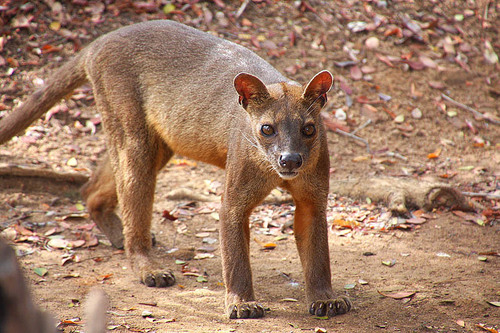
Likely predated upon by the Madagascar harrier-hawk (Polyboroides radiatus), the fossa (Cryptoprocta ferox), and various snake species (e.g., Ithycyphus and Sanzinia spp.). It may compete with mouse lemurs (Microcebus spp.) for similar food resources and den sites in overlapping habitats.
Role in its ecosystem
Serves as a potential pollinator of forest plants visited for nectar, and may contribute to seed dispersal of small-fruited species. As a prey species, it forms part of the food web supporting larger predators in northeastern Malagasy rainforests.
Reproduction and lifecycle
Breeding likely occurs in the austral spring (October–November) after emergence from torpor. Gestation period is not precisely documented but is estimated at approximately 2 months based on related species. Litter size is believed to be one to three young, but detailed data are lacking.
Raising the young
Females are presumed to be the primary caretakers, as in closely related cheirogaleids. Young are likely cached in a nest or tree hollow when the mother forages, and are progressively introduced to foraging before weaning. The precise duration of maternal care is unknown.
Maturity and lifespan
Age at sexual maturity and lifespan in the wild are unknown. Based on closely related Cheirogaleus species, sexual maturity likely occurs at approximately one year of age, with a potential wild lifespan of 5–8 years and possibly longer in captivity.
Taxonomy and naming of the Hairy-eared Dwarf Lemur
Classification
Mammalia > Primates > Cheirogaleidae > Allocebus > Allocebus trichotis
Scientific synonyms
Originally described as Cheirogaleus trichotis Günther, 1875. The genus Allocebus was later erected by Petter & Petter-Rousseaux (1967) to accommodate its unique morphological traits.
What research says
Recent studies
A landmark rediscovery study by Meier & Albignac (1991) formally re-documented the species after nearly a century of absence. Subsequent camera trap surveys in Makira and Masoala have expanded known range records. Molecular phylogenetic work (e.g., Groeneveld et al., 2009) has helped clarify its systematic position within Cheirogaleidae.
Genome and DNA
Limited molecular data exist. Phylogenomic analyses confirm Allocebus as a distinct basal lineage within Cheirogaleidae. Precise chromosome number is not well established in the literature. Molecular studies have been used to clarify its phylogenetic position relative to Cheirogaleus and Microcebus.
Compared with similar species
Allocebus trichotis resembles mouse lemurs (Microcebus spp.) in overall body size and nocturnal habits but is distinguished by its unique ear tufts, more elongated tongue, and distinct cranio-dental features. It differs from dwarf lemurs (Cheirogaleus spp.) primarily in its smaller size, ear morphology, and suspected greater reliance on nectarivory. Its monotypic genus status reflects its morphological uniqueness within the family.
The Hairy-eared Dwarf Lemur and people
The Hairy-eared Dwarf Lemur was so rarely encountered after its 1875 description that it was widely suspected to be extinct — making its 1989 rediscovery one of the most celebrated zoological surprises of the 20th century. Its genus name 'Allocebus' means 'different monkey' in Greek, reflecting how taxonomists recognized it as distinct from all other dwarf lemurs. Despite weighing less than a small apple, it can survive months of dormancy fueled entirely by fat stored in its tail.
Where and how to see it
The best opportunities exist during the wet season (November–April) at night in Mananara-Nord Biosphere Reserve and on guided nocturnal walks in Masoala National Park. Due to its rarity and cryptic behavior, sightings are uncommon even for experienced researchers; a good head torch and patience are essential. Hiring knowledgeable local guides significantly increases the chance of spotting this elusive species.
Risks to humans
No notable risk to humans. The species is extremely small and non-aggressive; it poses no physical danger and is not known to carry zoonotic diseases transmissible to humans under normal conditions.
Human uses
No significant traditional or commercial uses are documented. It is fully protected under Malagasy law and CITES Appendix I, prohibiting collection, trade, or keeping as a pet. Its primary value is ecological and scientific, as a flagship species for the conservation of northeastern Malagasy rainforests.
Myths and legends
No specific myths or legends unique to this species are documented in Malagasy cultural tradition. Like many lemurs, it may be subject to local 'fady' (taboos) in certain villages, but no species-specific cultural associations have been recorded in the scientific literature.
Countries where the Hairy-eared Dwarf Lemur is recorded
The 1 countries named in the range description of its IUCN Red List assessment.
Questions about the Hairy-eared Dwarf Lemur
Where does the Hairy-eared Dwarf Lemur live?
The Hairy-eared Dwarf Lemur is recorded in Madagascar across Africa. These countries come from the range description of its IUCN Red List assessment, and they are what place the species on the interactive map.
Is the Hairy-eared Dwarf Lemur endangered?
Yes. The IUCN Red List assesses the Hairy-eared Dwarf Lemur as Endangered, one of the three threatened categories. The species faces a very high risk of extinction in the wild — a step below Critically Endangered, but still on a trajectory that ends badly without intervention.
How many are left in the wild?
No reliable global population estimate exists due to the species' rarity and cryptic nocturnal habits. This figure comes from the species assessment on the IUCN Red List; population estimates for wild mammals are ranges, not counts, and are revised at each assessment.
What habitat does the Hairy-eared Dwarf Lemur live in?
Primary and secondary lowland tropical rainforests, including dense humid forest with abundant undergrowth and tree hollows for denning.
What is the scientific name of the Hairy-eared Dwarf Lemur?
The Hairy-eared Dwarf Lemur is Allocebus trichotis, in the family Cheirogaleidae, order Primates.
Species that share its range


Sources
Conservation status, range description and population estimate come from the IUCN Red List assessment for Allocebus trichotis. Countries are derived from that range description, not from a mapped country list. Last refreshed on .
The distribution map is drawn from the IUCN Red List spatial data compiled in 2020. IUCN (International Union for Conservation of Nature)