
Aye-aye
Daubentonia madagascariensis
Red List assessment
Endangeredon the IUCN Red List
- EXExtinct
- EWExtinct in the Wild
- CRCritically Endangered
- ENEndangered
- VUVulnerable
- NTNear Threatened
- LCLeast Concern
The Aye-aye is recorded in one country, Madagascar across Africa. The IUCN Red List assesses the Aye-aye as Endangered. Population size is unknown but believed to be declining; estimates suggest fewer than 10,000 mature individuals remain, with a continuing downward trend due to habitat loss.
- Family
- Daubentoniidae
- Order
- Primates
- Genus
- Daubentonia
- Countries recorded
- 1
- Continents
- Africa
- Red List category
- Endangered
- Data updated
- August 9, 2026
What is the Aye-aye?
The aye-aye is a highly unusual nocturnal primate endemic to Madagascar, notable for its rodent-like teeth and a uniquely elongated, skeletal middle finger used for foraging. It is the only extant member of the family Daubentoniidae and represents one of the most evolutionarily distinct primates on Earth. Its bizarre appearance has made it a subject of both scientific fascination and local superstition. Due to habitat loss and persecution, it is classified as Endangered.
Where does the Aye-aye live?
Madagascar (endemic)
Endemic to Madagascar, historically found along the eastern rainforest belt and in fragmented populations on the western and northern coasts. Current populations are patchy due to deforestation, with strongholds in northeastern and eastern Madagascar including Masoala and Nosy Mangabe.
Altitude and depth
Sea level to approximately 1,875 m
Seasonal movements
No true hibernation or migration, but activity levels and foraging ranges may shift seasonally with fruit availability during wet versus dry seasons.
Habitat of the Aye-aye
Aye-ayes inhabit a wide variety of forest types including primary and secondary rainforest, deciduous forest, mangroves, and cultivated areas like coconut and lychee plantations. They require dense canopy cover for nesting and travel almost exclusively arboreally.
Adaptations to its environment
The aye-aye possesses a specialized thin, elongated middle finger with a ball-and-socket joint used for percussive foraging (tapping wood to locate insect larvae) and extraction. Continuously growing incisors, similar to rodents, allow it to gnaw through bark and hard nut shells, an adaptation convergent with rodents rather than typical primates.
Conservation status and numbers
Endangered (EN) according to IUCN, due to ongoing habitat destruction and fragmentation combined with persecution by local communities who consider it a harbinger of death, leading to killing on sight in many areas.
Estimated population
Population size is unknown but believed to be declining; estimates suggest fewer than 10,000 mature individuals remain, with a continuing downward trend due to habitat loss.
What threatens the Aye-aye?
Deforestation for agriculture and logging, habitat fragmentation, and direct killing due to cultural taboos and superstition are the primary threats. Charcoal production and slash-and-burn agriculture also reduce available habitat.
Diseases and parasites
Limited data exists, but like other lemurs, aye-ayes are likely susceptible to internal parasites such as nematodes and external parasites including mites, though specific studies are scarce.
What is being done to protect it?
Protected under Malagasy law and listed on CITES Appendix I. Conservation programs include habitat protection in reserves such as Masoala National Park and Nosy Mangabe Special Reserve, along with captive breeding programs at institutions like the Duke Lemur Center.
Recommended actions
Priority actions include expanding protected forest habitat, community education programs to reduce killing due to superstition, enforcing anti-poaching and anti-deforestation laws, and continued captive breeding as an insurance population.
What the Aye-aye looks like
The aye-aye has coarse, dark brown to black fur, large membranous ears, bright yellow-orange eyes adapted for night vision, and a long bushy tail. Its most distinctive feature is the extremely thin, elongated middle finger on each hand, strikingly different from its other digits.
Size
Head-body length: 36-44 cm; tail length: 44-53 cm (tail is longer than the body)
Weight
2-2.7 kg for both sexes, with minimal difference between males and females
Distinctive features
Unlike any other primate, the aye-aye combines continuously growing rodent-like incisors with a specialized skeletal middle finger for extractive foraging, making it instantly recognizable and taxonomically unique within Primates.
Differences between males and females
Minimal sexual dimorphism; males and females are similar in size and appearance, though males may be slightly larger on average.
Behaviour and diet of the Aye-aye
Aye-ayes are largely solitary and non-territorial, though home ranges of multiple individuals overlap extensively. They are not aggressive toward conspecifics and occasionally forage or rest near one another.
When it is active
Strictly nocturnal, aye-ayes spend the day sleeping in spherical nests built from leaves and branches, emerging after dusk to forage for 8-12 hours before returning to nest before dawn.
Diet
Omnivorous, feeding on wood-boring insect larvae, seeds, nectar, fungi, and fruits such as coconuts, mangoes, and lychees. They are particularly known for extracting larvae from within tree bark and cracking open the Ramy nut (Canarium seeds).
How it feeds and hunts
Aye-ayes use percussive foraging, tapping tree bark rapidly with their elongated middle finger to detect hollow chambers via echolocation-like listening, then gnawing through the bark and using the thin finger to extract insect larvae.
Communication
Aye-ayes communicate through vocalizations such as high-pitched screeches and hisses, as well as scent marking using cheek and anogenital glands to convey reproductive and territorial information.
Interactions with other species
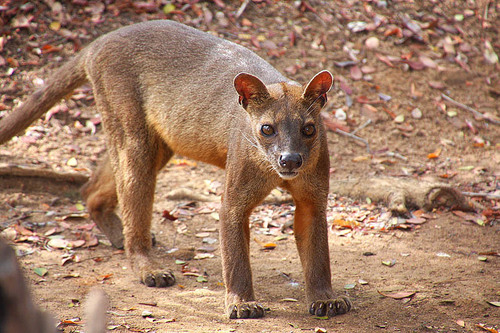
Predators include the fossa (Cryptoprocta ferox) and large birds of prey; humans also pose a significant threat through direct killing. Aye-ayes may compete with other nocturnal lemurs for fruit resources but largely occupy a distinct feeding niche due to their specialized foraging.
Role in its ecosystem
As a specialized insectivore-frugivore, the aye-aye plays a role in controlling wood-boring insect populations and contributes to seed dispersal for various fruiting trees within Madagascar's forest ecosystems.
Reproduction and lifecycle
Breeding can occur year-round with peaks varying by region; gestation lasts about 160-170 days, typically resulting in a single offspring. Weaning occurs around 7 months, though juveniles may stay dependent on the mother for over a year.
Raising the young
Mothers provide sole parental care, nursing and protecting the infant in nests, with juveniles remaining close to their mother for extended periods and gradually gaining independence in foraging skills.
Maturity and lifespan
Sexual maturity is reached around 2-3 years of age; lifespan in the wild is estimated at 20-23 years, while individuals in captivity have lived over 26 years.
Taxonomy and naming of the Aye-aye
Classification
Mammalia > Primates > Daubentoniidae > Daubentonia > Daubentonia madagascariensis
Scientific synonyms
Sciurus madagascariensis (Gmelin, 1788); Daubentonia psilodactylus
What research says
Recent studies
Recent research has focused on the biomechanics of the aye-aye's percussive foraging and echolocation-like tapping behavior, as well as conservation genetics to assess population structure and inform breeding programs.
Genome and DNA
The aye-aye has a diploid chromosome number of 2n=30; genomic studies have highlighted its deep evolutionary divergence from other lemurs, having split from other strepsirrhine lineages tens of millions of years ago.
Compared with similar species
Unlike other lemurs such as sifakas or true lemurs, the aye-aye lacks a toothcomb and instead has rodent-like incisors; its foraging niche is more similar to woodpeckers than to any other primate, representing a striking case of convergent evolution.
The Aye-aye and people
The aye-aye's middle finger is so thin it can rotate 360 degrees at the joint; local Malagasy folklore holds that if an aye-aye points its finger at you, it foretells death; and its foraging technique is functionally similar to that of woodpeckers, despite being a mammal.
Where and how to see it
Aye-ayes are best observed on guided night walks at reserves such as Nosy Mangabe or Palmarium Reserve near Lake Ampitabe, where habituated individuals are more reliably encountered after dark using red-filtered flashlights to minimize disturbance.
Risks to humans
No notable risk to humans; aye-ayes are shy and non-aggressive, posing no direct physical danger, though their unusual appearance often provokes fear rooted in cultural superstition rather than actual threat.
Human uses
Aye-ayes have no significant traditional economic use, though they are occasionally featured in ecotourism initiatives aimed at raising awareness and funding for lemur conservation in Madagascar.
Myths and legends
In many parts of Madagascar, the aye-aye is considered a harbinger of misfortune or death, leading some communities to kill the animal on sight if encountered near villages; other traditions view seeing one as an omen requiring ritual protection.
Countries where the Aye-aye is recorded
The 1 countries named in the range description of its IUCN Red List assessment.
Questions about the Aye-aye
Where does the Aye-aye live?
The Aye-aye is recorded in Madagascar across Africa. These countries come from the range description of its IUCN Red List assessment, and they are what place the species on the interactive map.
Is the Aye-aye endangered?
Yes. The IUCN Red List assesses the Aye-aye as Endangered, one of the three threatened categories. The species faces a very high risk of extinction in the wild — a step below Critically Endangered, but still on a trajectory that ends badly without intervention.
How many are left in the wild?
Population size is unknown but believed to be declining; estimates suggest fewer than 10,000 mature individuals remain, with a continuing downward trend due to habitat loss. This figure comes from the species assessment on the IUCN Red List; population estimates for wild mammals are ranges, not counts, and are revised at each assessment.
What habitat does the Aye-aye live in?
Aye-ayes inhabit a wide variety of forest types including primary and secondary rainforest, deciduous forest, mangroves, and cultivated areas like coconut and lychee plantations.
What is the scientific name of the Aye-aye?
The Aye-aye is Daubentonia madagascariensis, in the family Daubentoniidae, order Primates.
Species that share its range


Sources
Conservation status, range description and population estimate come from the IUCN Red List assessment for Daubentonia madagascariensis. Countries are derived from that range description, not from a mapped country list. Last refreshed on .
The distribution map is drawn from the IUCN Red List spatial data compiled in 2020. IUCN (International Union for Conservation of Nature)