
Eastern Woolly Lemur
Avahi laniger
Red List assessment
Vulnerableon the IUCN Red List
- EXExtinct
- EWExtinct in the Wild
- CRCritically Endangered
- ENEndangered
- VUVulnerable
- NTNear Threatened
- LCLeast Concern
The Eastern Woolly Lemur is recorded in one country, Madagascar across Africa. The IUCN Red List assesses the Eastern Woolly Lemur as Vulnerable. No precise global population estimate is available.
- Family
- Indriidae
- Order
- Primates
- Genus
- Avahi
- Countries recorded
- 1
- Continents
- Africa
- Red List category
- Vulnerable
- Data updated
- August 9, 2026
What is the Eastern Woolly Lemur?
The Eastern Woolly Lemur is a small, strictly nocturnal, arboreal primate endemic to the humid rainforests of eastern Madagascar. It belongs to the family Indriidae and is remarkable as the only nocturnal folivore (leaf-eater) among all lemur species — a dietary strategy extremely rare among primates. Its exceptionally dense, woolly fur gives the entire genus its common name. It is a vertical clinger and leaper, moving through the forest canopy with surprising agility despite its slow, deliberate foraging pace.
Where does the Eastern Woolly Lemur live?
Eastern Madagascar; found along the eastern rainforest corridor including protected areas such as Andasibe-Mantadia, Masoala, and Ranomafana
Endemic to Madagascar; restricted to the eastern rainforest corridor, ranging from around the Tsaratanana Massif in the north to the Ranomafana region in the south, with key populations in Andasibe-Mantadia, Masoala Peninsula, and Zahamena-Mantadia protected areas.
Altitude and depth
Typically found from near sea level up to approximately 1,800 m elevation in montane rainforests; most common at low to mid elevations.
Seasonal movements
No seasonal migration reported. Breeding is concentrated in the austral winter (May–July), with births occurring in August–September. Slight dietary shifts may occur seasonally depending on leaf availability and phenology.
Habitat of the Eastern Woolly Lemur
Primary and secondary tropical humid rainforests, including lowland coastal forests and montane rainforests. It favors areas with high canopy cover, dense undergrowth, and abundant foliage, and is also found in forest fragments and degraded secondary forest edges.
Adaptations to its environment
Large, forward-facing, orange-red eyes with a tapetum lucidum provide excellent nocturnal vision. The digestive system features an enlarged cecum specialized for fermenting and detoxifying tough leaf material. Elongated, powerful hindlimbs enable efficient vertical clinging and leaping locomotion. The woolly pelage provides thermal insulation in cool highland forests.
Conservation status and numbers
Listed as Vulnerable (VU) on the IUCN Red List. The population is suspected to have declined by more than 30% over three generations due to ongoing deforestation, habitat degradation, and fragmentation across its range. The rate of forest loss in eastern Madagascar continues to drive this negative trend.
Estimated population
No precise global population estimate is available. The population trend is considered declining, driven by continuous and widespread habitat loss across the eastern rainforest corridor.
What threatens the Eastern Woolly Lemur?
The primary threat is deforestation caused by slash-and-burn agriculture (tavy), illegal logging, and charcoal production. Habitat fragmentation isolates populations and reduces genetic connectivity. Localized hunting for bushmeat occurs in some regions, though cultural taboos (fady) offer partial protection in certain communities.
Diseases and parasites
Susceptible to intestinal parasites common among primates, including helminths and protozoans. Parasitic burdens may increase in degraded or fragmented habitats. No major specific disease outbreaks have been documented for this species.
What is being done to protect it?
The species is present within several protected areas including Andasibe-Mantadia, Masoala, Ranomafana, and Zahamena National Parks. It is listed on CITES Appendix I and is protected under Malagasy national law. Conservation NGOs such as WWF Madagascar, the Madagascar Biodiversity Partnership, and Durrell Wildlife Conservation Trust support habitat protection and community-based conservation programs.
Recommended actions
Priority actions include expanding and strictly enforcing protected area networks, reducing slash-and-burn agriculture through community outreach and alternative livelihood programs, restoring forest corridors to reconnect fragmented populations, systematic population monitoring, and supporting ex-situ conservation breeding programs as a genetic safeguard.
What the Eastern Woolly Lemur looks like
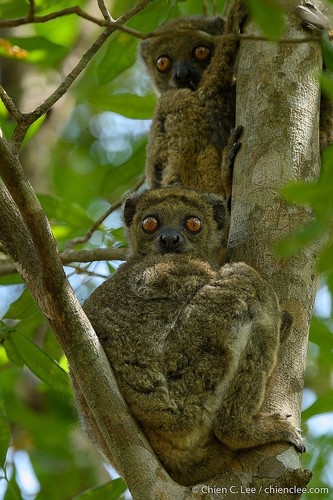
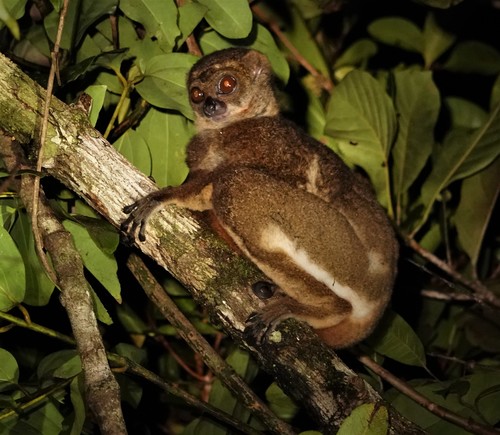
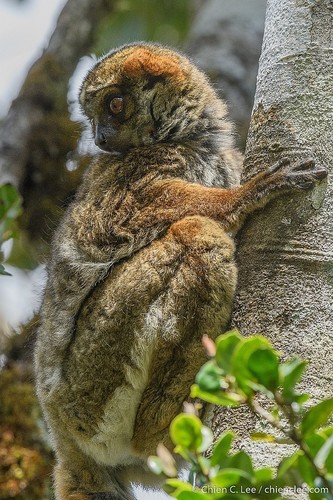
The Eastern Woolly Lemur has a dense, woolly coat with grayish-brown to reddish-brown dorsal coloration and pale whitish-cream to buff underparts. The rounded head bears a short muzzle, very short ears largely concealed within the fur, and conspicuously large, orange-red eyes. The reddish-brown tail is moderately long, and the inner thighs often display distinctive pale whitish patches.
Size
Head-body length: 27–29 cm; tail length: 33–37 cm; total length approximately 60–66 cm.
Weight
Approximately 1.0–1.3 kg; sexual dimorphism in mass is minimal.
Distinctive features
Distinguished from the Western Woolly Lemur (A. occidentalis) by geographic range and slightly darker, more reddish-brown dorsal coloration. The round head with almost invisible ears, extremely dense woolly fur, and large reflective eyes are hallmarks of the genus. Its strictly nocturnal habits and compact resting posture (curled into a tight ball by day) further set it apart.
Differences between males and females
Sexual dimorphism is minimal; males and females are nearly identical in size and coloration.
Behaviour and diet of the Eastern Woolly Lemur
Lives in small, monogamous family units typically comprising 2–5 individuals — a bonded pair and their offspring from previous seasons. These family groups maintain and defend territories through vocalizations. Group members sleep pressed together in dense vine tangles or tree forks during the day, which likely reduces heat loss.
When it is active
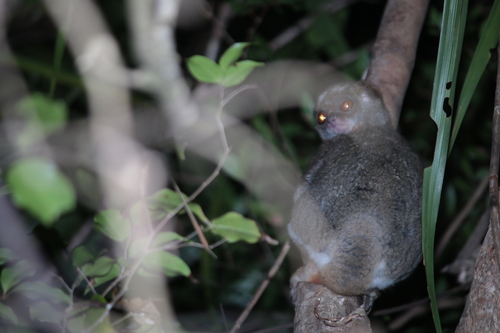
Strictly nocturnal. During daylight hours, individuals remain completely motionless in dense foliage or vine tangles, relying on cryptic coloration for camouflage. Active foraging begins after dusk and continues throughout the night.
Diet
Primarily folivorous; leaves constitute the majority of the diet, including mature and young leaves of various rainforest tree species. The diet is supplemented with buds, flowers, bark, and occasionally fruit. This reliance on leaves as a primary food source is exceptionally rare among nocturnal primates.
How it feeds and hunts
Not a predator. Forages by moving slowly and deliberately through the canopy, selectively browsing preferred plant species. Uses hands and the dental toothcomb to manipulate and process foliage and plant material.
Communication
Produces loud, high-pitched, melodious calls used for territory advertisement and pair-bond reinforcement, most commonly heard in the early hours of the night. Scent marking is used to delineate home ranges. Tactile grooming reinforces social bonds within the family unit, and body postures communicate arousal or submission.
Interactions with other species
Primary natural predators include the fossa (Cryptoprocta ferox), Madagascar Long-eared Owl (Asio madagascariensis), and large snakes. May experience resource competition with other sympatric folivorous lemurs. As an occasional fruit consumer, it plays a modest role in seed dispersal within the rainforest ecosystem.
Role in its ecosystem
Functions as a folivore, contributing to the regulation of leaf biomass in rainforest ecosystems. As a prey species for top predators such as the fossa, it plays an important role in forest food webs. Its modest fruit consumption gives it a secondary role as a seed disperser.
Reproduction and lifecycle
Breeding is strictly seasonal, occurring primarily between May and July. Gestation lasts approximately 136–150 days (roughly 4.5–5 months), with births concentrated in August–September. A single offspring is produced per reproductive cycle.
Raising the young
The newborn initially clings tightly to the mother's belly, gradually transitioning to riding on her back as it develops. Both parents may participate in vigilance and infant care. Juveniles are weaned after several months and typically remain with the family group for up to two years before dispersing to establish their own territories.
Maturity and lifespan
Sexual maturity is typically reached at approximately 2–3 years of age. Lifespan in the wild is estimated at 10–15 years; individuals in captivity may live somewhat longer under managed care.
Taxonomy and naming of the Eastern Woolly Lemur
Classification
Mammalia > Primates > Indriidae > Avahi > Avahi laniger
Subspecies
No currently recognized subspecies. The formerly broad concept of A. laniger has been split into multiple distinct species (including A. peyrierasi, A. unicolor, and A. meridionalis), leaving A. laniger sensu stricto without recognized subspecies.
Scientific synonyms
Lichanotus laniger É. Geoffroy Saint-Hilaire, 1796 (original description); Microrhynchus laniger Lesson, 1840; Habrocebus laniger.
What research says
Recent studies
Comprehensive molecular and morphological revisions (Groves 2001; Zaramody et al. 2006; and subsequent studies) have elevated the genus Avahi from 2 to approximately 9 recognized species, fundamentally reshaping understanding of woolly lemur diversity. Ongoing research into the physiological adaptations enabling nocturnal folivory in this genus continues to interest primatologists studying primate digestive ecology.
Genome and DNA
A diploid chromosome number of 2n = 66 has been reported for Avahi species. Molecular phylogenetic analyses of mitochondrial and nuclear DNA have been the primary driver of the major taxonomic revision of the genus Avahi, revealing cryptic species diversity previously undetected by morphology alone.
Compared with similar species
Within the genus Avahi (~9 species), all share woolly fur, nocturnal habits, and folivory. The Eastern Woolly Lemur (A. laniger) is most closely compared to A. occidentalis (western Madagascar), from which it differs in range, coloration, and genetics. As an Indriidae, its nearest relatives are the diurnal sifakas (Propithecus spp.) and the Indri (Indri indri), all of which share folivory but are active during the day — highlighting the uniqueness of Avahi's nocturnal niche.
The Eastern Woolly Lemur and people
The Eastern Woolly Lemur is the only nocturnal folivore among all ~100 lemur species, occupying an ecological niche that is vanishingly rare in the primate world. Family groups spend the daytime pressed together in a motionless bundle resembling a clump of moss or bark, making them extraordinarily difficult to spot even for experienced naturalists. Despite their slow and deliberate foraging movements, they can launch themselves in powerful vertical leaps of several meters between tree trunks when needed.
Where and how to see it
Best observed on guided night walks in Andasibe-Mantadia National Park or Ranomafana National Park in eastern Madagascar, where experienced local guides know the habitual sleeping sites of resident family groups. Use a red-filtered torch to minimize disturbance to the animals' vision. Listen for their distinctive series of high-pitched calls starting shortly after dusk, and scan for the characteristic orange eye-shine in vegetation.
Risks to humans
No notable risk to humans. The Eastern Woolly Lemur is shy, non-aggressive, and avoids contact with people; it may bite defensively if restrained, but poses no significant danger under normal conditions.
Human uses
Not systematically hunted in communities where fady applies, providing localized cultural protection. Some bushmeat hunting has been reported in areas without such taboos. The species has significant ecotourism value, contributing to local economies near protected areas such as Andasibe, where night lemur walks are a popular tourist activity. Occasionally maintained in zoos and research facilities for conservation breeding and behavioral studies.
Myths and legends
In several Malagasy communities, avahis are protected by fady — traditional taboos that prohibit their killing or consumption. This cultural protection has provided a degree of incidental conservation benefit in certain localities, though the geographic extent and enforcement of such taboos vary considerably across the species' range.
Countries where the Eastern Woolly Lemur is recorded
The 1 countries named in the range description of its IUCN Red List assessment.
Questions about the Eastern Woolly Lemur
Where does the Eastern Woolly Lemur live?
The Eastern Woolly Lemur is recorded in Madagascar across Africa. These countries come from the range description of its IUCN Red List assessment, and they are what place the species on the interactive map.
Is the Eastern Woolly Lemur endangered?
Yes. The IUCN Red List assesses the Eastern Woolly Lemur as Vulnerable, one of the three threatened categories. The species faces a high risk of extinction in the wild. It is the first of the three threatened categories: numbers are falling, the range is shrinking, or the population is small enough that a single bad event could do lasting damage.
How many are left in the wild?
No precise global population estimate is available. This figure comes from the species assessment on the IUCN Red List; population estimates for wild mammals are ranges, not counts, and are revised at each assessment.
What habitat does the Eastern Woolly Lemur live in?
Primary and secondary tropical humid rainforests, including lowland coastal forests and montane rainforests.
What is the scientific name of the Eastern Woolly Lemur?
The Eastern Woolly Lemur is Avahi laniger, in the family Indriidae, order Primates.
Other species in the genus Avahi


Other species in the family Indriidae
Species that share its range

Sources
Conservation status, range description and population estimate come from the IUCN Red List assessment for Avahi laniger. Countries are derived from that range description, not from a mapped country list. Last refreshed on .
The distribution map is drawn from the IUCN Red List spatial data compiled in 2020. IUCN (International Union for Conservation of Nature)