
Forest Giant Pouched Rat
Cricetomys emini
Red List assessment
Least Concernon the IUCN Red List
- EXExtinct
- EWExtinct in the Wild
- CRCritically Endangered
- ENEndangered
- VUVulnerable
- NTNear Threatened
- LCLeast Concern
The Forest Giant Pouched Rat is recorded in 6 countries across Africa. The IUCN Red List assesses the Forest Giant Pouched Rat as Least Concern. No precise global population estimate exists, but the species is considered common within suitable forest habitat; overall trend is believed to be stable to slightly declining due to habitat loss
- Family
- Nesomyidae
- Order
- Rodentia
- Genus
- Cricetomys
- Countries recorded
- 6
- Continents
- Africa
- Red List category
- Least Concern
- Data updated
- August 9, 2026
What is the Forest Giant Pouched Rat?
The Forest Giant Pouched Rat is a large, nocturnal rodent native to the tropical rainforests of Central and East Africa. It is closely related to the more widely known Gambian pouched rat but is adapted specifically to dense forest habitats. Known for its expandable cheek pouches used for food storage and transport, this species plays an important ecological role as a seed disperser and forest floor forager. It is remarkable for its size, being one of the largest rodents in Africa.
Where does the Forest Giant Pouched Rat live?
Central and East Africa, primarily the Congo Basin and surrounding forested regions including DR Congo, Uganda, Rwanda, Burundi, and parts of the Central African Republic
Found across the Congo Basin rainforest zone, including the Democratic Republic of Congo, Republic of Congo, Uganda, Rwanda, Burundi, and parts of the Central African Republic and western Kenya. Its range is closely tied to the extent of contiguous tropical forest cover.
Altitude and depth
0-2500 meters above sea level, with populations found in both lowland rainforest and montane forest habitats
Seasonal movements
No true hibernation or long-distance migration; activity levels may fluctuate seasonally with food availability, particularly in relation to fruiting seasons of forest trees
Habitat of the Forest Giant Pouched Rat
Primarily inhabits lowland and montane tropical rainforests, including primary and secondary forest, forest edges, and sometimes adjacent agricultural areas near forest cover. Prefers dense vegetation with good ground cover for burrowing and foraging.
Adaptations to its environment
Possesses large cheek pouches for transporting food over long distances back to burrows, reducing foraging risk exposure. Strong sense of smell and whiskers aid navigation in dark forest understory. Burrowing behavior provides protection from predators and stable microclimate.
Conservation status and numbers
Listed as Least Concern (LC) by IUCN due to its wide distribution across Central Africa and presumed large population size, though localized declines occur due to habitat loss.
Estimated population
No precise global population estimate exists, but the species is considered common within suitable forest habitat; overall trend is believed to be stable to slightly declining due to habitat loss
What threatens the Forest Giant Pouched Rat?
Deforestation and forest fragmentation for agriculture and logging, hunting for bushmeat in some regions, and habitat degradation from human encroachment
Diseases and parasites
Known to carry various ectoparasites such as fleas and mites; pouched rats in general have been studied as potential reservoirs for zoonotic diseases including monkeypox virus
What is being done to protect it?
Benefits indirectly from protected areas within its range such as national parks in the Congo Basin; no species-specific conservation programs are currently in place
Recommended actions
Continued protection of Congo Basin forest habitats, monitoring of hunting pressure for bushmeat, and further research into population densities and ecological role
What the Forest Giant Pouched Rat looks like
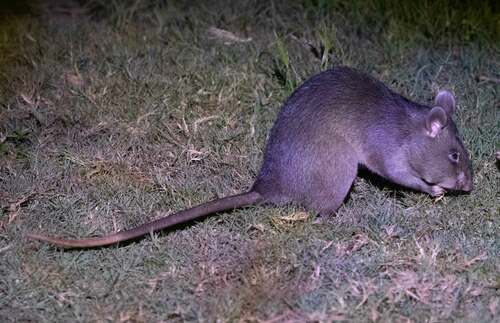
Has coarse grayish-brown to dark brown fur on the back with paler underparts, large rounded ears, and a long naked or sparsely-haired tail. The face features large dark eyes adapted for nocturnal vision and prominent cheek pouches used for carrying food.
Size
Head-body length approximately 30-45 cm, with a tail nearly as long as the body, adding another 35-45 cm
Weight
Typically weighs between 1 and 1.5 kg, with some large individuals reaching up to 2 kg
Distinctive features
Distinguished from the Gambian pouched rat (Cricetomys gambianus) by generally darker fur coloration, slightly smaller size, and specific skull and dental characteristics; primarily separated by forest habitat preference versus the savanna-associated gambianus
Differences between males and females
Minimal sexual dimorphism; males and females are similar in size and coloration, though males may be marginally larger
Behaviour and diet of the Forest Giant Pouched Rat
Largely solitary or found in small family groups; individuals maintain separate burrow systems though ranges may overlap. Not strongly territorial but avoids direct competition through spacing.
When it is active
Strictly nocturnal, emerging from burrows after dusk to forage and returning before dawn
Diet
Omnivorous, feeding on a wide variety of forest fruits, seeds, nuts, insects, snails, and occasionally small vertebrates. Diet varies seasonally based on fruit and seed availability in the forest.
How it feeds and hunts
Forages on the forest floor using keen sense of smell to locate fallen fruits, seeds, and invertebrates; stores excess food in cheek pouches to carry back to burrow for later consumption or caching
Communication
Communicates through scent marking of burrows and territories, along with vocalizations including squeaks and chirps, especially between mother and offspring
Interactions with other species
Predators include large snakes, birds of prey, and carnivorous mammals such as genets and civets; the species has no strong symbiotic relationships but contributes to forest ecology through seed caching
Role in its ecosystem
Plays a significant role as a seed disperser and occasional seed predator within tropical forest ecosystems, contributing to forest regeneration and plant community structure
Reproduction and lifecycle
Breeding can occur year-round in favorable conditions, with gestation lasting approximately 27-36 days. Litters typically consist of 2-6 pups, born in underground burrows.
Raising the young
Females provide sole parental care, nursing and protecting young in the burrow until weaning at around 4-6 weeks of age; young become independent shortly after weaning
Maturity and lifespan
Reaches sexual maturity around 5-7 months of age; lifespan in the wild is estimated at 4-5 years, while captive individuals have been recorded living up to 8 years
Taxonomy and naming of the Forest Giant Pouched Rat
Classification
Class Mammalia > Order Rodentia > Family Nesomyidae > Genus Cricetomys > Species Cricetomys emini
Scientific synonyms
Formerly considered a subspecies or synonym of Cricetomys gambianus in some older taxonomic treatments; occasionally referenced as Cricetomys gambianus emini
What research says
Recent studies
Recent research has focused on the genus Cricetomys as potential disease reservoirs, particularly regarding monkeypox and other zoonotic pathogens circulating in Central African forests
Compared with similar species
Similar in size and general appearance to the Gambian pouched rat (Cricetomys gambianus), but C. emini is more strictly forest-adapted with darker pelage; both species share the distinctive cheek pouch adaptation seen in the genus
The Forest Giant Pouched Rat and people
This rodent's cheek pouches can expand significantly to carry large quantities of food, similar to a built-in shopping bag. Giant pouched rats have been trained in some parts of Africa to detect landmines and even tuberculosis due to their acute sense of smell, though this is more commonly documented in the related Gambian pouched rat.
Where and how to see it
Best observed at night using red-filtered flashlights in Congo Basin forest reserves; patient observers near burrow entrances at dusk have the highest chance of sighting this elusive nocturnal species
Risks to humans
No notable risk to humans directly, though as with other rodents, there is a low potential for zoonotic disease transmission through contact with feces or bites
Human uses
Hunted for bushmeat in some local communities within its range; not commonly used in trade or traditional medicine to the same extent as its relative, the Gambian pouched rat
Countries where the Forest Giant Pouched Rat is recorded
The 6 countries named in the range description of its IUCN Red List assessment.
Questions about the Forest Giant Pouched Rat
Where does the Forest Giant Pouched Rat live?
The Forest Giant Pouched Rat is recorded in Burundi, Central African Republic, Democratic Republic of the Congo, Kenya and Rwanda, among 6 countries in total across Africa. These countries come from the range description of its IUCN Red List assessment, and they are what place the species on the interactive map.
Is the Forest Giant Pouched Rat endangered?
The IUCN Red List assesses the Forest Giant Pouched Rat as Least Concern. The species is widespread and abundant enough not to qualify for any threatened category. It does not mean the species is safe forever, only that nothing in the current data raises an alarm.
How many are left in the wild?
No precise global population estimate exists, but the species is considered common within suitable forest habitat; overall trend is believed to be stable to slightly declining due to habitat loss This figure comes from the species assessment on the IUCN Red List; population estimates for wild mammals are ranges, not counts, and are revised at each assessment.
What habitat does the Forest Giant Pouched Rat live in?
Primarily inhabits lowland and montane tropical rainforests, including primary and secondary forest, forest edges, and sometimes adjacent agricultural areas near forest cover.
What is the scientific name of the Forest Giant Pouched Rat?
The Forest Giant Pouched Rat is Cricetomys emini, in the family Nesomyidae, order Rodentia.
Other species in the genus Cricetomys
Other species in the family Nesomyidae


Species that share its range

Sources
Conservation status, range description and population estimate come from the IUCN Red List assessment for Cricetomys emini. Countries are derived from that range description, not from a mapped country list. Last refreshed on .
The distribution map is drawn from the IUCN Red List spatial data compiled in 2008. IUCN (International Union for Conservation of Nature)