
Fossa
Cryptoprocta ferox
Red List assessment
Vulnerableon the IUCN Red List
- EXExtinct
- EWExtinct in the Wild
- CRCritically Endangered
- ENEndangered
- VUVulnerable
- NTNear Threatened
- LCLeast Concern
The Fossa is recorded in one country, Madagascar across Africa. The IUCN Red List assesses the Fossa as Vulnerable. Population size is unknown precisely but believed to be declining; estimates suggest fewer than 2,500 mature individuals in some assessments, with fragmented subpopulations.
- Family
- Eupleridae
- Order
- Carnivora
- Genus
- Cryptoprocta
- Countries recorded
- 1
- Continents
- Africa
- Red List category
- Vulnerable
- Data updated
- August 9, 2026
What is the Fossa?
The fossa is Madagascar's largest carnivorous mammal, resembling a small cougar but actually related to mongooses within the endemic family Eupleridae. It is an agile, arboreal predator found throughout the island's forests, notable for its slender body, long tail, and retractable claws. As the apex predator of Madagascar, it plays a critical ecological role controlling lemur and other prey populations.
Where does the Fossa live?
Madagascar (endemic)
Endemic to Madagascar, found in fragmented forest patches across the island including the eastern rainforests, western dry forests, and southern spiny forests.
Altitude and depth
Sea level to approximately 2000m
Seasonal movements
Breeding is seasonal, occurring primarily between September and December (austral spring), with increased territorial and mating activity during this period.
Habitat of the Fossa
Primarily found in primary and secondary tropical rainforests, dry deciduous forests, and spiny forests across Madagascar. It requires large tracts of intact forest with sufficient canopy cover and prey density.
Adaptations to its environment
Highly flexible ankle joints and semi-retractable claws allow exceptional climbing and descending trees head-first. A long tail aids balance during arboreal locomotion, and scent glands are used for territory marking in dense forest environments.
Conservation status and numbers
Vulnerable (IUCN), with population declines driven primarily by habitat loss; the species has experienced significant range contraction and is predicted to continue declining due to ongoing deforestation.
Estimated population
Population size is unknown precisely but believed to be declining; estimates suggest fewer than 2,500 mature individuals in some assessments, with fragmented subpopulations.
What threatens the Fossa?
Deforestation and habitat fragmentation from slash-and-burn agriculture (tavy), logging, mining, hunting by local communities, and predation/competition from introduced species like feral dogs and cats.
Diseases and parasites
Susceptible to diseases transmitted by domestic carnivores, including canine distemper virus and toxoplasmosis; various endoparasites and ectoparasites have been documented.
What is being done to protect it?
Protected under Malagasy law and listed on CITES Appendix II; found within several protected areas including Ranomafana, Masoala, and Ankarafantsika National Parks; research and monitoring programs track population trends.
Recommended actions
Expand and connect protected forest corridors, strengthen anti-poaching and anti-deforestation enforcement, engage local communities in conservation incentives, and continue population monitoring and genetic studies.
What the Fossa looks like
Sleek, muscular body covered in short, dense reddish-brown to golden-brown fur, paler on the underside; cat-like face with rounded ears and large forward-facing eyes adapted for both diurnal and nocturnal activity.
Size
Head-body length 61-80cm, with tail nearly as long (65-70cm), giving a total length up to 152cm; shoulder height approximately 37cm.
Weight
Males typically 6.2-8.6kg; females somewhat smaller at 5.5-6.8kg.
Distinctive features
Distinguished from other carnivores by its unusually long tail (nearly body length), semi-retractable claws, and specialized ankle structure enabling headfirst descent from trees; the only member of its genus.
Differences between males and females
Males are noticeably larger and heavier than females, with males possessing a specialized penis bone (baculum) and pseudo-baculum-like structure in females that may relate to mating behavior.
Behaviour and diet of the Fossa
Generally solitary except during breeding season, though some studies show occasional loose social tolerance; individuals maintain large home ranges that may overlap.
When it is active
Cathemeral, active during both day and night, though often exhibits peaks of activity at dawn and dusk (crepuscular tendencies).
Diet
Carnivorous, primarily preying on lemurs of all sizes (including large species like sifakas and indri), as well as tenrecs, rodents, birds, reptiles, and occasionally domestic poultry.
How it feeds and hunts
Ambush predator that hunts both on the ground and in trees, using stealth and agility to stalk and pounce on prey; capable of pursuing lemurs through the canopy with remarkable speed and agility.
Communication
Uses scent marking via anal and other glands to communicate territory and reproductive status; vocalizations include mews, purrs, and hisses; body postures and tail signals also convey social information.
Interactions with other species
As apex predator, fossas have few natural predators aside from large raptors preying on juveniles; they compete with introduced carnivores like feral cats and dogs, which also threaten them through disease and predation.
Role in its ecosystem
Functions as the apex predator in Madagascar's forest ecosystems, regulating lemur and other prey populations, which helps maintain ecological balance and forest health.
Reproduction and lifecycle
Mating occurs September-December; females exhibit a promiscuous mating system often mating with multiple males at traditional tree sites; gestation lasts approximately 90 days, resulting in litters of 2-4 cubs.
Raising the young
Females raise young alone in dens (often tree hollows); cubs are altricial at birth, opening eyes around 2 weeks, and are weaned around 4-5 months, remaining with mother up to a year or more before independence.
Maturity and lifespan
Sexual maturity reached around 3-4 years; lifespan in the wild is approximately 15-20 years, with captive individuals sometimes living slightly longer under proper care.
Taxonomy and naming of the Fossa
Classification
Mammalia > Carnivora > Eupleridae > Cryptoprocta > Cryptoprocta ferox
Scientific synonyms
Viverra ferox, Cryptoprocta typica
What research says
Recent studies
Recent studies using camera traps and GPS collaring have revealed more detailed information on fossa home range sizes, activity patterns, and the impact of forest fragmentation on population connectivity.
Genome and DNA
Diploid chromosome number of 2n=42; genetic studies have clarified its placement within the endemic Malagasy carnivoran family Eupleridae, confirming a single mongoose-like ancestor colonized Madagascar.
Compared with similar species
Often compared to small cougars or pumas due to convergent body shape, but is genetically more closely related to mongooses and civets; unlike true cats, it has a unique reproductive anatomy and specialized arboreal adaptations.
The Fossa and people
Fossas can descend trees headfirst like squirrels thanks to their flexible ankles; females sometimes undergo a temporary masculinization phase as juveniles, developing an enlarged clitoris resembling a penis, possibly to avoid aggression from adult males.
Where and how to see it
Best observed in well-protected reserves such as Kirindy Forest or Ranomafana National Park, particularly during the mating season (September-November) when individuals are more visible; patience and guided night walks increase chances of sighting.
Risks to humans
Generally poses no significant threat to humans; attacks are extremely rare, though it may prey on domestic poultry, leading to conflict with local communities.
Human uses
Not significantly used commercially, though occasionally killed by farmers to protect poultry; ecotourism related to fossa observation contributes to local conservation economies.
Myths and legends
In Malagasy folklore, the fossa is often feared and associated with supernatural danger, believed by some rural communities to steal livestock or even harm humans, leading to persecution despite limited evidence of such behavior.
Countries where the Fossa is recorded
The 1 countries named in the range description of its IUCN Red List assessment.
Questions about the Fossa
Where does the Fossa live?
The Fossa is recorded in Madagascar across Africa. These countries come from the range description of its IUCN Red List assessment, and they are what place the species on the interactive map.
Is the Fossa endangered?
Yes. The IUCN Red List assesses the Fossa as Vulnerable, one of the three threatened categories. The species faces a high risk of extinction in the wild. It is the first of the three threatened categories: numbers are falling, the range is shrinking, or the population is small enough that a single bad event could do lasting damage.
How many are left in the wild?
Population size is unknown precisely but believed to be declining; estimates suggest fewer than 2,500 mature individuals in some assessments, with fragmented subpopulations. This figure comes from the species assessment on the IUCN Red List; population estimates for wild mammals are ranges, not counts, and are revised at each assessment.
What habitat does the Fossa live in?
Primarily found in primary and secondary tropical rainforests, dry deciduous forests, and spiny forests across Madagascar.
What is the scientific name of the Fossa?
The Fossa is Cryptoprocta ferox, in the family Eupleridae, order Carnivora.
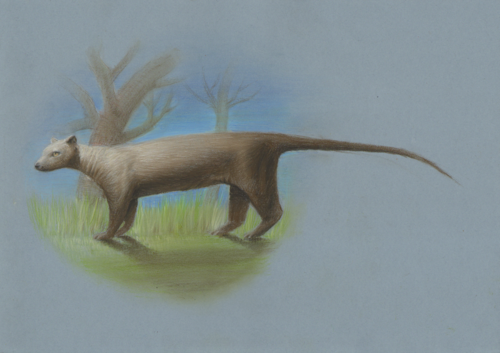
Other species in the genus Cryptoprocta
Species that share its range


Sources
Conservation status, range description and population estimate come from the IUCN Red List assessment for Cryptoprocta ferox. Countries are derived from that range description, not from a mapped country list. Last refreshed on .
The distribution map is drawn from the IUCN Red List spatial data compiled in 2016. IUCN (International Union for Conservation of Nature)