
White-bellied Duiker
Cephalophus leucogaster
Red List assessment
Near Threatenedon the IUCN Red List
- EXExtinct
- EWExtinct in the Wild
- CRCritically Endangered
- ENEndangered
- VUVulnerable
- NTNear Threatened
- LCLeast Concern
The White-bellied Duiker is recorded in 5 countries across Africa. The IUCN Red List assesses the White-bellied Duiker as Near Threatened. No precise global population estimate exists, but the population is believed to be declining due to hunting pressure and habitat degradation across much of its range.
- Family
- Bovidae
- Order
- Artiodactyla
- Genus
- Cephalophus
- Countries recorded
- 5
- Continents
- Africa
- Red List category
- Near Threatened
- Data updated
- August 9, 2026
What is the White-bellied Duiker?
The White-bellied Duiker is a small forest antelope native to the dense rainforests of Central Africa. It is named for its distinctive white underside contrasting with its darker upper body. This shy, secretive species plays an important ecological role as a seed disperser in tropical forest ecosystems. Like other duikers, it is elusive and rarely observed due to its dense forest habitat and cryptic behavior.
Where does the White-bellied Duiker live?
Central Africa, primarily the Congo Basin including Cameroon, Central African Republic, Republic of Congo, Democratic Republic of Congo, Gabon, and Equatorial Guinea
Found across the Congo Basin in Central Africa, including Cameroon, southeastern Central African Republic, Republic of Congo, Democratic Republic of Congo, Gabon, and Equatorial Guinea. Its range is largely continuous within the core Congo Basin rainforest block.
Altitude and depth
Generally found at lowland elevations from sea level up to approximately 1000 meters.
Seasonal movements
No significant migratory behavior; the species is largely sedentary and maintains stable home ranges year-round, though breeding activity may show slight seasonal peaks correlated with fruit availability.
Habitat of the White-bellied Duiker
Primarily inhabits lowland tropical rainforest and dense secondary forest, showing a preference for areas near water sources and swampy forest patches. It also uses riverine forest and can tolerate some degraded or logged forest habitats.
Adaptations to its environment
Its compact body and low-slung posture allow efficient movement through dense forest understory. Cryptic coloration provides camouflage in the dappled forest light, while acute hearing and a habit of freezing or fleeing quickly help it evade predators in thick vegetation.
Conservation status and numbers
Classified as Near Threatened by the IUCN due to ongoing population declines driven by habitat loss and unsustainable bushmeat hunting across its range, though it remains relatively widespread in undisturbed forest areas.
Estimated population
No precise global population estimate exists, but the population is believed to be declining due to hunting pressure and habitat degradation across much of its range.
What threatens the White-bellied Duiker?
Major threats include commercial and subsistence bushmeat hunting (often using wire snares), habitat destruction from logging, agricultural expansion, and infrastructure development in the Congo Basin.
Diseases and parasites
Susceptible to various internal and external parasites common to forest antelopes, including ticks and gastrointestinal nematodes, though specific disease studies are limited.
What is being done to protect it?
The species occurs in several protected areas within the Congo Basin, including national parks and reserves in Gabon, Cameroon, and the Republic of Congo. It is also covered by regional bushmeat management initiatives and CITES-related trade monitoring in some areas.
Recommended actions
Priority actions include strengthening anti-poaching enforcement, regulating and reducing snare-based hunting, protecting remaining intact forest habitat, and conducting further population surveys to better assess conservation status.
What the White-bellied Duiker looks like
The upperparts are reddish-brown to chestnut, while the belly, chest, and inner legs are notably white or cream-colored, giving the species its common name. It has a small, arched back typical of duikers, short legs, and a tuft of hair on the forehead.
Size
Shoulder height ranges from approximately 40-50 cm, with a body length of around 70-90 cm.
Weight
Adults typically weigh between 15-20 kg, with limited difference between males and females.
Distinctive features
The sharply contrasting white underside is the key distinguishing feature separating it from many other similarly-sized forest duikers, which tend to have more uniform coloring.
Differences between males and females
Minimal sexual dimorphism; both sexes possess short, backward-pointing horns, though those of males may be slightly more robust.
Behaviour and diet of the White-bellied Duiker
Generally solitary or found in monogamous pairs that maintain and defend a shared territory; family groups with a single offspring are also observed.
When it is active
Primarily crepuscular and nocturnal, though some activity may occur during daylight hours in undisturbed areas with low human presence.
Diet
Herbivorous/frugivorous diet consisting mainly of fallen fruits, leaves, seeds, and fungi, with fruit forming a significant portion of the diet when available.
Communication
Communication includes scent marking via preorbital glands to delineate territory, along with alarm snorts or whistles and body postures to signal danger to mates or offspring.
Interactions with other species
Natural predators include leopards, large forest eagles, pythons, and human hunters; the species also faces competition with other duiker species for similar food resources within the same forest habitat.
Role in its ecosystem
Acts as an important seed disperser for various forest fruit-bearing plants, contributing to forest regeneration and plant diversity within the Congo Basin ecosystem.
Reproduction and lifecycle
Breeding can occur year-round with possible peaks tied to fruit abundance; gestation lasts approximately 7-8 months, typically resulting in a single offspring.
Raising the young
The mother provides sole parental care, nursing and protecting the calf, which remains hidden in vegetation during its first weeks before gradually accompanying the mother.
Maturity and lifespan
Sexual maturity is typically reached around 1-2 years of age; lifespan in the wild is estimated at 10-12 years, potentially longer in captivity.
Taxonomy and naming of the White-bellied Duiker
Classification
Mammalia > Artiodactyla > Bovidae > Cephalophus > Cephalophus leucogaster
Subspecies
Two subspecies are generally recognized: C. l. leucogaster (western/central Congo Basin populations) and C. l. arrhenii (found in more eastern parts of the range), though taxonomic boundaries are not always clearly defined.
What research says
Recent studies
Recent camera-trap and bushmeat market studies in the Congo Basin have provided updated data on the species' distribution and hunting pressure, though genetic and behavioral research remains limited compared to other duiker species.
Compared with similar species
Similar in size to other forest duikers such as the Bay Duiker (Cephalophus dorsalis) and Black-fronted Duiker (Cephalophus nigrifrons), but is distinguished by its notably white belly, which contrasts more sharply than in related species.
The White-bellied Duiker and people
Despite being a relatively common target in bushmeat markets, the White-bellied Duiker remains one of the least-studied forest antelopes in Central Africa. Its white belly is thought to help with visual signaling between individuals in the dim forest understory.
Where and how to see it
Best observed with the aid of camera traps or guided night walks in well-protected reserves within Gabon or the Republic of Congo, as the species is extremely shy and difficult to spot directly in the wild.
Risks to humans
No notable risk to humans.
Human uses
Widely hunted for bushmeat throughout its range, representing an important source of protein and income in local and commercial bushmeat trade networks in Central Africa.
Countries where the White-bellied Duiker is recorded
The 5 countries named in the range description of its IUCN Red List assessment.
Questions about the White-bellied Duiker
Where does the White-bellied Duiker live?
The White-bellied Duiker is recorded in Cameroon, Central African Republic, Democratic Republic of the Congo, Equatorial Guinea and Gabon across Africa. These countries come from the range description of its IUCN Red List assessment, and they are what place the species on the interactive map.
Is the White-bellied Duiker endangered?
The IUCN Red List assesses the White-bellied Duiker as Near Threatened. The species does not qualify as threatened today, but it is close to the thresholds and likely to cross them soon. It is the category that most often changes at the next assessment.
How many are left in the wild?
No precise global population estimate exists, but the population is believed to be declining due to hunting pressure and habitat degradation across much of its range. This figure comes from the species assessment on the IUCN Red List; population estimates for wild mammals are ranges, not counts, and are revised at each assessment.
What habitat does the White-bellied Duiker live in?
Primarily inhabits lowland tropical rainforest and dense secondary forest, showing a preference for areas near water sources and swampy forest patches.
What is the scientific name of the White-bellied Duiker?
The White-bellied Duiker is Cephalophus leucogaster, in the family Bovidae, order Artiodactyla.
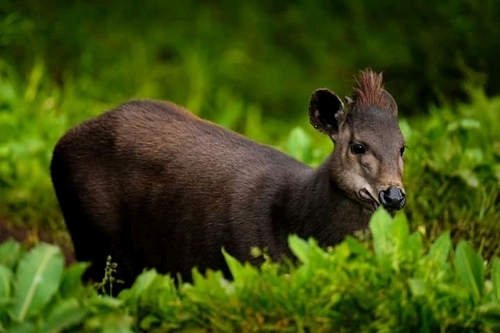
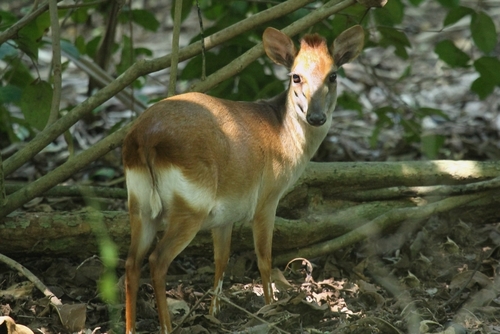
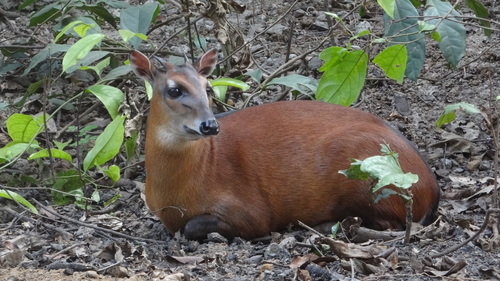
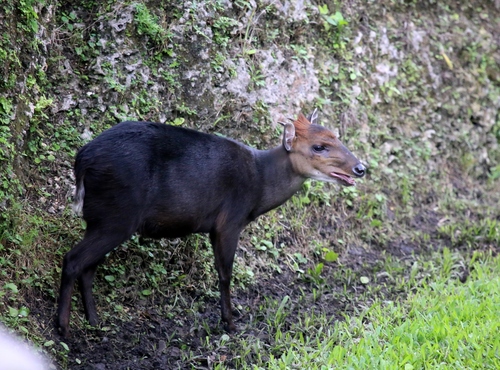
Other species in the genus Cephalophus
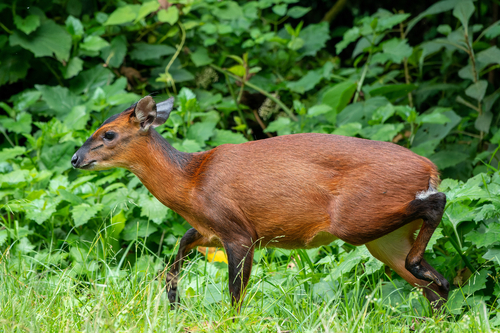
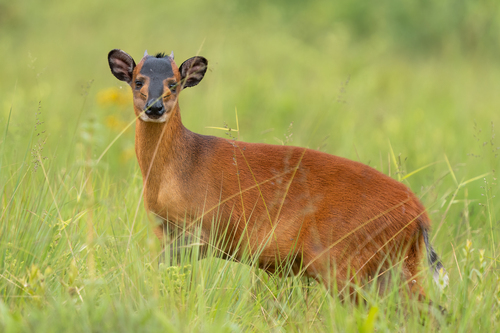
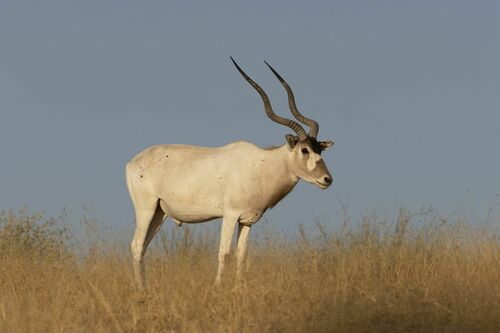
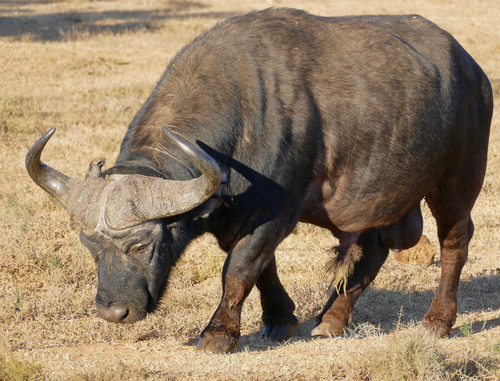
Other species in the family Bovidae
Sources
Conservation status, range description and population estimate come from the IUCN Red List assessment for Cephalophus leucogaster. Countries are derived from that range description, not from a mapped country list. Last refreshed on .
The distribution map is drawn from the IUCN Red List spatial data compiled in 2016. IUCN (International Union for Conservation of Nature)