
White Bald-headed Uakari
Cacajao calvus
Red List assessment
Least Concernon the IUCN Red List
- EXExtinct
- EWExtinct in the Wild
- CRCritically Endangered
- ENEndangered
- VUVulnerable
- NTNear Threatened
- LCLeast Concern
The White Bald-headed Uakari is recorded in 2 countries across South America. The IUCN Red List assesses the White Bald-headed Uakari as Least Concern. No precise global population estimate exists, but populations are considered stable to slightly declining in areas with increasing human encroachment; local densities can be moderate to high in protected várzea forests.
- Family
- Pitheciidae
- Order
- Primates
- Genus
- Cacajao
- Countries recorded
- 2
- Continents
- South America
- Red List category
- Least Concern
- Data updated
- August 9, 2026
What is the White Bald-headed Uakari?
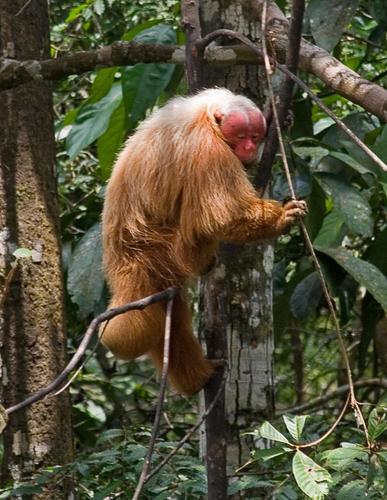
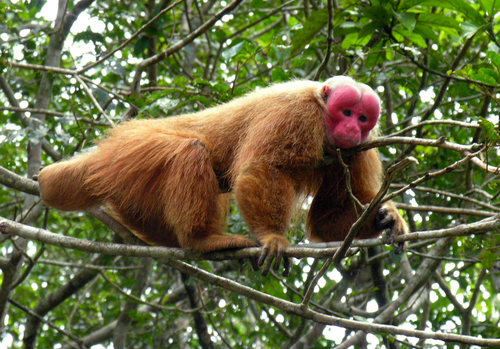
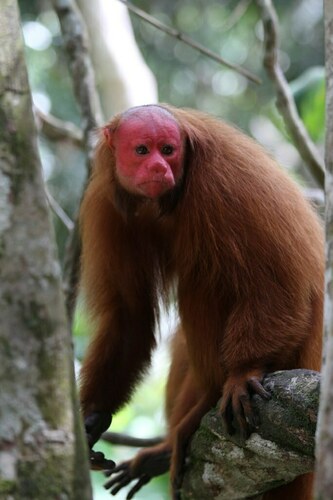
The White Bald-headed Uakari is a striking New World monkey known for its bright red bald face contrasting with its whitish to pale orange fur. It inhabits seasonally flooded (várzea) forests of the western Amazon basin. This species is remarkable for its unusual naked scarlet face, which is thought to signal health status, and its highly specialized diet centered on hard-shelled seeds.
Where does the White Bald-headed Uakari live?
Brazilian and Peruvian Amazon, primarily in the flooded forests along the Solimões, Japurá and Purus rivers
Restricted to the western Amazon basin in Brazil and Peru, particularly between the Solimões, Japurá, and Purus rivers, extending into Peruvian Amazon along the Ucayali river system.
Altitude and depth
Lowland tropical forest, typically below 200 meters elevation
Seasonal movements
Movements are closely tied to seasonal flooding cycles, with the monkeys shifting between flooded and non-flooded forest areas depending on water levels and fruit availability, but no true migration or hibernation occurs.
Habitat of the White Bald-headed Uakari
Primarily found in várzea (seasonally flooded) and igapó forests along whitewater rivers, where it depends on the fruiting cycles of flooded forest trees; occasionally uses adjacent terra firme forest.
Adaptations to its environment
The bald red face is thought to reduce heat stress and may indicate health/fitness to conspecifics; strong jaws and teeth allow it to crack open unripe, hard-shelled fruits and seeds unavailable to other primates. Its short tail and agile limbs aid in navigating flooded forest canopy.
Conservation status and numbers
Listed as Least Concern by IUCN, though populations are patchily distributed and some subspecies face localized threats; overall the species remains relatively widespread within its restricted flooded-forest habitat.
Estimated population
No precise global population estimate exists, but populations are considered stable to slightly declining in areas with increasing human encroachment; local densities can be moderate to high in protected várzea forests.
What threatens the White Bald-headed Uakari?
Habitat loss from deforestation, logging, and hydroelectric dam construction that alters flooding regimes; hunting for bushmeat in some areas; and fragmentation of várzea forest habitat.
Diseases and parasites
Susceptible to various intestinal parasites and arboviruses common to Amazonian primates, though specific comprehensive studies on disease prevalence are limited.
What is being done to protect it?
Protected within Mamirauá Sustainable Development Reserve and Amanã Reserve in Brazil, which specifically safeguard várzea habitat; included in CITES Appendix II regulating international trade.
Recommended actions
Expand protection of várzea forest corridors, regulate hydroelectric projects affecting flood cycles, enforce anti-hunting laws, and conduct further population surveys across its range.
What the White Bald-headed Uakari looks like
Distinctive bald, bright scarlet-red face; body fur ranges from creamy white to pale orange-yellow, sometimes with a reddish tinge on the crown; short, non-prehensile tail; robust build with a shaggy long-haired coat.
Size
Head-body length approximately 40-57 cm, with a notably short tail of about 15-18 cm, unusual among New World monkeys.
Weight
Adults typically weigh between 2.5 and 3.5 kg, with males slightly larger than females.
Distinctive features
The combination of a bald red face with white/pale body fur distinguishes it from the Red Uakari (Cacajao rubicundus/ucayalii group with reddish fur) and Black-headed Uakari (Cacajao melanocephalus).
Differences between males and females
Minimal sexual dimorphism; males are marginally larger in body size but coloration and facial features are similar between sexes.
Behaviour and diet of the White Bald-headed Uakari
Highly social, living in multi-male, multi-female groups that can range from 15 to over 100 individuals, often fissioning into smaller subgroups during foraging and reuniting later, a fission-fusion social system.
When it is active
Diurnal, most active during daylight hours, spending significant time foraging in the forest canopy and resting during midday heat.
Diet
Primarily frugivorous, especially seed predators specializing on unripe, hard-shelled seeds and fruits; also consumes flowers, young leaves, and occasionally insects.
Communication
Uses a range of vocalizations including loud calls for group coordination and alarm, along with facial expressions, body postures, and possibly the reddening of the face as a visual signal.
Interactions with other species
Preyed upon by large raptors (such as harpy eagles) and forest cats (jaguars, ocelots); competes with other primates and frugivorous mammals for fruit resources in overlapping habitats.
Role in its ecosystem
Plays an important ecological role as a seed predator and occasional disperser, influencing forest regeneration dynamics within seasonally flooded Amazonian ecosystems.
Reproduction and lifecycle
Breeding appears linked to fruiting seasons; gestation lasts approximately 5-6 months, typically resulting in a single offspring; births often coincide with periods of higher fruit abundance.
Raising the young
Mothers provide primary care, carrying and nursing infants for several months; infants are weaned around 6-12 months, with juveniles remaining closely associated with mothers and social group members during development.
Maturity and lifespan
Sexual maturity is reached around 3-4 years of age; lifespan in the wild is estimated at 15-20 years, with captive individuals sometimes living slightly longer under managed care.
Taxonomy and naming of the White Bald-headed Uakari
Classification
Mammalia > Primates > Pitheciidae > Cacajao > Cacajao calvus
Subspecies
Cacajao calvus calvus (Solimões-Japurá interfluve), C. c. ucayalii (Peru, Ucayali region), C. c. rubicundus (also called C. c. novaesi in some classifications, though taxonomy is debated)
Scientific synonyms
Brachyurus calvus, Cacajao rubicundus (sometimes treated as synonym or separate species depending on authority)
What research says
Recent studies
Recent genetic and ecological studies have focused on clarifying the taxonomic status of uakari subspecies and understanding how hydrological changes from dams affect their flooded forest habitat.
Genome and DNA
Diploid chromosome number reported as 2n=54; genetic studies have been used to help clarify uakari species boundaries and subspecies relationships within Cacajao.
Compared with similar species
Similar to the Red Uakari (Cacajao rubicundus group) but distinguished by pale/white rather than reddish body fur; both share the characteristic bald red face setting them apart from the Black-headed Uakari, which has darker fur and face.
The White Bald-headed Uakari and people
Its bald red face turns pale when the animal is sick, functioning almost like a health indicator visible to other troop members. It has one of the shortest tails of any New World monkey despite living an almost entirely arboreal lifestyle. Uakaris are among the few primates specialized in eating unripe seeds that are toxic or indigestible to most other animals.
Where and how to see it
Best observed in protected várzea reserves such as Mamirauá Reserve in Brazil, particularly during the dry season when groups concentrate in accessible forest patches; early morning boat trips along flooded forest channels offer good viewing opportunities.
Risks to humans
No notable risk to humans; uakaris are shy and avoid human contact, posing no direct threat.
Human uses
Historically hunted by some indigenous groups for bushmeat; increasingly valued for ecotourism in reserves like Mamirauá, providing sustainable income alternatives to hunting.
Myths and legends
Local Amazonian communities have sometimes associated the uakari's strikingly red, human-like face with folklore about forest spirits, though specific documented legends are limited.
Countries where the White Bald-headed Uakari is recorded
The 2 countries named in the range description of its IUCN Red List assessment.
Questions about the White Bald-headed Uakari
Where does the White Bald-headed Uakari live?
The White Bald-headed Uakari is recorded in Brazil and Peru across South America. These countries come from the range description of its IUCN Red List assessment, and they are what place the species on the interactive map.
Is the White Bald-headed Uakari endangered?
The IUCN Red List assesses the White Bald-headed Uakari as Least Concern. The species is widespread and abundant enough not to qualify for any threatened category. It does not mean the species is safe forever, only that nothing in the current data raises an alarm.
How many are left in the wild?
No precise global population estimate exists, but populations are considered stable to slightly declining in areas with increasing human encroachment; local densities can be moderate to high in protected várzea forests. This figure comes from the species assessment on the IUCN Red List; population estimates for wild mammals are ranges, not counts, and are revised at each assessment.
What habitat does the White Bald-headed Uakari live in?
Primarily found in várzea (seasonally flooded) and igapó forests along whitewater rivers, where it depends on the fruiting cycles of flooded forest trees; occasionally uses adjacent terra firme forest.
What is the scientific name of the White Bald-headed Uakari?
The White Bald-headed Uakari is Cacajao calvus, in the family Pitheciidae, order Primates.
Other species in the genus Cacajao
Other species in the family Pitheciidae
Sources
Conservation status, range description and population estimate come from the IUCN Red List assessment for Cacajao calvus. Countries are derived from that range description, not from a mapped country list. Last refreshed on .
The distribution map is drawn from the IUCN Red List spatial data compiled in 2024. IUCN (International Union for Conservation of Nature)