
San Martin Titi Monkey
Plecturocebus oenanthe
Red List assessment
Critically Endangeredon the IUCN Red List
- EXExtinct
- EWExtinct in the Wild
- CRCritically Endangered
- ENEndangered
- VUVulnerable
- NTNear Threatened
- LCLeast Concern
The San Martin Titi Monkey is recorded in one country, Peru across South America. The IUCN Red List assesses the San Martin Titi Monkey as Critically Endangered. Estimated at fewer than 10,000 individuals remaining, with a continuing declining trend due to ongoing habitat destruction.
- Family
- Pitheciidae
- Order
- Primates
- Genus
- Plecturocebus
- Countries recorded
- 1
- Continents
- South America
- Red List category
- Critically Endangered
- Data updated
- August 9, 2026
What is the San Martin Titi Monkey?
The San Martín titi monkey is a small, arboreal New World monkey endemic to a restricted area of the Peruvian Amazon, primarily within the San Martín region. It is one of the most threatened primates in South America due to extreme habitat loss from agricultural expansion. Known for its monogamous pair bonding and characteristic tail-twining behavior, it plays an important role in seed dispersal within its fragmented forest habitat. Its critically endangered status makes it a flagship species for conservation efforts in the region.
Where does the San Martin Titi Monkey live?
Peru (San Martín region and adjacent parts of Loreto and Amazonas)
Endemic to Peru, found mainly in the San Martín region along the Huallaga River valley, with some populations extending into neighboring Loreto and Amazonas regions. Its range is highly fragmented due to extensive deforestation for agriculture.
Altitude and depth
200-1000 meters above sea level
Seasonal movements
No true migration or hibernation; activity levels may shift slightly with wet and dry season fruit availability.
Habitat of the San Martin Titi Monkey
Inhabits humid tropical and subtropical lowland and premontane forests, including secondary growth and forest edges. It shows some tolerance for degraded and fragmented habitats but depends on continuous canopy cover for movement and food resources.
Adaptations to its environment
Possesses a long prehensile-like tail (non-grasping but used for balance and pair bonding via tail-twining), strong hind limbs for leaping between branches, and a specialized diet allowing flexibility in fragmented, resource-poor habitats. Its small body size and quiet behavior help it avoid predators in disturbed forest edges.
Conservation status and numbers
Critically Endangered (IUCN) due to an estimated population decline exceeding 80% over the past three generations, driven primarily by habitat loss and fragmentation from agricultural conversion in the San Martín region.
Estimated population
Estimated at fewer than 10,000 individuals remaining, with a continuing declining trend due to ongoing habitat destruction.
What threatens the San Martin Titi Monkey?
Massive deforestation for cash crops (coffee, cacao, oil palm), cattle ranching, illegal logging, and human settlement expansion. Habitat fragmentation isolates populations, reducing genetic diversity and increasing local extinction risk.
Diseases and parasites
Limited specific data available, but like other titi monkeys it may be susceptible to gastrointestinal parasites and stress-related conditions linked to habitat fragmentation.
What is being done to protect it?
Conservation efforts include the establishment of the Ojos de Agua Conservation Concession and community-based reforestation projects in San Martín, along with research and monitoring by organizations such as Proyecto Mono Tocón. Peruvian law protects the species, though enforcement remains limited.
Recommended actions
Priority actions include expanding protected areas and habitat corridors, strengthening enforcement of deforestation laws, promoting agroforestry alternatives for local communities, and continuing population monitoring and genetic studies to guide conservation planning.
What the San Martin Titi Monkey looks like
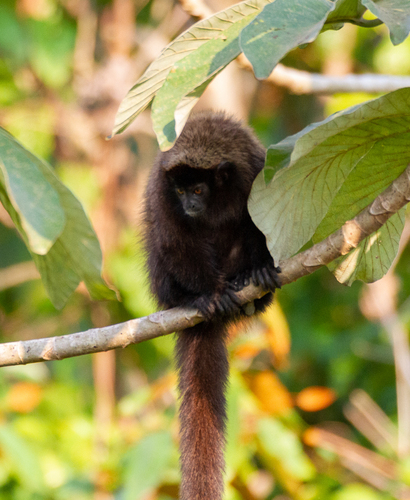
Has soft, dense fur that is typically grayish-brown to reddish-brown on the body, with a pale orange or buff-colored underside and a dark tail. The face is framed by a light-colored band across the forehead, giving it a distinctive appearance among titi monkeys.
Size
Body length approximately 28-38 cm, with a tail length of 38-48 cm.
Weight
Approximately 800-1000 grams for adults, with minimal difference between sexes.
Distinctive features
Distinguished from other Plecturocebus species by its specific coloration pattern, particularly the pale forehead band and reddish tones on the limbs, as well as its restricted geographic range in San Martín.
Differences between males and females
Minimal sexual dimorphism; males and females are similar in size and coloration, typical of monogamous titi monkey species.
Behaviour and diet of the San Martin Titi Monkey
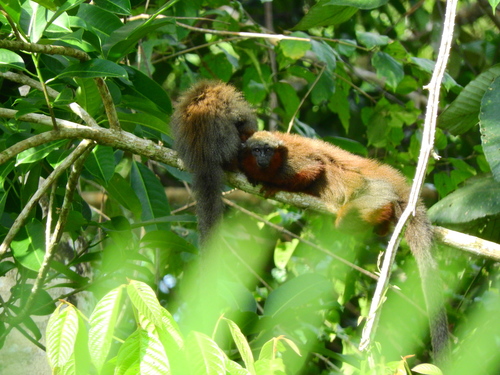
Lives in small monogamous family groups typically consisting of a mated pair and their offspring, usually numbering 2-4 individuals. Pairs display strong social bonds reinforced by tail-twining and mutual grooming.
When it is active
Diurnal, active during daylight hours with peaks in early morning and late afternoon; rests during the hottest midday period.
Diet
Omnivorous, feeding primarily on fruits, supplemented with leaves, flowers, and small invertebrates such as insects.
How it feeds and hunts
Forages by moving through the forest canopy in small groups, using visual and manual searching to locate ripe fruit and insects rather than active predation.
Communication
Communicates through loud duet vocalizations between mated pairs used for territory defense, along with scent marking and physical contact behaviors like tail-twining.
Interactions with other species
Faces predation pressure from raptors and small carnivores; competes with other primate and frugivore species for fruit resources in fragmented habitats.
Role in its ecosystem
Acts as a seed disperser within its forest habitat, contributing to forest regeneration and plant diversity, which is especially important in fragmented and degraded landscapes.
Reproduction and lifecycle
Breeding is generally non-seasonal or weakly seasonal, with gestation lasting about 4.5 months and typically producing a single offspring per birth.
Raising the young
Both parents are involved in raising the young, but the father plays a particularly prominent role in carrying and caring for the infant, a behavior typical of titi monkeys.
Maturity and lifespan
Reaches sexual maturity around 2-3 years of age; lifespan in the wild is estimated at 12-15 years, potentially longer in captivity.
Taxonomy and naming of the San Martin Titi Monkey
Classification
Class Mammalia > Order Primates > Family Pitheciidae > Genus Plecturocebus > Species Plecturocebus oenanthe
Scientific synonyms
Callicebus oenanthe (former genus placement before Pitheciidae taxonomy revision in 2016)
What research says
Recent studies
Recent studies have focused on habitat fragmentation impacts, population genetics, and the effectiveness of community-based conservation concessions in maintaining viable populations in San Martín.
Compared with similar species
Similar to other Plecturocebus species such as Plecturocebus cupreus, but distinguished by its more restricted range, distinct coloration, and higher conservation threat level due to extreme habitat loss.
The San Martin Titi Monkey and people
Mated pairs often intertwine their tails while resting, a behavior thought to strengthen social bonds; they are also known for their loud, coordinated morning duets that can be heard across the forest.
Where and how to see it
Best observed early morning in remaining forest fragments near Moyobamba and the Ojos de Agua Conservation Concession in San Martín, Peru, where local guides can help locate family groups by their distinctive vocal duets.
Risks to humans
No notable risk to humans.
Human uses
Not significantly used by humans; primarily valued for ecotourism and scientific research related to primate conservation.
Countries where the San Martin Titi Monkey is recorded
The 1 countries named in the range description of its IUCN Red List assessment.
Questions about the San Martin Titi Monkey
Where does the San Martin Titi Monkey live?
The San Martin Titi Monkey is recorded in Peru across South America. These countries come from the range description of its IUCN Red List assessment, and they are what place the species on the interactive map.
Is the San Martin Titi Monkey endangered?
Yes. The IUCN Red List assesses the San Martin Titi Monkey as Critically Endangered, one of the three threatened categories. The species faces an extremely high risk of extinction in the wild. This is the last category before extinction, and it is reached through a very small or steeply declining population, a tiny range, or both.
How many are left in the wild?
Estimated at fewer than 10,000 individuals remaining, with a continuing declining trend due to ongoing habitat destruction. This figure comes from the species assessment on the IUCN Red List; population estimates for wild mammals are ranges, not counts, and are revised at each assessment.
What habitat does the San Martin Titi Monkey live in?
Inhabits humid tropical and subtropical lowland and premontane forests, including secondary growth and forest edges.
What is the scientific name of the San Martin Titi Monkey?
The San Martin Titi Monkey is Plecturocebus oenanthe, in the family Pitheciidae, order Primates.
Other species in the genus Plecturocebus
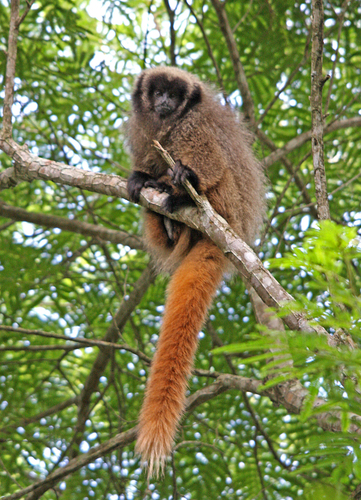
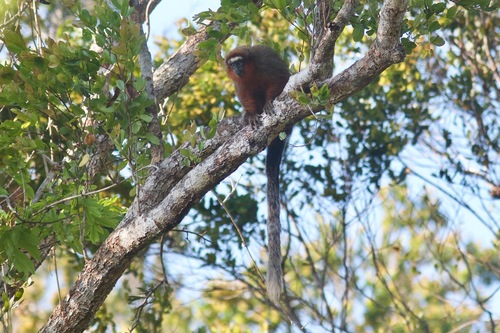
Other species in the family Pitheciidae
Sources
Conservation status, range description and population estimate come from the IUCN Red List assessment for Plecturocebus oenanthe. Countries are derived from that range description, not from a mapped country list. Last refreshed on .
The distribution map is drawn from the IUCN Red List spatial data compiled in 2020. IUCN (International Union for Conservation of Nature)