
Novaes' Bald-headed Uacari
Cacajao novaesi
Red List assessment
Near Threatenedon the IUCN Red List
- EXExtinct
- EWExtinct in the Wild
- CRCritically Endangered
- ENEndangered
- VUVulnerable
- NTNear Threatened
- LCLeast Concern
The Novaes' Bald-headed Uacari is recorded in one country, Brazil across South America. The IUCN Red List assesses the Novaes' Bald-headed Uacari as Near Threatened. Exact population numbers are unknown due to limited field surveys, but the population is believed to be relatively small and potentially declining due to habitat pressures.
- Family
- Pitheciidae
- Order
- Primates
- Genus
- Cacajao
- Countries recorded
- 1
- Continents
- South America
- Red List category
- Near Threatened
- Data updated
- August 9, 2026
What is the Novaes' Bald-headed Uacari?
Novaes' Bald-headed Uacari is a little-known primate endemic to a restricted area of the western Brazilian Amazon, distinguished by its bare, reddish face and short tail. It inhabits seasonally flooded forests along blackwater and whitewater river systems, living in cohesive social groups. Its rarity and limited range make it one of the least studied members of the uakari group, and its taxonomic status remains debated among primatologists.
Where does the Novaes' Bald-headed Uacari live?
Western Brazilian Amazon, specifically the interfluvial region between the Juruá and Purus rivers in the state of Amazonas, Brazil.
Restricted to a small area of the western Brazilian Amazon between the Juruá and Purus rivers in the state of Amazonas. This range is one of the most geographically limited among the bald uakari group, making the species particularly vulnerable to habitat disturbance.
Altitude and depth
Lowland Amazonian rainforest, typically between 50-200 meters above sea level.
Seasonal movements
Movement patterns shift seasonally with river flooding cycles, as groups move between flooded várzea/igapó forest and higher terra firme forest depending on water levels and fruit availability.
Habitat of the Novaes' Bald-headed Uacari
Primarily found in várzea (whitewater flooded) and igapó (blackwater flooded) forests, as well as adjacent terra firme forest during dry seasons. These habitats provide fruiting trees and canopy cover essential for foraging and predator avoidance.
Adaptations to its environment
Its bald, vascularized face may aid in thermoregulation and signaling health status to conspecifics. Strong hind limbs and a short tail assist in efficient movement through the canopy of flooded forests where terrestrial travel is limited by seasonal inundation.
Conservation status and numbers
Classified as Near Threatened (NT) by the IUCN due to its extremely restricted range and ongoing habitat loss, though population declines have not yet reached thresholds for a higher threat category.
Estimated population
Exact population numbers are unknown due to limited field surveys, but the population is believed to be relatively small and potentially declining due to habitat pressures.
What threatens the Novaes' Bald-headed Uacari?
Deforestation for agriculture and logging, habitat fragmentation, and hunting pressure in parts of its range are the primary threats. Its small geographic range increases vulnerability to any localized habitat destruction.
Diseases and parasites
Specific disease and parasite data are lacking, though like other primates it is likely susceptible to gastrointestinal parasites and arboviruses present in Amazonian wildlife.
What is being done to protect it?
Some populations may occur within protected areas of the Amazonas state reserve network, though specific protections targeting this species are limited. Broader Amazon conservation initiatives indirectly benefit its habitat.
Recommended actions
Priority actions include conducting comprehensive population surveys, establishing dedicated protected areas within its range, and increasing enforcement against illegal logging and hunting in the Juruá-Purus interfluve.
What the Novaes' Bald-headed Uacari looks like
Features a bald, reddish or pinkish face contrasting with a coat that ranges from pale gray to whitish or cream-colored fur, shorter than that of the red uakari. The short, bushy tail is a hallmark of the genus.
Size
Body length approximately 40-48 cm, with a short tail of about 15-18 cm, typical of the bald uakari group.
Weight
Adults typically weigh between 2.5 and 3.5 kg, with limited data on sex-based differences.
Distinctive features
Distinguished from other Cacajao species primarily by subtle differences in fur coloration (paler, more grayish-white tones) and its highly restricted geographic range compared to the more widespread red and black-headed uakaris.
Differences between males and females
Sexual dimorphism appears minimal, with males and females similar in size and coloration, though detailed studies are lacking.
Behaviour and diet of the Novaes' Bald-headed Uacari
Lives in cohesive social groups, likely ranging from 10 to 30 individuals, consistent with other uakari species, exhibiting fission-fusion dynamics depending on food availability.
When it is active
Diurnal, active during daylight hours foraging in the forest canopy and resting during midday heat.
Diet
Primarily frugivorous, feeding heavily on seeds and unripe fruits, supplemented with leaves, flowers, and occasionally insects, similar to other uakari species with specialized seed-predating dentition.
Communication
Communication likely includes vocalizations such as barks and chirps, facial expressions involving the bare colored face, and scent marking, similar to congeners in the genus Cacajao.
Interactions with other species
Potential predators include large raptors and felids such as ocelots or jaguars; the species may compete with other frugivorous primates for fruiting resources in overlapping habitats.
Role in its ecosystem
Acts as a seed predator and occasional seed disperser within its forest ecosystem, influencing plant community dynamics through selective feeding on seeds and unripe fruits.
Reproduction and lifecycle
Breeding likely follows a seasonal pattern tied to fruit abundance, with females giving birth to a single offspring after a gestation period estimated around 180 days, based on related Cacajao species.
Raising the young
Mothers provide primary care, carrying and nursing infants for several months, while other group members may show limited allomaternal interest, as observed in related uakari species.
Maturity and lifespan
Sexual maturity is estimated around 4-5 years based on related species; lifespan in the wild is unknown but may reach 15-20 years, with captivity data unavailable due to the species not being commonly held.
Taxonomy and naming of the Novaes' Bald-headed Uacari
Classification
Class Mammalia > Order Primates > Family Pitheciidae > Genus Cacajao > Species Cacajao novaesi
Scientific synonyms
Sometimes classified as Cacajao calvus novaesi, a subspecies of the bald uakari complex rather than a full species.
What research says
Recent studies
Recent taxonomic reassessments continue to debate whether Cacajao novaesi warrants full species status or should remain a subspecies of Cacajao calvus, with genetic studies ongoing to clarify relationships within the genus.
Compared with similar species
Compared to the red uakari (Cacajao calvus calvus), Novaes' uakari has paler, more grayish-white fur rather than the vivid reddish-orange coat, while sharing the characteristic bald red face and short tail.
The Novaes' Bald-headed Uacari and people
The bald, bright face of uakaris is thought to signal health, as pale or dull faces may indicate illness such as malaria. Novaes' uakari is one of the rarest and least photographed primates in the Amazon due to its remote habitat.
Where and how to see it
Observation is extremely difficult due to the species' remote range and limited accessibility; specialized ecotourism expeditions into the Juruá-Purus interfluve during the dry season offer the best, though rare, chances of sighting.
Risks to humans
No notable risk to humans.
Human uses
No significant documented human uses; the species is not commonly hunted for bushmeat or trade compared to other regional primates, though local subsistence hunting may occasionally occur.
Countries where the Novaes' Bald-headed Uacari is recorded
The 1 countries named in the range description of its IUCN Red List assessment.
Questions about the Novaes' Bald-headed Uacari
Where does the Novaes' Bald-headed Uacari live?
The Novaes' Bald-headed Uacari is recorded in Brazil across South America. These countries come from the range description of its IUCN Red List assessment, and they are what place the species on the interactive map.
Is the Novaes' Bald-headed Uacari endangered?
The IUCN Red List assesses the Novaes' Bald-headed Uacari as Near Threatened. The species does not qualify as threatened today, but it is close to the thresholds and likely to cross them soon. It is the category that most often changes at the next assessment.
How many are left in the wild?
Exact population numbers are unknown due to limited field surveys, but the population is believed to be relatively small and potentially declining due to habitat pressures. This figure comes from the species assessment on the IUCN Red List; population estimates for wild mammals are ranges, not counts, and are revised at each assessment.
What habitat does the Novaes' Bald-headed Uacari live in?
Primarily found in várzea (whitewater flooded) and igapó (blackwater flooded) forests, as well as adjacent terra firme forest during dry seasons.
What is the scientific name of the Novaes' Bald-headed Uacari?
The Novaes' Bald-headed Uacari is Cacajao novaesi, in the family Pitheciidae, order Primates.
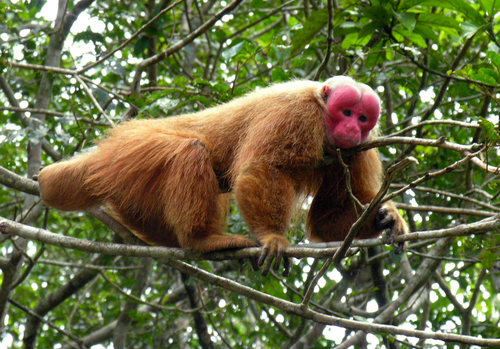
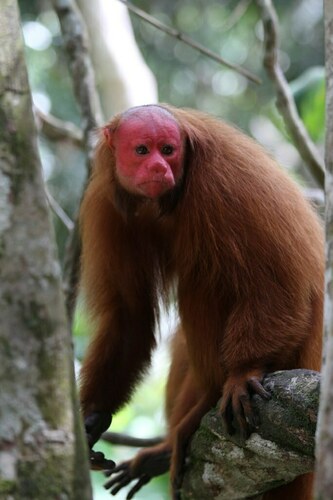
Other species in the genus Cacajao
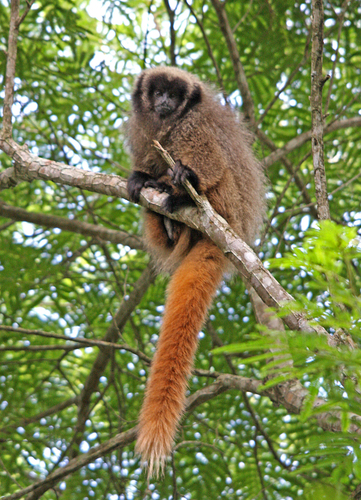
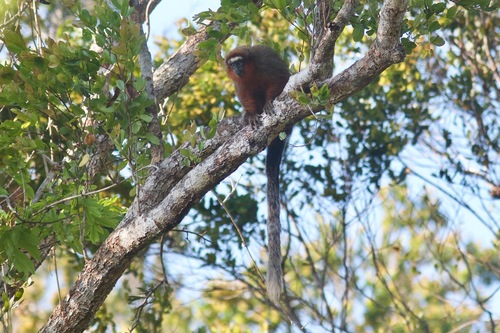
Other species in the family Pitheciidae
Sources
Conservation status, range description and population estimate come from the IUCN Red List assessment for Cacajao novaesi. Countries are derived from that range description, not from a mapped country list. Last refreshed on .
The distribution map is drawn from the IUCN Red List spatial data compiled in 2024. IUCN (International Union for Conservation of Nature)