
White-nosed Saki
Chiropotes albinasus
Red List assessment
Vulnerableon the IUCN Red List
- EXExtinct
- EWExtinct in the Wild
- CRCritically Endangered
- ENEndangered
- VUVulnerable
- NTNear Threatened
- LCLeast Concern
The White-nosed Saki is recorded in one country, Brazil across South America. The IUCN Red List assesses the White-nosed Saki as Vulnerable. Exact population size is unknown but is inferred to be declining due to continuing habitat loss across its range; considered uncommon to locally common in remaining intact forest fragments.
- Family
- Pitheciidae
- Order
- Primates
- Genus
- Chiropotes
- Countries recorded
- 1
- Continents
- South America
- Red List category
- Vulnerable
- Data updated
- August 9, 2026
What is the White-nosed Saki?
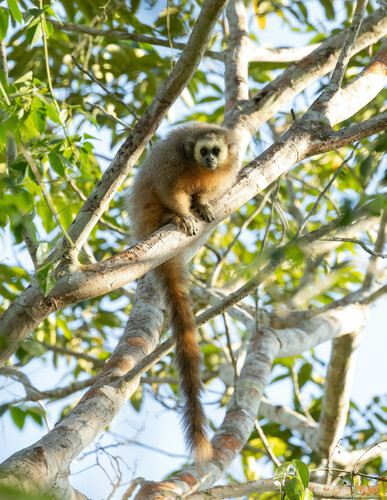
The White-nosed Saki is a medium-sized New World monkey endemic to the southern Amazon basin in Brazil, easily recognized by its striking pale pink to white muzzle contrasting with its dark fur. It lives in the upper canopy of undisturbed tropical rainforest and is a specialized seed predator. This species is remarkable for its bushy tail, distinctive beard, and its dependence on large tracts of continuous primary forest, making it highly sensitive to deforestation.
Where does the White-nosed Saki live?
Brazil, south of the Amazon River, primarily in the states of Pará, Mato Grosso, Amazonas and Maranhão
Endemic to Brazil, south of the Amazon River, ranging through the states of Pará, Amazonas, Mato Grosso, and parts of Maranhão within the 'arc of deforestation'. Its range is bounded by major rivers such as the Tapajós and Xingu, which limit gene flow between populations.
Altitude and depth
Lowland tropical forest, generally below 500 meters elevation
Seasonal movements
No true migration or hibernation; however, movement patterns and diet shift seasonally following the availability of fruiting and seeding trees, with greater reliance on immature seeds during specific fruiting seasons.
Habitat of the White-nosed Saki
Primarily found in terra firme (non-flooded) primary tropical rainforest with a closed canopy, though it can also occur in seasonally flooded forests along rivers. It prefers tall, mature forest with abundant fruiting trees and avoids heavily disturbed or fragmented habitats.
Adaptations to its environment
Possesses specialized, robust jaws and teeth adapted for cracking hard, unripe fruit husks to access seeds unavailable to other frugivores. Its long, non-prehensile bushy tail aids in balance during arboreal locomotion, and strong hindlimbs allow for powerful leaping between canopy trees.
Conservation status and numbers
Classified as Vulnerable (VU) by the IUCN due to ongoing habitat loss and fragmentation from deforestation across its restricted range, with population declines estimated to continue into the future. Its endemic and restricted distribution in a heavily deforested region of Brazil increases its vulnerability.
Estimated population
Exact population size is unknown but is inferred to be declining due to continuing habitat loss across its range; considered uncommon to locally common in remaining intact forest fragments.
What threatens the White-nosed Saki?
Primary threats include large-scale deforestation for cattle ranching and soybean agriculture, logging, road construction, and habitat fragmentation. Hunting for bushmeat and the pet trade also pose localized pressures.
Diseases and parasites
Specific data are limited, but like other Neotropical primates it is likely susceptible to internal parasites such as nematodes and protozoan infections, as well as arboviruses circulating in Amazonian wildlife.
What is being done to protect it?
The species occurs in several protected areas including Tapajós National Forest and other reserves within the Brazilian Amazon; it is also protected under Brazilian wildlife law and listed on CITES Appendix II. Conservation organizations monitor populations and advocate for expanded protected area networks.
Recommended actions
Priority actions include strengthening enforcement of protected areas, creating forest corridors to reconnect fragmented habitat, curbing illegal deforestation and hunting, and conducting further population surveys to refine conservation status.
What the White-nosed Saki looks like
The body is covered in dense black fur, with a distinctive bright pink to white muzzle devoid of fur, giving the species its common name. The tail is thick, bushy, and non-prehensile, and the face (aside from the nose) is typically black.
Size
Head-body length approximately 33-46 cm, with a bushy tail of similar or greater length (35-45 cm)
Weight
Adults typically weigh between 2.5 and 3.5 kg, with males slightly larger than females
Distinctive features
The bare, pale pink-to-white nose is unique among Chiropotes species and immediately distinguishes it from the bearded sakis (Chiropotes satanas and relatives), which have entirely dark faces. Its bushy tail and beard-like facial hair also give it a bat-like or bearded appearance.
Differences between males and females
Sexual dimorphism is minimal, with males being only slightly larger and heavier than females; coloration is essentially the same between sexes.
Behaviour and diet of the White-nosed Saki
Highly social, living in multi-male, multi-female groups ranging from about 8 to over 30 individuals, sometimes fissioning into smaller subgroups while foraging. Groups show cohesive social bonds and coordinated movement through the canopy.
When it is active
Diurnal, active during daylight hours with peak activity in the morning and late afternoon; rests during the hottest midday period.
Diet
Primarily a seed predator (sclerocarpic frugivore), feeding on immature seeds extracted from hard, unripe fruit pods; it also consumes ripe fruit, flowers, and occasionally insects and leaves.
How it feeds and hunts
Uses strong jaws and specialized incisors to crack open hard fruit husks to extract immature seeds, a foraging strategy that reduces competition with other frugivores relying on ripe fruit.
Communication
Communicates through a range of vocalizations including contact calls, alarm calls, and grunts to maintain group cohesion in dense canopy; also uses body postures and tail movements as visual signals.
Interactions with other species
Predators include large raptors such as harpy eagles and forest felids such as ocelots and margays; it competes with other frugivorous primates and birds for fruiting resources but reduces competition through its seed-predation niche.
Role in its ecosystem
Plays an important ecological role as a seed predator, influencing plant population dynamics by consuming seeds before they mature, thereby affecting forest regeneration patterns and plant community composition.
Reproduction and lifecycle
Breeding is seasonal, often linked to fruiting cycles, with gestation lasting approximately 5 months; females typically give birth to a single offspring.
Raising the young
Mothers provide the primary care, carrying and nursing the infant for several months; other group members, including juveniles, may show interest in and occasionally assist with infant care.
Maturity and lifespan
Sexual maturity is reached at around 3-4 years of age; lifespan in the wild is estimated at 15-20 years, potentially longer in captivity.
Taxonomy and naming of the White-nosed Saki
Classification
Mammalia > Primates > Pitheciidae > Chiropotes > Chiropotes albinasus
Scientific synonyms
Pithecia albinasa (original combination); sometimes previously treated as a subspecies of Chiropotes satanas
What research says
Recent studies
Recent studies have used genetic and ecological data to refine understanding of Chiropotes species boundaries and to assess the impacts of Amazonian deforestation on population connectivity and viability.
Genome and DNA
Specific chromosome number and detailed genomic studies are not widely documented, though molecular phylogenetic studies have helped clarify its relationships within the genus Chiropotes.
Compared with similar species
Compared to its closest relatives in the genus Chiropotes (such as C. satanas and C. chiropotes), the White-nosed Saki is distinguished by its unique pale nose, while other bearded sakis retain fully dark faces; body size and social structure are broadly similar across the genus.
The White-nosed Saki and people
Its bright pink-white nose stands out vividly against otherwise entirely black fur, unlike any other primate in its genus. It is one of the few primates specialized enough to habitually crack open unripe, hard fruit husks just to eat the seeds inside. Despite its striking appearance, it remains one of the lesser-studied Amazonian primates.
Where and how to see it
Best observed in protected forest reserves such as Tapajós National Forest in Pará, Brazil, during early morning or late afternoon when groups are actively foraging in the canopy. Patience and knowledge of local fruiting tree locations greatly increase chances of sighting, ideally with an experienced local guide.
Risks to humans
No notable risk to humans; it is a shy, arboreal species that avoids direct contact with people.
Human uses
Not commonly used commercially, though it may be hunted locally for bushmeat in some areas and is occasionally captured for the illegal pet trade.
Countries where the White-nosed Saki is recorded
The 1 countries named in the range description of its IUCN Red List assessment.
Questions about the White-nosed Saki
Where does the White-nosed Saki live?
The White-nosed Saki is recorded in Brazil across South America. These countries come from the range description of its IUCN Red List assessment, and they are what place the species on the interactive map.
Is the White-nosed Saki endangered?
Yes. The IUCN Red List assesses the White-nosed Saki as Vulnerable, one of the three threatened categories. The species faces a high risk of extinction in the wild. It is the first of the three threatened categories: numbers are falling, the range is shrinking, or the population is small enough that a single bad event could do lasting damage.
How many are left in the wild?
Exact population size is unknown but is inferred to be declining due to continuing habitat loss across its range; considered uncommon to locally common in remaining intact forest fragments. This figure comes from the species assessment on the IUCN Red List; population estimates for wild mammals are ranges, not counts, and are revised at each assessment.
What habitat does the White-nosed Saki live in?
Primarily found in terra firme (non-flooded) primary tropical rainforest with a closed canopy, though it can also occur in seasonally flooded forests along rivers.
What is the scientific name of the White-nosed Saki?
The White-nosed Saki is Chiropotes albinasus, in the family Pitheciidae, order Primates.
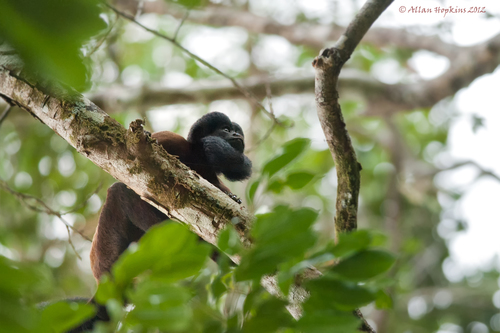
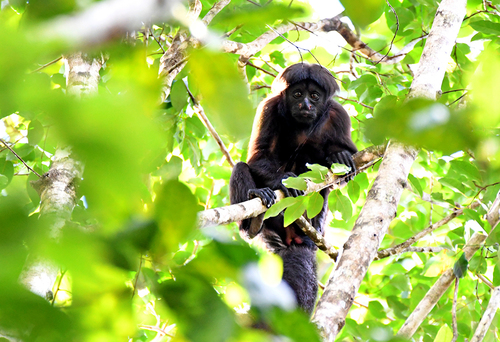
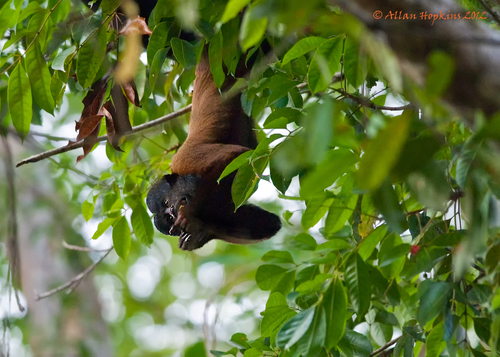
Other species in the genus Chiropotes
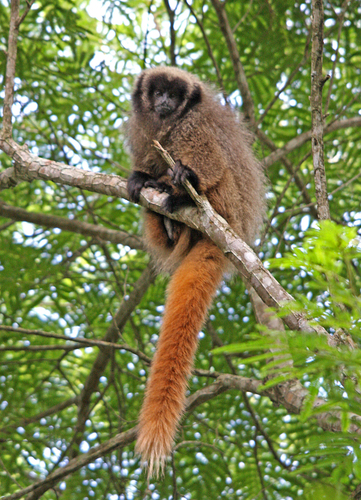
Other species in the family Pitheciidae
Species that share its range
Sources
Conservation status, range description and population estimate come from the IUCN Red List assessment for Chiropotes albinasus. Countries are derived from that range description, not from a mapped country list. Last refreshed on .
The distribution map is drawn from the IUCN Red List spatial data compiled in 2008. IUCN (International Union for Conservation of Nature)