
Olalla Brothers' Titi
Plecturocebus olallae
Red List assessment
Critically Endangeredon the IUCN Red List
- EXExtinct
- EWExtinct in the Wild
- CRCritically Endangered
- ENEndangered
- VUVulnerable
- NTNear Threatened
- LCLeast Concern
The Olalla Brothers' Titi is recorded in one country, Bolivia across South America. The IUCN Red List assesses the Olalla Brothers' Titi as Critically Endangered. Estimated at fewer than 5,000 individuals, with a declining population trend due to continued habitat loss.
- Family
- Pitheciidae
- Order
- Primates
- Genus
- Plecturocebus
- Countries recorded
- 1
- Continents
- South America
- Red List category
- Critically Endangered
- Data updated
- August 9, 2026
What is the Olalla Brothers' Titi?
The Olalla Brothers' Titi is a small, critically endangered New World monkey endemic to a tiny area of northern Bolivia. It is one of the rarest primates in South America, known from only a few isolated forest fragments. Its restricted range and ongoing habitat loss make it a top conservation priority. The species was named after the Olalla brothers, Ecuadorian naturalist-collectors of the early 20th century.
Where does the Olalla Brothers' Titi live?
Bolivia (Beni Department)
Endemic to a very small region in the Beni Department of northern Bolivia, near the town of Santa Rosa. Its total known range covers less than 500 km², among the smallest of any primate species.
Altitude and depth
Approximately 150-250 meters above sea level
Seasonal movements
No long-distance migration; activity patterns may shift slightly with seasonal flooding that affects forest accessibility.
Habitat of the Olalla Brothers' Titi
Inhabits seasonally flooded and gallery forests, as well as forest islands within savanna mosaics in the Beni lowlands. It relies on dense forest patches surrounded by open grassland, making it highly sensitive to fragmentation.
Adaptations to its environment
Adapted to arboreal life in fragmented forest patches, with a prehensile tail (non-grasping but used for balance) and strong limbs for agile movement through the canopy. Its diet flexibility allows survival in small, resource-limited forest islands.
Conservation status and numbers
Critically Endangered (CR) according to IUCN due to an extremely restricted geographic range, ongoing habitat fragmentation, and a very small, declining population confined to isolated forest patches.
Estimated population
Estimated at fewer than 5,000 individuals, with a declining population trend due to continued habitat loss.
What threatens the Olalla Brothers' Titi?
Habitat destruction from cattle ranching, agricultural expansion, and forest clearing for pasture are the primary threats. Fragmentation isolates populations, reducing genetic diversity and increasing local extinction risk.
What is being done to protect it?
Some populations occur within private reserves and protected areas in Beni, and conservation organizations have proposed habitat corridors. Research and monitoring programs have been initiated to better understand its distribution and ecology.
Recommended actions
Priority actions include establishing formal protected areas covering its full range, creating forest corridors between fragments, and engaging local communities in sustainable land-use practices to prevent further deforestation.
What the Olalla Brothers' Titi looks like
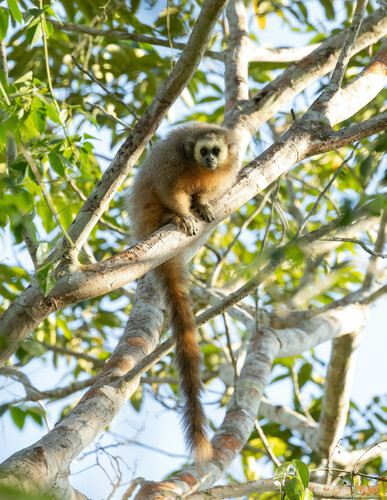
Has a grayish-brown to reddish-brown coat with lighter underparts, and a long bushy tail. The face is typically pale or grayish with dark markings around the eyes.
Size
Body length approximately 28-38 cm, with a non-prehensile tail of similar or greater length (30-40 cm).
Weight
Approximately 700-900 grams for adults, with minimal difference between sexes.
Distinctive features
Distinguished from closely related titi species by subtle differences in fur coloration and its extremely restricted, isolated geographic range in Bolivia.
Behaviour and diet of the Olalla Brothers' Titi
Lives in small monogamous family groups typically consisting of a mated pair and their offspring, usually 2-4 individuals per group. Groups defend small territories against neighboring family units.
When it is active
Diurnal, active during daylight hours foraging and moving through the forest canopy.
Diet
Primarily frugivorous, supplementing its diet with leaves, seeds, and occasionally insects. Fruit availability strongly influences ranging behavior within small forest patches.
Communication
Uses loud, distinctive duetting vocalizations between mated pairs to maintain pair bonds and defend territory. Tail-twining and physical contact also serve as social bonding behaviors.
Interactions with other species
Faces predation pressure from raptors and small carnivores; limited data exists on specific predator-prey dynamics due to its rarity and restricted range.
Role in its ecosystem
Plays a role in seed dispersal within its fragmented forest habitat, contributing to forest regeneration and plant diversity in the small patches it inhabits.
Reproduction and lifecycle
Believed to follow a similar pattern to related titi species, with a single offspring born after a gestation period of approximately 4-5 months. Breeding likely occurs once per year.
Raising the young
Both parents, particularly the father, are heavily involved in carrying and caring for the infant, a behavior typical of titi monkeys. The infant is carried primarily by the male except during nursing.
Maturity and lifespan
Sexual maturity is reached around 2-3 years of age; lifespan in the wild is estimated at 12-15 years, potentially longer in captivity, though specific data for this species is limited.
Taxonomy and naming of the Olalla Brothers' Titi
Classification
Mammalia > Primates > Pitheciidae > Plecturocebus > Plecturocebus olallae
Scientific synonyms
Callicebus olallae
What research says
Recent studies
Recent surveys have focused on mapping the species' precise distribution and remaining forest fragments to inform conservation planning, given how little was historically known about this species.
Compared with similar species
Closely resembles other Bolivian titi monkeys such as Plecturocebus modestus, but differs in range and some pelage characteristics; both species are similarly threatened by habitat loss in the same region.
The Olalla Brothers' Titi and people
This species is one of the rarest primates in the world, known from an area smaller than many cities. Its entire global range could fit within a small conservation reserve, highlighting the extreme vulnerability of highly localized species.
Where and how to see it
Observation opportunities are extremely limited due to its restricted range and rarity; visits would require coordination with local researchers or conservation organizations working in the Beni region of Bolivia.
Risks to humans
No notable risk
Countries where the Olalla Brothers' Titi is recorded
The 1 countries named in the range description of its IUCN Red List assessment.
Questions about the Olalla Brothers' Titi
Where does the Olalla Brothers' Titi live?
The Olalla Brothers' Titi is recorded in Bolivia across South America. These countries come from the range description of its IUCN Red List assessment, and they are what place the species on the interactive map.
Is the Olalla Brothers' Titi endangered?
Yes. The IUCN Red List assesses the Olalla Brothers' Titi as Critically Endangered, one of the three threatened categories. The species faces an extremely high risk of extinction in the wild. This is the last category before extinction, and it is reached through a very small or steeply declining population, a tiny range, or both.
How many are left in the wild?
Estimated at fewer than 5,000 individuals, with a declining population trend due to continued habitat loss. This figure comes from the species assessment on the IUCN Red List; population estimates for wild mammals are ranges, not counts, and are revised at each assessment.
What habitat does the Olalla Brothers' Titi live in?
Inhabits seasonally flooded and gallery forests, as well as forest islands within savanna mosaics in the Beni lowlands.
What is the scientific name of the Olalla Brothers' Titi?
The Olalla Brothers' Titi is Plecturocebus olallae, in the family Pitheciidae, order Primates.
Other species in the genus Plecturocebus
Other species in the family Pitheciidae
Sources
Conservation status, range description and population estimate come from the IUCN Red List assessment for Plecturocebus olallae. Countries are derived from that range description, not from a mapped country list. Last refreshed on .
The distribution map is drawn from the IUCN Red List spatial data compiled in 2020. IUCN (International Union for Conservation of Nature)