
Ucayali Bald-headed Uacari
Cacajao ucayalii
Red List assessment
Vulnerableon the IUCN Red List
- EXExtinct
- EWExtinct in the Wild
- CRCritically Endangered
- ENEndangered
- VUVulnerable
- NTNear Threatened
- LCLeast Concern
The Ucayali Bald-headed Uacari is recorded in 2 countries across South America. The IUCN Red List assesses the Ucayali Bald-headed Uacari as Vulnerable. Exact population numbers are unknown, but the species is believed to be declining due to ongoing habitat degradation and hunting.
- Family
- Pitheciidae
- Order
- Primates
- Genus
- Cacajao
- Countries recorded
- 2
- Continents
- South America
- Red List category
- Vulnerable
- Data updated
- August 9, 2026
What is the Ucayali Bald-headed Uacari?
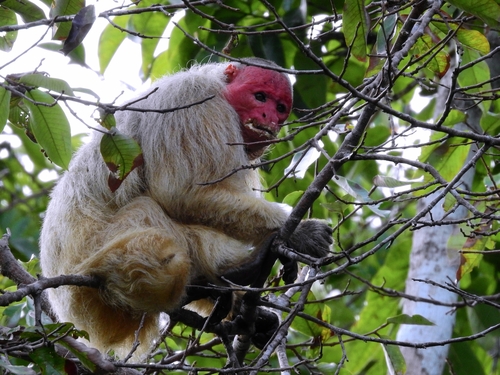
The Ucayali Bald-headed Uacari is a striking Amazonian primate known for its bright red, bald face and reddish-orange fur. It inhabits flooded and seasonally inundated forests in eastern Peru. This species is remarkable for its distinctive facial coloration and its strong ecological ties to várzea forest ecosystems. It is one of several taxa within the Cacajao calvus species complex.
Where does the Ucayali Bald-headed Uacari live?
Peru, in the western Amazon basin between the Ucayali and Javari rivers
Restricted to a limited area in eastern Peru, mainly along the Ucayali River and its tributaries, extending toward the Peru-Brazil border region.
Altitude and depth
Generally found at low elevations, typically below 400m in the Amazon lowlands.
Seasonal movements
Movements are linked to seasonal flooding cycles, with the species shifting between flooded and non-flooded forest areas depending on water levels.
Habitat of the Ucayali Bald-headed Uacari
Primarily found in seasonally flooded várzea and igapó forests, as well as terra firme forest near river systems; often associated with palm swamps and riparian vegetation.
Adaptations to its environment
Adapted to flooded forest environments with strong climbing and leaping abilities to navigate the forest canopy during high water periods; specialized dentition for cracking hard seeds and unripe fruits.
Conservation status and numbers
Classified as Vulnerable (VU) by the IUCN due to habitat loss, hunting pressure, and a restricted geographic range that makes the species particularly susceptible to local extinctions.
Estimated population
Exact population numbers are unknown, but the species is believed to be declining due to ongoing habitat degradation and hunting.
What threatens the Ucayali Bald-headed Uacari?
Deforestation for agriculture and logging, hunting for bushmeat, and habitat fragmentation from human settlement expansion along river systems.
Diseases and parasites
Susceptible to various gastrointestinal parasites common in wild primates; specific studies on this species are limited.
What is being done to protect it?
Some populations occur within protected areas in Peru, though enforcement and habitat protection remain limited; included in regional conservation assessments for Amazonian primates.
Recommended actions
Expand protected area coverage in its range, strengthen anti-poaching enforcement, and conduct further population surveys to better assess conservation status.
What the Ucayali Bald-headed Uacari looks like
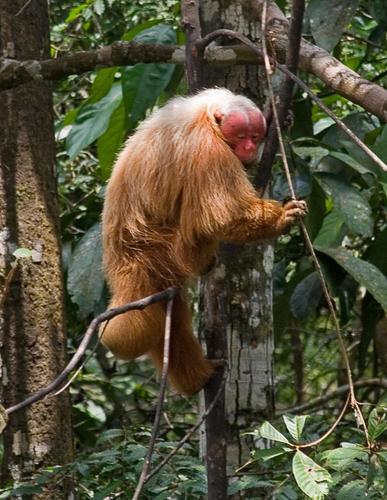
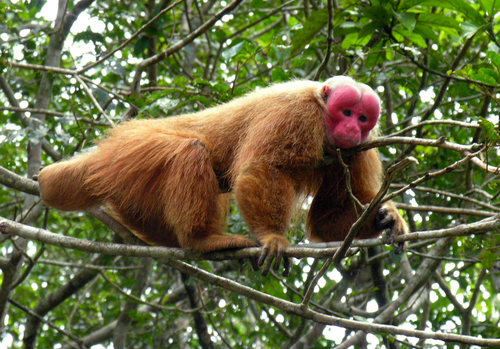
Distinguished by a bald, bright red face contrasting with dense reddish-orange to chestnut fur covering the body; the tail is notably short compared to other New World monkeys.
Size
Body length approximately 40-50 cm, with a short tail of about 15-18 cm.
Weight
Typically weighs between 2.5 and 3.5 kg.
Distinctive features
Distinguished from other Cacajao taxa by subtle differences in fur coloration and geographic range; shares the bald red face typical of the calvus group but with a more localized distribution.
Differences between males and females
Minimal sexual dimorphism; males and females are similar in size and coloration.
Behaviour and diet of the Ucayali Bald-headed Uacari
Lives in social groups that can range from a few individuals to over 20, sometimes forming larger fission-fusion communities while foraging.
When it is active
Diurnal, active during daylight hours foraging in the forest canopy.
Diet
Primarily frugivorous, with a strong preference for seeds, including unripe and hard-shelled fruits; also consumes leaves, flowers, and occasionally insects.
Communication
Uses vocalizations such as loud calls for group coordination and alarm, along with facial expressions and body postures for social signaling.
Interactions with other species
Preyed upon by large raptors and felids such as jaguars and ocelots; may compete with other frugivorous primates for fruiting resources.
Role in its ecosystem
Plays an important role as a seed disperser and seed predator within flooded forest ecosystems, influencing plant community composition.
Reproduction and lifecycle
Breeding is not tightly seasonal; females typically give birth to a single offspring after a gestation period of about 5-6 months.
Raising the young
Mothers provide primary care, nursing and carrying the infant for several months until it becomes more independent.
Maturity and lifespan
Sexual maturity is reached around 4-5 years; lifespan in the wild is estimated at 15-20 years, potentially longer in captivity.
Taxonomy and naming of the Ucayali Bald-headed Uacari
Classification
Mammalia > Primates > Pitheciidae > Cacajao > Cacajao ucayalii
Scientific synonyms
Sometimes classified as a subspecies of Cacajao calvus (Cacajao calvus ucayalii)
What research says
Recent studies
Recent taxonomic studies continue to debate the species-level status of Cacajao ucayalii versus its classification as a subspecies of Cacajao calvus, based on genetic and morphological analyses.
Compared with similar species
Closely related to other bald-headed uacaris such as Cacajao calvus calvus and Cacajao calvus novaesi, differing mainly in fur color intensity and geographic range rather than major morphological traits.
The Ucayali Bald-headed Uacari and people
Its bright red face is thought to signal health status, similar to some birds; the bald head has no functional purpose related to thermoregulation confirmed yet, making it a topic of ongoing scientific curiosity.
Where and how to see it
Best observed in remote flooded forest reserves in eastern Peru during the dry season when groups are more concentrated near remaining fruiting trees; requires guided boat and forest excursions due to remote habitat.
Risks to humans
No notable risk to humans.
Human uses
Hunted locally for bushmeat in some areas, though not commercially traded internationally due to conservation status.
Countries where the Ucayali Bald-headed Uacari is recorded
The 2 countries named in the range description of its IUCN Red List assessment.
Questions about the Ucayali Bald-headed Uacari
Where does the Ucayali Bald-headed Uacari live?
The Ucayali Bald-headed Uacari is recorded in Brazil and Peru across South America. These countries come from the range description of its IUCN Red List assessment, and they are what place the species on the interactive map.
Is the Ucayali Bald-headed Uacari endangered?
Yes. The IUCN Red List assesses the Ucayali Bald-headed Uacari as Vulnerable, one of the three threatened categories. The species faces a high risk of extinction in the wild. It is the first of the three threatened categories: numbers are falling, the range is shrinking, or the population is small enough that a single bad event could do lasting damage.
How many are left in the wild?
Exact population numbers are unknown, but the species is believed to be declining due to ongoing habitat degradation and hunting. This figure comes from the species assessment on the IUCN Red List; population estimates for wild mammals are ranges, not counts, and are revised at each assessment.
What habitat does the Ucayali Bald-headed Uacari live in?
Primarily found in seasonally flooded várzea and igapó forests, as well as terra firme forest near river systems; often associated with palm swamps and riparian vegetation.
What is the scientific name of the Ucayali Bald-headed Uacari?
The Ucayali Bald-headed Uacari is Cacajao ucayalii, in the family Pitheciidae, order Primates.
Other species in the genus Cacajao
Other species in the family Pitheciidae
Sources
Conservation status, range description and population estimate come from the IUCN Red List assessment for Cacajao ucayalii. Countries are derived from that range description, not from a mapped country list. Last refreshed on .
The distribution map is drawn from the IUCN Red List spatial data compiled in 2024. IUCN (International Union for Conservation of Nature)