
Hershkovitz's Titi
Plecturocebus dubius
Red List assessment
Least Concernon the IUCN Red List
- EXExtinct
- EWExtinct in the Wild
- CRCritically Endangered
- ENEndangered
- VUVulnerable
- NTNear Threatened
- LCLeast Concern
The Hershkovitz's Titi is recorded in one country, Brazil across South America. The IUCN Red List assesses the Hershkovitz's Titi as Least Concern. No precise global population estimate exists; presumed stable but likely declining slowly in areas with active deforestation.
- Family
- Pitheciidae
- Order
- Primates
- Genus
- Plecturocebus
- Countries recorded
- 1
- Continents
- South America
- Red List category
- Least Concern
- Data updated
- August 9, 2026
What is the Hershkovitz's Titi?
Hershkovitz's Titi is a small New World monkey endemic to the Brazilian Amazon, named in honor of primatologist Philip Hershkovitz who extensively studied titi monkey taxonomy. It inhabits lowland tropical rainforest along interfluvial regions of the Amazon basin. Like other titis, it is notable for forming strong monogamous pair bonds and displaying tail-twining behavior between partners. The species remains relatively understudied compared to other titi monkeys.
Where does the Hershkovitz's Titi live?
Brazil, in the central Amazon basin
Found in the central Brazilian Amazon, generally between the Purus and Madeira rivers, within the state of Amazonas. Its range is delimited by major Amazonian rivers which act as biogeographic barriers for titi monkey species.
Altitude and depth
Lowland tropical forest, typically below 200m elevation
Seasonal movements
No true migration or hibernation; activity patterns may shift slightly with wet and dry seasons due to fruit availability.
Habitat of the Hershkovitz's Titi
Primarily lowland tropical rainforest, including terra firme (non-flooded) forest and areas near forest edges. It favors dense understory vegetation and mid-canopy layers for movement and foraging.
Adaptations to its environment
Long prehensile-like tail (non-grasping but used for balance) aids arboreal locomotion; strong hind limbs allow leaping between branches. Monogamous pair bonding and tail-twining behavior strengthen social cohesion in dense forest environments where visual contact is limited.
Conservation status and numbers
Listed as Least Concern by the IUCN, reflecting a relatively stable population without severe range-wide decline, though localized habitat loss is a concern.
Estimated population
No precise global population estimate exists; presumed stable but likely declining slowly in areas with active deforestation.
What threatens the Hershkovitz's Titi?
Deforestation for agriculture, cattle ranching, and infrastructure development in the Amazon; habitat fragmentation from logging and road construction.
Diseases and parasites
Specific data limited, but likely susceptible to common primate parasites such as intestinal helminths and ectoparasites.
What is being done to protect it?
Benefits indirectly from protected areas and indigenous reserves within its Amazonian range; no species-specific conservation program is documented.
Recommended actions
Increased population surveys to clarify range and abundance, protection of remaining forest habitat from deforestation, and monitoring of taxonomic status given ongoing revisions within the Plecturocebus genus.
What the Hershkovitz's Titi looks like
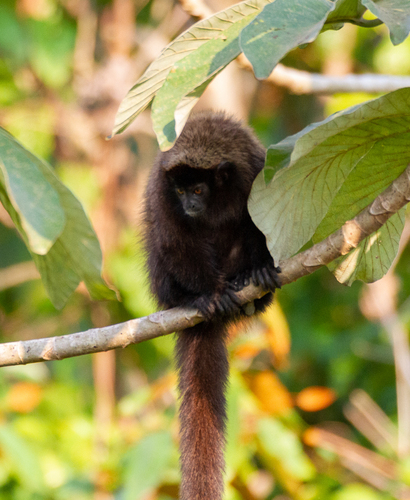
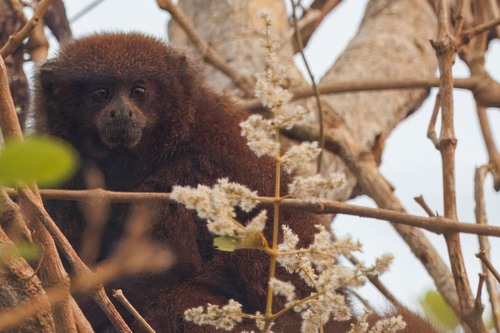
Overall grayish-brown to reddish-brown fur with a paler underside; some individuals show a reddish tinge on the tail and limbs. The face is typically dark, and fur texture is dense and soft.
Size
Head-body length approximately 28-38 cm, with a tail of roughly 35-45 cm
Weight
Approximately 0.8-1.2 kg for adults of both sexes
Distinctive features
Distinguished from closely related titi species primarily by subtle differences in pelage coloration and geographic range rather than dramatic morphological differences.
Differences between males and females
Minimal sexual dimorphism; males and females are similar in size and coloration.
Behaviour and diet of the Hershkovitz's Titi
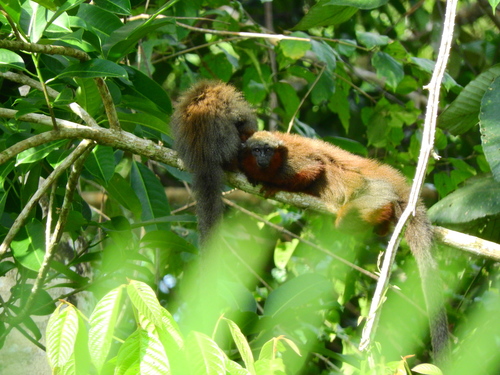
Lives in small monogamous family groups typically consisting of a mated pair and their offspring, usually 2-4 individuals total. Strong social bonds are reinforced through grooming and tail-twining while resting.
When it is active
Diurnal, active during daylight hours with peaks in early morning and late afternoon; rests during midday heat.
Diet
Primarily frugivorous, supplemented with young leaves, flowers, and occasionally insects.
Communication
Uses loud, coordinated duet calls between mates to defend territory and reinforce pair bonds; also relies on scent marking and physical contact such as tail-twining.
Interactions with other species
Predated upon by raptors and forest felids; may compete with other small primates for fruiting trees but generally occupies a distinct ecological niche.
Role in its ecosystem
Plays a role as a seed disperser for various fruiting trees in its rainforest habitat, contributing to forest regeneration.
Reproduction and lifecycle
Breeding is generally non-seasonal or weakly seasonal; gestation lasts approximately 5-6 months, with a single infant born per pregnancy.
Raising the young
Unusually for primates, the father carries and cares for the infant most of the time, transferring it to the mother mainly for nursing; both parents contribute to protection and socialization of the young.
Maturity and lifespan
Sexual maturity around 2-3 years of age; lifespan is estimated at 15-20 years in the wild, potentially longer in captivity.
Taxonomy and naming of the Hershkovitz's Titi
Classification
Class Mammalia > Order Primates > Family Pitheciidae > Genus Plecturocebus > Species Plecturocebus dubius
Scientific synonyms
Callicebus dubius; formerly classified within the Callicebus moloch species group
What research says
Recent studies
Recent molecular phylogenetic studies have contributed to reclassifying titi monkeys from genus Callicebus into Plecturocebus, clarifying evolutionary relationships within the group including P. dubius.
Compared with similar species
Closely related to other titis in the Plecturocebus moloch group, such as Plecturocebus moloch and Plecturocebus cinerascens, differing mainly in subtle pelage coloration and precise geographic distribution.
The Hershkovitz's Titi and people
Titi monkey pairs often sit intertwining their tails while resting, a behavior thought to strengthen their pair bond. Males typically carry the infant almost constantly except during nursing, an unusual paternal investment among primates.
Where and how to see it
Best observed in undisturbed terra firme forest areas of the central Amazon, particularly early morning when duet calls are most vocal and pairs are active in the mid-canopy.
Risks to humans
No notable risk
Countries where the Hershkovitz's Titi is recorded
The 1 countries named in the range description of its IUCN Red List assessment.
Questions about the Hershkovitz's Titi
Where does the Hershkovitz's Titi live?
The Hershkovitz's Titi is recorded in Brazil across South America. These countries come from the range description of its IUCN Red List assessment, and they are what place the species on the interactive map.
Is the Hershkovitz's Titi endangered?
The IUCN Red List assesses the Hershkovitz's Titi as Least Concern. The species is widespread and abundant enough not to qualify for any threatened category. It does not mean the species is safe forever, only that nothing in the current data raises an alarm.
How many are left in the wild?
No precise global population estimate exists; presumed stable but likely declining slowly in areas with active deforestation. This figure comes from the species assessment on the IUCN Red List; population estimates for wild mammals are ranges, not counts, and are revised at each assessment.
What habitat does the Hershkovitz's Titi live in?
Primarily lowland tropical rainforest, including terra firme (non-flooded) forest and areas near forest edges.
What is the scientific name of the Hershkovitz's Titi?
The Hershkovitz's Titi is Plecturocebus dubius, in the family Pitheciidae, order Primates.
Other species in the genus Plecturocebus
Other species in the family Pitheciidae
Sources
Conservation status, range description and population estimate come from the IUCN Red List assessment for Plecturocebus dubius. Countries are derived from that range description, not from a mapped country list. Last refreshed on .
The distribution map is drawn from the IUCN Red List spatial data compiled in 2018. IUCN (International Union for Conservation of Nature)