
Western Gorilla
Gorilla gorilla
Red List assessment
Critically Endangeredon the IUCN Red List
- EXExtinct
- EWExtinct in the Wild
- CRCritically Endangered
- ENEndangered
- VUVulnerable
- NTNear Threatened
- LCLeast Concern
The Western Gorilla is recorded in 7 countries across Africa. The IUCN Red List assesses the Western Gorilla as Critically Endangered. Approximately 316,000 Western Lowland Gorillas remaining, with fewer than 300 Cross River Gorillas; overall population trend is declining
- Family
- Hominidae
- Order
- Primates
- Genus
- Gorilla
- Countries recorded
- 7
- Continents
- Africa
- Red List category
- Critically Endangered
- Data updated
- August 9, 2026
What is the Western Gorilla?
The Western Gorilla is the largest living primate species found in Central Africa's dense tropical forests. It is a highly intelligent, socially complex great ape known for its gentle nature despite immense physical strength. This species plays a crucial ecological role as a seed disperser and is critically endangered due to poaching, disease, and habitat loss.
Where does the Western Gorilla live?
Central Africa - primarily Cameroon, Central African Republic, Republic of Congo, Equatorial Guinea, Gabon, and Angola (Cabinda)
Found across the Congo Basin in Cameroon, Republic of Congo, Gabon, Equatorial Guinea, Central African Republic, and a small population in Cabinda, Angola. The Cross River Gorilla occupies a very restricted range along the Nigeria-Cameroon border.
Altitude and depth
0-1600m, with most populations in lowland forests below 500m
Seasonal movements
No true migration, but movements are influenced by seasonal fruit availability, with groups ranging more widely during fruiting seasons
Habitat of the Western Gorilla
Lowland tropical rainforests, swamp forests, secondary forests, and forest clearings called 'bais'. Also found in montane and submontane forests at higher elevations for the Cross River subspecies.
Adaptations to its environment
Strong arms and opposable thumbs for manipulating vegetation and climbing; broad chest and robust build for terrestrial knuckle-walking; large molars and strong jaw muscles for processing fibrous plant material.
Conservation status and numbers
Critically Endangered (CR) - population has declined by more than 60% over the last 20-25 years due to poaching, disease (especially Ebola), and habitat destruction, with continued decline projected.
Estimated population
Approximately 316,000 Western Lowland Gorillas remaining, with fewer than 300 Cross River Gorillas; overall population trend is declining
What threatens the Western Gorilla?
Commercial poaching for bushmeat trade, Ebola virus outbreaks, habitat loss from logging and agricultural expansion, and disease transmission from human contact
Diseases and parasites
Highly susceptible to Ebola virus (has caused massive die-offs), respiratory diseases transmissible from humans, and various intestinal parasites and pathogens
What is being done to protect it?
Protected areas including Dzanga-Sangha (CAR), Lopé National Park (Gabon), and Cross River National Park (Nigeria); anti-poaching patrols, ecotourism programs, and CITES Appendix I listing restricting international trade
Recommended actions
Strengthen anti-poaching law enforcement, expand protected habitat corridors, implement disease surveillance and vaccination research, reduce bushmeat demand through community education, and improve transboundary conservation cooperation
What the Western Gorilla looks like
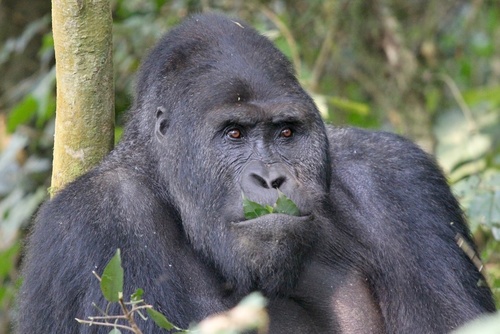
Dark black to brownish-black fur covering most of the body, with bare black skin on face, palms, and soles. Mature males develop a distinctive silver-gray saddle of fur on their back, earning the name 'silverback'.
Size
Standing height (bipedal): 1.25-1.8m; body length when quadrupedal knuckle-walking varies with build
Weight
Males: 140-180kg; Females: 68-90kg, showing significant sexual dimorphism
Distinctive features
Compared to Eastern Gorillas, Western Gorillas have shorter, softer fur, smaller body size, more pronounced brow ridges, and a more pronounced brownish tinge to their coat, particularly on the crown
Differences between males and females
Males are significantly larger and heavier than females (nearly double the weight), develop the characteristic silver saddle on their back at maturity, and have larger canine teeth and more pronounced sagittal crests
Behaviour and diet of the Western Gorilla
Live in cohesive family groups (troops) typically led by one dominant silverback male, with several adult females, their offspring, and sometimes subordinate males. Group sizes typically range from 2-20 individuals.
When it is active
Diurnal, with activity peaks in morning and late afternoon; midday is typically spent resting and socializing
Diet
Primarily herbivorous, consuming fruits, leaves, stems, bark, and pith; occasionally eats insects like termites and ants for protein supplementation
Communication
Vocalizations include chest-beating displays, hoots, grunts, screams, and roars; also uses body language, facial expressions, and scent marking to communicate status and emotional states
Interactions with other species
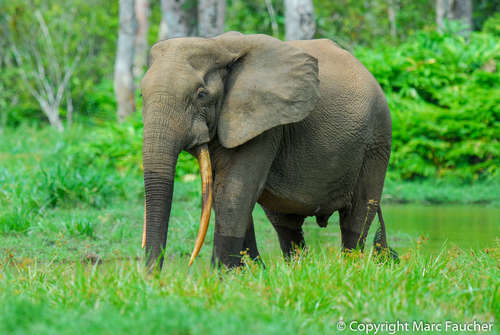
Few natural predators exist (occasional leopard predation on young); shares habitat with forest elephants and various monkey species; humans pose the greatest threat through poaching and habitat encroachment
Role in its ecosystem
Important seed disperser for numerous forest plant species due to their large home ranges and fruit-heavy diet, contributing significantly to forest regeneration and biodiversity maintenance
Reproduction and lifecycle
No fixed breeding season; females give birth after a gestation period of approximately 8.5 months, typically to a single infant, with birth intervals of 4-6 years
Raising the young
Mothers provide extensive care, carrying infants for the first few months and nursing for 3-4 years; the silverback plays a protective role for all group offspring, and juveniles learn through observation and play
Maturity and lifespan
Females reach sexual maturity around 8-10 years, males around 10-12 years but typically don't breed until later; lifespan is 35-40 years in the wild, up to 50+ years in captivity
Taxonomy and naming of the Western Gorilla
Classification
Class: Mammalia > Order: Primates > Family: Hominidae > Genus: Gorilla > Species: Gorilla gorilla
Subspecies
Western Lowland Gorilla (Gorilla gorilla gorilla) - widespread across Congo Basin lowland forests; Cross River Gorilla (Gorilla gorilla diehli) - critically small population in the Nigeria-Cameroon border region.
Scientific synonyms
Troglodytes gorilla (original 1847 classification by Savage & Wyman)
What research says
Recent studies
Recent genomic studies have refined understanding of Cross River Gorilla's genetic distinctiveness and low genetic diversity, informing targeted conservation strategies; camera trap studies continue to reveal new insights into social structure and tool use behaviors
Genome and DNA
Diploid chromosome number of 48; genome sequencing has revealed close genetic relation to humans (approximately 98% shared DNA) and confirmed distinct genetic divergence from Eastern Gorilla species
Compared with similar species
Smaller and with shorter fur than Eastern Gorillas (Gorilla beringei); shares many behavioral similarities with chimpanzees but is significantly larger and less arboreal; less aggressive temperament compared to popular media portrayals
The Western Gorilla and people
Gorillas share about 98% of their DNA with humans, making them one of our closest living relatives; despite their intimidating size, gorillas are predominantly gentle and shy; each gorilla has a unique nose print, similar to human fingerprints, used by researchers for individual identification.
Where and how to see it
Best observed through licensed ecotourism programs in habituated groups at reserves like Dzanga-Sangha (CAR) or Odzala-Kokoua National Park (Congo); early morning viewing is recommended, and strict distance protocols must be followed to prevent disease transmission
Risks to humans
Low risk under normal circumstances as gorillas are generally non-aggressive toward humans unless provoked or threatened; habituated gorillas pose minimal danger, though wild encounters could result in defensive charges if surprised
Human uses
Historically hunted for bushmeat trade (illegal), body parts sometimes used in traditional medicine or as trophies; increasingly valuable for ecotourism revenue in range countries, providing economic incentive for conservation
Myths and legends
Historically portrayed in Western media as aggressive monsters (inspiring King Kong), though this contradicts their actual peaceful and family-oriented nature; some Central African cultures traditionally view gorillas with spiritual reverence or as forest guardians
Countries where the Western Gorilla is recorded
The 7 countries named in the range description of its IUCN Red List assessment.
Questions about the Western Gorilla
Where does the Western Gorilla live?
The Western Gorilla is recorded in Angola, Cameroon, Central African Republic, Democratic Republic of the Congo and Equatorial Guinea, among 7 countries in total across Africa. These countries come from the range description of its IUCN Red List assessment, and they are what place the species on the interactive map.
Is the Western Gorilla endangered?
Yes. The IUCN Red List assesses the Western Gorilla as Critically Endangered, one of the three threatened categories. The species faces an extremely high risk of extinction in the wild. This is the last category before extinction, and it is reached through a very small or steeply declining population, a tiny range, or both.
How many are left in the wild?
Approximately 316,000 Western Lowland Gorillas remaining, with fewer than 300 Cross River Gorillas; overall population trend is declining This figure comes from the species assessment on the IUCN Red List; population estimates for wild mammals are ranges, not counts, and are revised at each assessment.
What habitat does the Western Gorilla live in?
Lowland tropical rainforests, swamp forests, secondary forests, and forest clearings called 'bais'.
What is the scientific name of the Western Gorilla?
The Western Gorilla is Gorilla gorilla, in the family Hominidae, order Primates.
Other species in the genus Gorilla
Other species in the family Hominidae
Species that share its range

Sources
Conservation status, range description and population estimate come from the IUCN Red List assessment for Gorilla gorilla. Countries are derived from that range description, not from a mapped country list. Last refreshed on .
The distribution map is drawn from the IUCN Red List spatial data compiled in 2016. UNEP-WCMC and IUCN (International Union for Conservation of Nature)