
Bornean Orangutan
Pongo pygmaeus
Red List assessment
Critically Endangeredon the IUCN Red List
- EXExtinct
- EWExtinct in the Wild
- CRCritically Endangered
- ENEndangered
- VUVulnerable
- NTNear Threatened
- LCLeast Concern
The Bornean Orangutan is recorded in 2 countries across Asia. The IUCN Red List assesses the Bornean Orangutan as Critically Endangered. Approximately 104,700 individuals remaining as of recent estimates, with a continuing declining trend.
- Family
- Hominidae
- Order
- Primates
- Genus
- Pongo
- Countries recorded
- 2
- Continents
- Asia
- Red List category
- Critically Endangered
- Data updated
- August 9, 2026
What is the Bornean Orangutan?
The Bornean orangutan is a large, arboreal great ape endemic to the island of Borneo, distinguished by its shaggy reddish-brown fur and remarkable intelligence. It is one of humanity's closest living relatives, sharing about 97% of its DNA with humans. Highly adapted to life in the rainforest canopy, it is the most solitary of the great apes. It is critically endangered due to massive habitat loss from logging and palm oil plantations.
Where does the Bornean Orangutan live?
Island of Borneo, shared by Indonesia (Kalimantan) and Malaysia (Sabah and Sarawak)
Found only on the island of Borneo, distributed across Indonesian Kalimantan and Malaysian Sabah and Sarawak, in increasingly fragmented forest patches.
Altitude and depth
Sea level up to approximately 1,500 meters, though they are most common below 500 meters in lowland forests.
Seasonal movements
No true migration or hibernation, but movement patterns shift seasonally in response to fruit availability, especially during mast fruiting events of dipterocarp trees.
Habitat of the Bornean Orangutan
Primarily lowland and hill dipterocarp tropical rainforests, peat swamp forests, and riparian forests. They rely heavily on continuous canopy cover for movement and foraging, rarely descending to the ground.
Adaptations to its environment
Long, powerful arms (arm span up to 2.2m) and hook-like hands and feet enable efficient brachiation and climbing through the canopy. A slow metabolism and ability to store fat allow survival during periods of fruit scarcity. They build new sleeping nests nightly from branches and leaves for safety and comfort.
Conservation status and numbers
Critically Endangered (IUCN), with population declines exceeding 50% over the past 60 years due to habitat destruction and hunting, and projected further declines making recovery uncertain.
Estimated population
Approximately 104,700 individuals remaining as of recent estimates, with a continuing declining trend.
What threatens the Bornean Orangutan?
Deforestation for palm oil plantations and logging, forest fires, illegal hunting and pet trade, human-wildlife conflict, and habitat fragmentation isolating populations.
Diseases and parasites
Susceptible to respiratory infections, malaria, and various gastrointestinal parasites; increased human contact has raised risks of disease transmission from humans.
What is being done to protect it?
Protected under Indonesian and Malaysian law; populations conserved in protected areas like Tanjung Puting, Kutai, and Danum Valley; rehabilitation and reintroduction centers operated by organizations such as BOS Foundation and Orangutan Foundation International.
Recommended actions
Expand and connect protected forest corridors, strengthen anti-poaching and anti-trafficking enforcement, promote sustainable palm oil certification, and support community-based conservation and habitat restoration programs.
What the Bornean Orangutan looks like
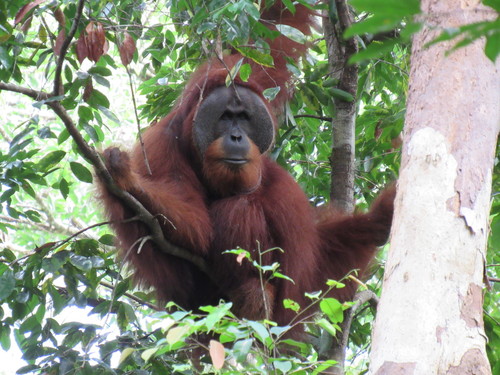
Covered in long, shaggy reddish-brown to orange hair, with a robust body, long arms, and a protruding jaw. Mature males develop distinctive wide cheek pads (flanges) and a throat pouch used for vocalizations.
Size
Body length (standing) approximately 1.0-1.4m; males have an arm span reaching up to 2.2m.
Weight
Males typically weigh 50-90 kg; females are smaller, weighing 30-50 kg.
Distinctive features
Compared to the Sumatran orangutan, Bornean orangutans have darker, coarser fur, broader faces, and more pronounced cheek flanges in males; they are also generally more solitary and terrestrial in movement.
Differences between males and females
Pronounced sexual dimorphism: males are significantly larger, develop large cheek flanges and throat pouches, while females remain smaller and lack these flanges.
Behaviour and diet of the Bornean Orangutan
Largely solitary, especially adult males, though mothers stay with offspring for years; loose associations occur among females and during fruiting season aggregations.
When it is active
Diurnal, active primarily during the day foraging and traveling, resting and nesting at night.
Diet
Predominantly frugivorous, feeding on a wide variety of fruits, especially figs, supplemented with leaves, bark, insects, honey, and occasionally small vertebrates.
How it feeds and hunts
Not a hunter in the traditional sense; forages selectively by memory of fruiting tree locations and uses tools such as sticks to extract insects or seeds.
Communication
Communicates through long calls (especially by males to signal location and attract females), body postures, facial expressions, and scent cues; uses branch-shaking as a warning display.
Interactions with other species
Few natural predators as adults, though clouded leopards may prey on juveniles; competes with other frugivores for fruit resources and plays a role in seed dispersal for various tree species.
Role in its ecosystem
Important seed disperser in tropical rainforest ecosystems, contributing to forest regeneration and plant diversity through their frugivorous diet.
Reproduction and lifecycle
Breeding is non-seasonal; gestation lasts about 8.5-9 months, typically resulting in a single offspring. Interbirth intervals are among the longest of any mammal, roughly 6-8 years.
Raising the young
Mothers provide extensive, prolonged care, nursing and teaching young for up to 7-8 years, including skills like nest-building and foraging techniques.
Maturity and lifespan
Sexual maturity around 8-15 years for females and later for males; average lifespan is 35-45 years in the wild, potentially exceeding 50 years in captivity.
Taxonomy and naming of the Bornean Orangutan
Classification
Class Mammalia > Order Primates > Family Hominidae > Genus Pongo > Species Pongo pygmaeus
Subspecies
Three recognized subspecies: Pongo pygmaeus pygmaeus (northwest Kalimantan), Pongo pygmaeus wurmbii (central/south Kalimantan), and Pongo pygmaeus morio (Sabah and eastern Kalimantan).
Scientific synonyms
Simia satyrus (historical usage), Pongo borneo
What research says
Recent studies
Recent studies have documented tool use, cultural variation in behavior between populations, and vocal communication complexity, alongside genomic research clarifying subspecies divergence times.
Genome and DNA
Diploid chromosome number of 48; genome sequencing has confirmed close genetic relation to humans and other great apes, revealing insights into ape evolution and cognition.
Compared with similar species
Similar to the Sumatran orangutan (Pongo abelii) but generally larger-bodied with darker fur and more solitary tendencies; both differ from African great apes by their highly arboreal lifestyle and reddish coloring.
The Bornean Orangutan and people
Orangutans build a fresh sleeping nest almost every night; they share about 97% of their DNA with humans; and 'orangutan' means 'person of the forest' in Malay.
Where and how to see it
Best observed in protected reserves such as Tanjung Puting National Park (Kalimantan) or Sepilok Orangutan Rehabilitation Centre (Sabah), typically during morning feeding times when they are most active.
Risks to humans
Generally low risk to humans; wild orangutans avoid confrontation, though large males can become defensive if threatened or cornered.
Human uses
Historically hunted for bushmeat and captured for the illegal pet trade; today primarily valued for ecotourism and conservation research rather than direct exploitation.
Myths and legends
In local Bornean folklore, orangutans are sometimes seen as forest spirits or transformed humans, reflecting deep cultural respect and mystique surrounding the species.
Countries where the Bornean Orangutan is recorded
The 2 countries named in the range description of its IUCN Red List assessment.
Questions about the Bornean Orangutan
Where does the Bornean Orangutan live?
The Bornean Orangutan is recorded in Indonesia and Malaysia across Asia. These countries come from the range description of its IUCN Red List assessment, and they are what place the species on the interactive map.
Is the Bornean Orangutan endangered?
Yes. The IUCN Red List assesses the Bornean Orangutan as Critically Endangered, one of the three threatened categories. The species faces an extremely high risk of extinction in the wild. This is the last category before extinction, and it is reached through a very small or steeply declining population, a tiny range, or both.
How many are left in the wild?
Approximately 104,700 individuals remaining as of recent estimates, with a continuing declining trend. This figure comes from the species assessment on the IUCN Red List; population estimates for wild mammals are ranges, not counts, and are revised at each assessment.
What habitat does the Bornean Orangutan live in?
Primarily lowland and hill dipterocarp tropical rainforests, peat swamp forests, and riparian forests.
What is the scientific name of the Bornean Orangutan?
The Bornean Orangutan is Pongo pygmaeus, in the family Hominidae, order Primates.
Other species in the genus Pongo
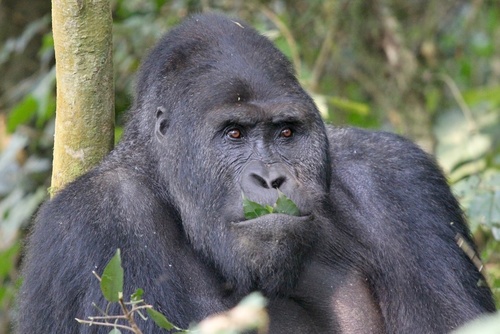
Other species in the family Hominidae
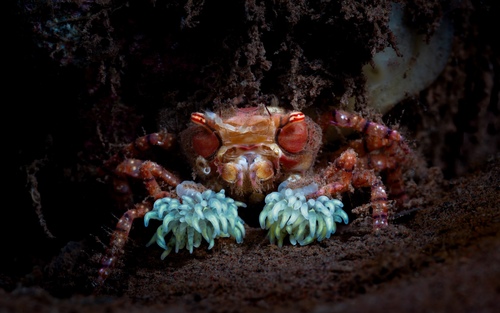
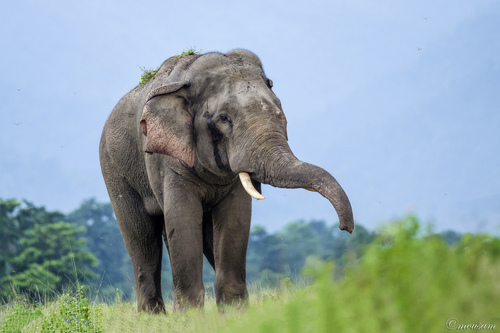
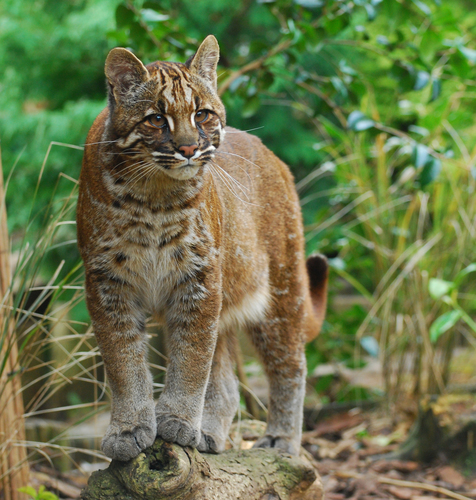
Species that share its range
Sources
Conservation status, range description and population estimate come from the IUCN Red List assessment for Pongo pygmaeus. Countries are derived from that range description, not from a mapped country list. Last refreshed on .
The distribution map is drawn from the IUCN Red List spatial data compiled in 2023. Meijaard, E., Ni’Matullah, S, Dennis, R.A., Ancrenaz, M., Sherman, J. and Wich, S.A. 2023. Spatial data for P. pygmaeus Red Listing. Borneo Futures, Brunei Darussalam