
Sumatran Orangutan
Pongo abelii
Red List assessment
Critically Endangeredon the IUCN Red List
- EXExtinct
- EWExtinct in the Wild
- CRCritically Endangered
- ENEndangered
- VUVulnerable
- NTNear Threatened
- LCLeast Concern
The Sumatran Orangutan is recorded in one country, Indonesia across Asia. The IUCN Red List assesses the Sumatran Orangutan as Critically Endangered. Approximately 14,000 individuals remaining in the wild, with a continuing declining trend due to ongoing habitat loss.
- Family
- Hominidae
- Order
- Primates
- Genus
- Pongo
- Countries recorded
- 1
- Continents
- Asia
- Red List category
- Critically Endangered
- Data updated
- August 9, 2026
What is the Sumatran Orangutan?
The Sumatran Orangutan is one of three species of orangutan, found exclusively in the tropical rainforests of northern Sumatra, Indonesia. It is a highly intelligent great ape known for its arboreal lifestyle, distinctive reddish fur, and complex cognitive abilities including tool use. This species is Critically Endangered and considered one of the most threatened great apes on Earth due to severe habitat loss.
Where does the Sumatran Orangutan live?
Northern Sumatra, Indonesia
Endemic to the island of Sumatra, Indonesia, primarily restricted to the northern provinces of Aceh and North Sumatra. Population is fragmented across the Leuser Ecosystem and surrounding forest areas.
Altitude and depth
0-1500m, though most individuals are found below 1000m in lowland and hill forests
Seasonal movements
No true migration or hibernation, but fruiting seasonality influences ranging patterns; orangutans travel further during fruit scarcity and may cluster near masting fruit trees during peak fruiting events.
Habitat of the Sumatran Orangutan
Lowland and montane tropical rainforests, peat swamp forests, and freshwater swamp forests. They require large tracts of continuous forest with dense canopy cover for their arboreal lifestyle and abundant fruiting trees.
Adaptations to its environment
Long, powerful arms (longer than legs) and hook-like hands/feet enable efficient brachiation and climbing through the forest canopy. Their diet flexibility allows survival during fruit scarcity by consuming bark, leaves, and insects. Nest-building behavior each night provides safe, comfortable sleeping platforms high in trees.
Conservation status and numbers
Critically Endangered (IUCN Red List) due to a population decline exceeding 80% over the past 75 years, driven primarily by habitat destruction and fragmentation. The species faces an extremely high risk of extinction in the wild without intensive conservation intervention.
Estimated population
Approximately 14,000 individuals remaining in the wild, with a continuing declining trend due to ongoing habitat loss.
What threatens the Sumatran Orangutan?
Deforestation for palm oil plantations, illegal logging, forest fires, mining, and infrastructure development (roads, dams). Poaching for the illegal pet trade and human-wildlife conflict when orangutans raid crops also pose significant threats.
Diseases and parasites
Susceptible to respiratory infections, malaria, and various intestinal parasites; increased human contact has raised risks of disease transmission between humans and orangutans, including potential exposure to human pathogens.
What is being done to protect it?
Protected under Indonesian law and listed on CITES Appendix I. Key conservation efforts include the Leuser Ecosystem protection, Sumatran Orangutan Conservation Programme (SOCP), rehabilitation and reintroduction centers, and anti-poaching patrols. Several national parks like Gunung Leuser National Park provide protected habitat.
Recommended actions
Strengthen enforcement against illegal logging and palm oil expansion in critical habitats, expand and connect protected forest corridors, increase funding for anti-poaching and rehabilitation programs, and promote sustainable palm oil certification to reduce market-driven deforestation.
What the Sumatran Orangutan looks like
Long, shaggy reddish-orange fur covering the body, with bare, dark grayish-black skin on the face, hands, and feet. Sumatran orangutans tend to have lighter, more cinnamon-colored fur and longer facial hair compared to Bornean orangutans.
Size
Males: 1.25-1.5m standing height; females are smaller at approximately 1-1.2m. Arm span can reach up to 2.2m in males.
Weight
Males: 50-90 kg; Females: 30-50 kg, showing significant sexual size dimorphism.
Distinctive features
Distinguished from Bornean orangutans by a more slender build, longer facial hair, lighter and more uniform coat color, and a narrower face. Adult males of this species develop flatter, more pronounced cheek pads (flanges) that can take on a distinctive shape.
Differences between males and females
Pronounced sexual dimorphism: males are significantly larger and heavier than females, develop large cheek pads (flanges) and throat pouches, and possess longer fur, particularly around the face.
Behaviour and diet of the Sumatran Orangutan
Largely solitary, especially adult males who maintain loose territories; females often travel with dependent offspring. Sumatran orangutans show more social tolerance than Bornean orangutans, occasionally forming temporary feeding aggregations at abundant fruit sources.
When it is active
Diurnal, with activity concentrated in daylight hours; the day is spent foraging, traveling through the canopy, and resting, with nights spent sleeping in freshly built nests.
Diet
Primarily frugivorous, with fruit constituting up to 60% of the diet, especially favoring figs and durians when available. Diet also includes young leaves, bark, flowers, insects, and occasionally bird eggs or small vertebrates.
How it feeds and hunts
Not a hunter in the traditional sense; forages by carefully searching the canopy for ripe fruit, using memory of fruiting tree locations, and using simple tools like sticks to extract insects or seeds from difficult-to-reach places.
Communication
Communication includes long calls (loud vocalizations by males audible over long distances to signal presence and attract females), various grunts and squeaks, and extensive body language including facial expressions and postural displays.
Interactions with other species
Adult orangutans have few natural predators, though Sumatran tigers can pose a threat, especially to young or vulnerable individuals. They compete with other frugivores like gibbons and hornbills for fruit resources but generally coexist without direct conflict.
Role in its ecosystem
Orangutans play a crucial ecological role as seed dispersers, spreading seeds of numerous fruit tree species throughout the forest via their droppings, which supports forest regeneration and biodiversity maintenance.
Reproduction and lifecycle
Breeding occurs year-round without a fixed season; gestation lasts approximately 8-9 months, typically resulting in a single offspring. Interbirth intervals are among the longest of any mammal, averaging 8-9 years.
Raising the young
Mothers provide extensive, prolonged care, nursing and carrying offspring for several years while teaching essential survival skills like nest-building and food identification. Juveniles may stay with their mothers for up to 8-9 years, one of the longest childhood dependency periods among non-human primates.
Maturity and lifespan
Females reach sexual maturity around 10-12 years, while males mature later, around 15 years, with full flanged development sometimes delayed further. Lifespan in the wild is approximately 30-40 years, while captive individuals can live into their 50s.
Taxonomy and naming of the Sumatran Orangutan
Classification
Class: Mammalia > Order: Primates > Family: Hominidae > Genus: Pongo > Species: Pongo abelii
Scientific synonyms
Simia abelii (original name given by Lesson in 1827)
What research says
Recent studies
Recent research has focused on orangutan tool use and cultural behavior variations between populations, as well as genomic studies revealing surprisingly high genetic diversity despite small population size, informing conservation genetics strategies.
Genome and DNA
Sumatran orangutans have 48 chromosomes (24 pairs), matching other great apes except humans. Genomic studies have revealed distinct genetic differentiation from Bornean orangutans, supporting their classification as a separate species.
Compared with similar species
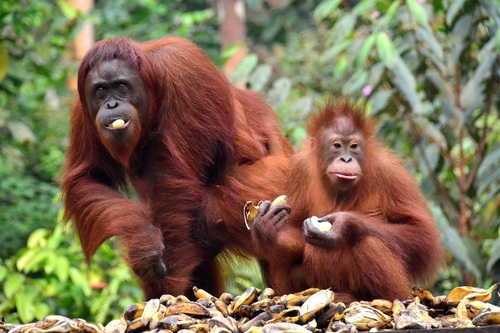
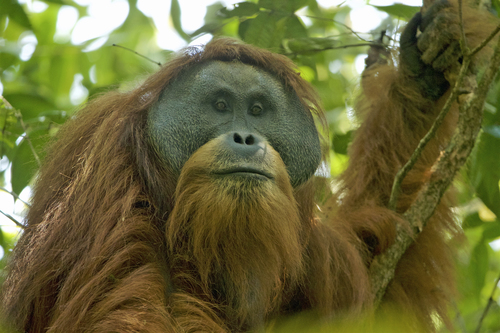
Compared to the Bornean orangutan (Pongo pygmaeus), the Sumatran species is generally more slender, has lighter fur, longer facial hair, and exhibits greater sociality. The Tapanuli orangutan (Pongo tapanuliensis), a more recently described sister species, is geographically isolated in southern Sumatra and is even more critically endangered.
The Sumatran Orangutan and people
Sumatran orangutans are among the few non-human animals documented using tools in the wild, such as using sticks to extract seeds from Neesia fruits. They share approximately 97% of their DNA with humans, making them one of our closest living relatives.
Where and how to see it
Gunung Leuser National Park in Aceh and North Sumatra offers the best opportunities for observing wild Sumatran orangutans, particularly around Bukit Lawang and Ketambe research areas. Early morning hours provide the highest chances of sightings, with guided treks recommended for both safety and conservation awareness.
Risks to humans
No notable risk under normal circumstances, though wild orangutans can become defensive or aggressive if threatened or cornered, particularly large flanged males; disease transmission risk exists in both directions during close human contact.
Human uses
Historically and illegally captured for the exotic pet trade, though this is now heavily prohibited. Orangutans hold significant value for ecotourism, generating revenue for local conservation and communities through wildlife tourism in protected areas.
Myths and legends
The name 'orangutan' derives from Malay words meaning 'person of the forest,' reflecting long-standing local beliefs in their human-like intelligence and forest spirit associations. In some Indonesian folklore, orangutans are considered to possess almost mystical wisdom and are respected as forest guardians.
Countries where the Sumatran Orangutan is recorded
The 1 countries named in the range description of its IUCN Red List assessment.
Questions about the Sumatran Orangutan
Where does the Sumatran Orangutan live?
The Sumatran Orangutan is recorded in Indonesia across Asia. These countries come from the range description of its IUCN Red List assessment, and they are what place the species on the interactive map.
Is the Sumatran Orangutan endangered?
Yes. The IUCN Red List assesses the Sumatran Orangutan as Critically Endangered, one of the three threatened categories. The species faces an extremely high risk of extinction in the wild. This is the last category before extinction, and it is reached through a very small or steeply declining population, a tiny range, or both.
How many are left in the wild?
Approximately 14,000 individuals remaining in the wild, with a continuing declining trend due to ongoing habitat loss. This figure comes from the species assessment on the IUCN Red List; population estimates for wild mammals are ranges, not counts, and are revised at each assessment.
What habitat does the Sumatran Orangutan live in?
Lowland and montane tropical rainforests, peat swamp forests, and freshwater swamp forests.
What is the scientific name of the Sumatran Orangutan?
The Sumatran Orangutan is Pongo abelii, in the family Hominidae, order Primates.
Other species in the genus Pongo
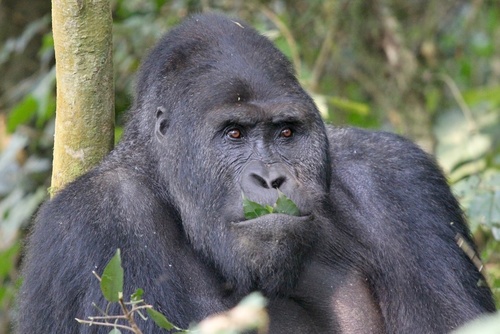
Other species in the family Hominidae
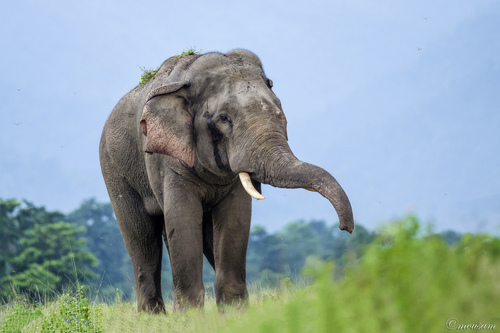
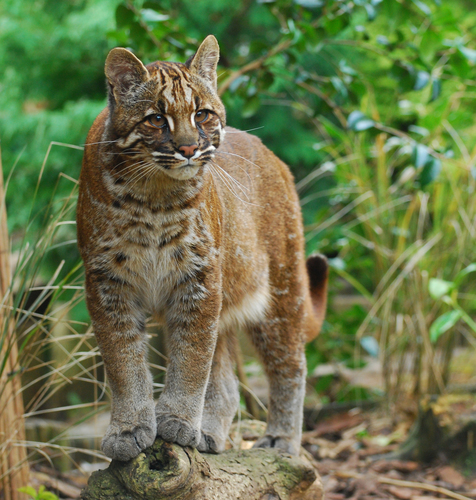
Species that share its range
Sources
Conservation status, range description and population estimate come from the IUCN Red List assessment for Pongo abelii. Countries are derived from that range description, not from a mapped country list. Last refreshed on .
The distribution map is drawn from the IUCN Red List spatial data compiled in 2023. Wich, S.A., Ni’Matullah, S, Sherman, J.,and Meijaard, E. 2023. Spatial data for P. abelii Red Listing. Borneo Futures, Brunei Darussalam