
Bonobo
Pan paniscus
Red List assessment
Endangeredon the IUCN Red List
- EXExtinct
- EWExtinct in the Wild
- CRCritically Endangered
- ENEndangered
- VUVulnerable
- NTNear Threatened
- LCLeast Concern
The Bonobo is recorded in one country, Democratic Republic of the Congo across Africa. The IUCN Red List assesses the Bonobo as Endangered. Estimated 15,000-20,000 individuals in the wild, with a declining population trend.
- Family
- Hominidae
- Order
- Primates
- Genus
- Pan
- Countries recorded
- 1
- Continents
- Africa
- Red List category
- Endangered
- Data updated
- August 9, 2026
What is the Bonobo?
The bonobo is a great ape endemic to the Democratic Republic of the Congo, found exclusively south of the Congo River. Closely related to the common chimpanzee, it is notable for its highly egalitarian, female-centered social structure and use of sexual behavior to reduce social tension. Bonobos are considered, along with chimpanzees, humans' closest living relatives, sharing about 98.7% of our DNA.
Where does the Bonobo live?
Democratic Republic of the Congo (Central Africa)
Endemic to the Democratic Republic of the Congo, restricted to the region south of the Congo River and north of the Kasai River, within the central Congo Basin.
Altitude and depth
Typically 300-500m above sea level, occasionally up to 1000m in some forested areas.
Seasonal movements
No true migration or hibernation; ranging patterns shift somewhat with fruit availability across wet and dry seasons.
Habitat of the Bonobo
Lowland tropical rainforest, including primary and secondary forest, swamp forest, and seasonally flooded forest within the Congo Basin.
Adaptations to its environment
Highly arboreal and terrestrial locomotion adapted for dense forest travel; strong grasping hands and feet for climbing; flexible diet allows exploitation of variable fruit availability; complex social bonds help reduce feeding competition.
Conservation status and numbers
Endangered (EN) according to IUCN, due to ongoing habitat loss, hunting pressure, and a small, fragmented range entirely within one politically unstable country.
Estimated population
Estimated 15,000-20,000 individuals in the wild, with a declining population trend.
What threatens the Bonobo?
Bushmeat hunting, habitat destruction from logging and agriculture, human population expansion, and armed conflict limiting conservation access in DRC.
Diseases and parasites
Susceptible to respiratory infections, intestinal parasites, and diseases transmissible from humans (e.g., Ebola risk in great apes generally), though direct documentation in bonobos is more limited than in chimpanzees.
What is being done to protect it?
Protected under DRC law and CITES Appendix I; conservation efforts include Salonga National Park, Lomako-Yokokala Faunal Reserve, and sanctuary/rehabilitation programs like Lola ya Bonobo.
Recommended actions
Strengthen anti-poaching enforcement, expand protected area networks, support community-based conservation and alternative livelihoods, and reduce bushmeat trade through education and law enforcement.
What the Bonobo looks like
Black fur with a slender build, long limbs, pink lips, and a relatively small head compared to chimpanzees; often has a distinctive hair part on the head.
Size
Standing height around 70-83 cm; body length roughly 70-90 cm when quadrupedal.
Weight
Males typically 37-45 kg, females slightly smaller at 30-38 kg.
Distinctive features
Compared to chimpanzees, bonobos have a slimmer build, longer legs, pink lips, black face from birth, and a more upright posture when walking bipedally.
Differences between males and females
Modest sexual dimorphism; males are somewhat larger and more muscular than females, though less pronounced than in chimpanzees.
Behaviour and diet of the Bonobo
Live in fission-fusion communities of 30-80 individuals; society is female-centered with strong female bonds and generally lower aggression levels than chimpanzees.
When it is active
Diurnal, active during daylight hours foraging, traveling, resting, and socializing, with nest-building for sleeping at night.
Diet
Omnivorous, primarily frugivorous, supplemented by leaves, seeds, flowers, invertebrates, and occasionally small vertebrates.
How it feeds and hunts
Opportunistic foraging rather than coordinated hunting; occasional predation on small mammals like duikers or flying squirrels, but less frequent and less organized than in chimpanzees.
Communication
Uses vocalizations (calls, screams, hoots), facial expressions, gestures, and extensive tactile and sexual behaviors to communicate and maintain social bonds.
Interactions with other species
Few natural predators due to size and forest habitat; occasional interactions with leopards; competes with other frugivores for fruit resources but generally avoids overlap with chimpanzees due to geographic separation.
Role in its ecosystem
Important seed disperser for many tropical tree species, contributing to forest regeneration and biodiversity maintenance within the Congo Basin ecosystem.
Reproduction and lifecycle
No strict breeding season; females give birth to a single offspring after gestation of about 240 days (8 months), with births spaced 4-6 years apart.
Raising the young
Mothers provide extensive, prolonged care, nursing infants for 3-5 years; strong mother-offspring bonds persist into adulthood, especially between mothers and sons.
Maturity and lifespan
Sexual maturity around 8-12 years; lifespan approximately 40 years in the wild, up to 50-60 years in captivity.
Taxonomy and naming of the Bonobo
Classification
Class Mammalia > Order Primates > Family Hominidae > Genus Pan > Species Pan paniscus
Scientific synonyms
Pan satyrus paniscus (original 1929 classification); formerly called 'pygmy chimpanzee'
What research says
Recent studies
Recent genomic and behavioral studies have explored bonobo prosocial behavior, cooperation, and the evolutionary basis of reduced aggression compared to chimpanzees, informing theories on human social evolution.
Genome and DNA
Diploid chromosome number of 48; genome sequenced in 2012, confirming close genetic relationship to humans and chimpanzees (~98.7% similarity with humans).
Compared with similar species
Often compared to the common chimpanzee (Pan troglodytes); bonobos are generally less aggressive, more egalitarian, and rely more on sexual behavior for social bonding, while chimpanzees show more male dominance hierarchies and inter-group violence.
The Bonobo and people
Bonobos are one of the few animals besides humans observed using sex for social bonding rather than solely reproduction; they were the last great ape species to be scientifically described (1929); female bonobos often hold higher social rank than males despite smaller size.
Where and how to see it
Best observed in the wild at habituated research sites such as Wamba or LuiKotale in DRC, or at Lola ya Bonobo sanctuary near Kinshasa; early morning hours offer the best chance to see active foraging behavior.
Risks to humans
No notable risk to humans in the wild; however, as with other great apes, disease transmission between humans and bonobos can occur in both directions, requiring caution during close contact.
Human uses
Primarily valued for ecotourism and scientific research on primate behavior and human evolution; historically hunted for bushmeat despite legal protections.
Myths and legends
Bonobos hold cultural significance in some Congolese communities and are sometimes featured in local folklore as forest spirits or symbols of peace due to their gentle reputation, though detailed traditional mythology is less documented than for other African wildlife.
Countries where the Bonobo is recorded
The 1 countries named in the range description of its IUCN Red List assessment.
Questions about the Bonobo
Where does the Bonobo live?
The Bonobo is recorded in Democratic Republic of the Congo across Africa. These countries come from the range description of its IUCN Red List assessment, and they are what place the species on the interactive map.
Is the Bonobo endangered?
Yes. The IUCN Red List assesses the Bonobo as Endangered, one of the three threatened categories. The species faces a very high risk of extinction in the wild — a step below Critically Endangered, but still on a trajectory that ends badly without intervention.
How many are left in the wild?
Estimated 15,000-20,000 individuals in the wild, with a declining population trend. This figure comes from the species assessment on the IUCN Red List; population estimates for wild mammals are ranges, not counts, and are revised at each assessment.
What habitat does the Bonobo live in?
Lowland tropical rainforest, including primary and secondary forest, swamp forest, and seasonally flooded forest within the Congo Basin.
What is the scientific name of the Bonobo?
The Bonobo is Pan paniscus, in the family Hominidae, order Primates.
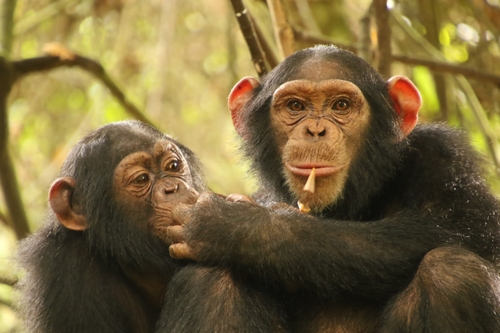
Other species in the genus Pan
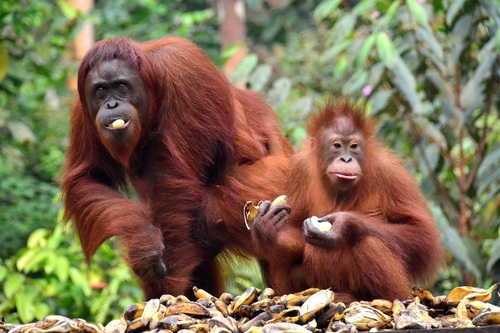
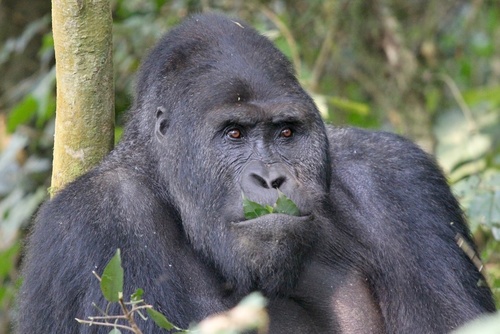
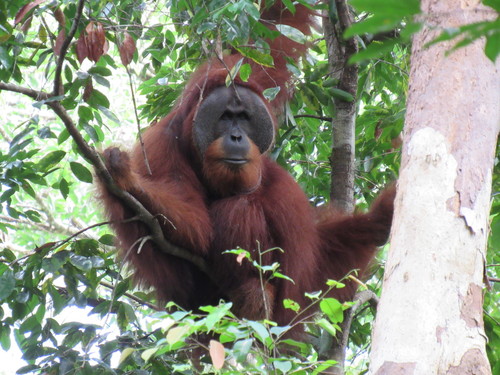
Other species in the family Hominidae
Species that share its range

Sources
Conservation status, range description and population estimate come from the IUCN Red List assessment for Pan paniscus. Countries are derived from that range description, not from a mapped country list. Last refreshed on .
The distribution map is drawn from the IUCN Red List spatial data compiled in 2016. IUCN SSC A.P.E.S. Database (2016)