
Chimpanzee
Pan troglodytes
Red List assessment
Endangeredon the IUCN Red List
- EXExtinct
- EWExtinct in the Wild
- CRCritically Endangered
- ENEndangered
- VUVulnerable
- NTNear Threatened
- LCLeast Concern
The Chimpanzee is recorded in 9 countries across Africa. The IUCN Red List assesses the Chimpanzee as Endangered. Estimated at 170,000 to 300,000 individuals remaining in the wild, with an ongoing declining trend across most of their range due to sustained anthropogenic pressures.
- Family
- Hominidae
- Order
- Primates
- Genus
- Pan
- Countries recorded
- 9
- Continents
- Africa
- Red List category
- Endangered
- Data updated
- August 9, 2026
What is the Chimpanzee?
The chimpanzee is one of humanity's closest living relatives, sharing approximately 98.6% of our DNA. Native to the forests and savanna-woodlands of equatorial Africa, chimpanzees are highly intelligent, social apes known for tool use, complex communication, and rich cultural behaviors that vary between populations. They live in fission-fusion societies called communities, and their study has profoundly shaped our understanding of primate cognition and human evolution.
Where does the Chimpanzee live?
Equatorial Africa, spanning West and Central Africa from Senegal to Uganda and western Tanzania
Found across a broad equatorial belt in Africa, from Senegal and Guinea in the west through Nigeria, Cameroon, Gabon, Republic of Congo, Democratic Republic of Congo, Central African Republic, to Uganda and western Tanzania in the east. Populations are increasingly fragmented due to habitat loss.
Altitude and depth
Sea level to approximately 2,800 meters, with most populations concentrated in lowland forests below 1,500 meters, though some Eastern chimpanzee populations inhabit montane forests at higher elevations.
Seasonal movements
No true migration or hibernation occurs, but ranging patterns and diet shift seasonally in response to fruit availability, with some populations traveling farther during dry seasons when preferred foods are scarce.
Habitat of the Chimpanzee
Chimpanzees inhabit a wide range of environments including tropical rainforest, montane forest, swamp forest, and savanna-woodland mosaics. They show remarkable ecological flexibility, adapting to both dense closed-canopy forest and more open, drier habitats depending on the region.
Adaptations to its environment
Chimpanzees possess opposable thumbs and big toes for grasping branches and manipulating tools, strong upper body musculature for climbing and knuckle-walking, and a flexible omnivorous digestive system. Their large brains support complex problem-solving, tool manufacture, and social learning that allow adaptation to diverse and changing environments.
Conservation status and numbers
Endangered (EN) according to IUCN, with populations having declined by more than 50% over the past 20-30 years (roughly one generation) due to habitat loss, poaching, and disease. Some subspecies, such as the Nigeria-Cameroon and Western chimpanzee, are classified as Critically Endangered.
Estimated population
Estimated at 170,000 to 300,000 individuals remaining in the wild, with an ongoing declining trend across most of their range due to sustained anthropogenic pressures.
What threatens the Chimpanzee?
Major threats include habitat destruction from logging, agriculture, and infrastructure development; poaching for bushmeat and the illegal pet trade; disease transmission from humans (including Ebola and respiratory illnesses); and habitat fragmentation isolating populations.
Diseases and parasites
Chimpanzees are susceptible to various diseases including Ebola virus, anthrax, respiratory illnesses (often transmitted from humans), and intestinal parasites; they can also carry pathogens like SIV (simian immunodeficiency virus), which is genetically related to HIV.
What is being done to protect it?
Conservation efforts include protected areas and national parks (e.g., Gombe, Taï, Kibale), CITES Appendix I listing banning international commercial trade, anti-poaching patrols, sanctuary and rehabilitation programs (e.g., Jane Goodall Institute, Tacugama), and community-based conservation initiatives.
Recommended actions
Priority actions include expanding and connecting protected habitat corridors, strengthening anti-poaching law enforcement, reducing disease transmission risk from ecotourism and research contact, and supporting community engagement programs that provide alternatives to bushmeat hunting and forest conversion.
What the Chimpanzee looks like
Chimpanzees have coarse black or dark brown body hair with bare, pinkish-to-dark skin on the face, hands, feet, and ears, which can darken with age. They have a protruding jaw (prognathism), large canine teeth, prominent brow ridges, and long arms relative to their legs, adapted for both quadrupedal knuckle-walking and arboreal climbing.
Size
Standing height when upright ranges from about 1.0 to 1.7 meters; body length (sitting) is roughly 63-94 cm; arm span can exceed 1.5 times body height due to long forelimbs.
Weight
Males typically weigh 40-70 kg in the wild, while females are somewhat smaller at 27-50 kg; captive individuals can be heavier due to lower activity levels and different diets.
Distinctive features
Compared to bonobos (Pan paniscus), chimpanzees are generally larger, more robust, with a broader chest and darker facial skin from a young age, and display more male-dominated, sometimes aggressive social hierarchies rather than the female-centered, more peaceful bonobo society.
Differences between males and females
Moderate sexual dimorphism exists, with males being notably larger and more muscular than females, possessing bigger canine teeth used in dominance displays and conflicts.
Behaviour and diet of the Chimpanzee
Chimpanzees live in large, complex fission-fusion communities of 15-150+ individuals that split into smaller temporary subgroups for foraging. Male-dominated hierarchies exist within communities, with alliances, grooming, and political maneuvering playing central roles in maintaining status.
When it is active
Chimpanzees are primarily diurnal, being active from dawn to dusk with periods devoted to foraging, traveling, socializing, and resting; they build fresh sleeping nests in trees each night.
Diet
Omnivorous diet consisting mainly of ripe fruit (which can comprise 50% or more of intake), supplemented by leaves, seeds, flowers, bark, insects (notably termites and ants), and occasionally hunted meat from small to medium-sized mammals such as red colobus monkeys.
How it feeds and hunts
Chimpanzees engage in cooperative group hunting, particularly targeting colobus monkeys, using coordinated ambush strategies with different individuals playing roles such as drivers, blockers, and ambushers; they also use tools like sharpened sticks to hunt bushbabies in tree hollows.
Communication
Chimpanzees communicate through an extensive repertoire of vocalizations (including pant-hoots, screams, and grunts), facial expressions, body postures, and gestures, as well as tactile communication like grooming and touching to reinforce social bonds.
Interactions with other species
Chimpanzees have few natural predators as adults, though leopards and occasionally large snakes may prey on younger or vulnerable individuals; they compete with other primates and forest herbivores for fruit resources and sometimes prey upon smaller primate species like red colobus monkeys.
Role in its ecosystem
As frugivores, chimpanzees play an important ecological role as seed dispersers, contributing to forest regeneration and plant diversity across their range; their foraging and nesting behaviors also influence local vegetation structure.
Reproduction and lifecycle
Breeding occurs year-round without a strict season; females have a gestation period of about 8 months (230-240 days) and typically give birth to a single offspring, with twins being rare. Females exhibit sexual swellings that signal fertility to males.
Raising the young
Mothers provide extensive, prolonged care, nursing infants for up to 5 years and carrying them constantly for the first few years of life. Offspring remain closely associated with their mothers for social learning and support even after weaning, often for 8-10 years or more.
Maturity and lifespan
Females typically reach sexual maturity around 11-13 years and males around 12-15 years, though social maturity may take longer; wild chimpanzees live 33-45+ years on average, while captive individuals can live into their 50s or 60s.
Taxonomy and naming of the Chimpanzee
Classification
Class Mammalia > Order Primates > Family Hominidae > Genus Pan > Species Pan troglodytes
Subspecies
Four recognized subspecies: Pan troglodytes verus (West African chimpanzee, Senegal to Ghana), P. t. ellioti (Nigeria-Cameroon chimpanzee), P. t. troglodytes (Central chimpanzee, Cameroon to Republic of Congo), and P. t. schweinfurthii (Eastern chimpanzee, CAR to Uganda and Tanzania).
Scientific synonyms
Simia troglodytes (original 1776 name by Blumenbach); historically also referred to as Anthropopithecus troglodytes and Troglodytes niger in older literature.
What research says
Recent studies
Recent research has revealed complex tool-use traditions that vary regionally like distinct cultures, evidence of self-medication behaviors using specific plants, and genomic studies identifying population-specific adaptations and disease susceptibilities relevant to conservation planning.
Genome and DNA
Chimpanzees have 48 chromosomes (24 pairs), one more pair than humans due to a chromosomal fusion event in human ancestry; genomic studies confirm chimpanzees share about 98.6% genetic similarity with humans, making them invaluable for comparative genomics and evolutionary studies.
Compared with similar species
Chimpanzees are often compared to bonobos, their closest relative, which are generally more slender, exhibit female-dominated social structures, and show reduced aggression; compared to gorillas, chimpanzees are smaller, more arboreal, and exhibit more frequent tool use and hunting behavior.
The Chimpanzee and people
Chimpanzees can craft and use tools such as termite-fishing sticks and leaf sponges, demonstrate self-awareness in mirror tests, and have been observed engaging in warfare-like violent conflicts between neighboring communities, a behavior rarely documented in other non-human species.
Where and how to see it
Best observed in habituated groups within national parks such as Gombe Stream and Mahale Mountains in Tanzania, Kibale National Park in Uganda, or Taï National Park in Côte d'Ivoire, typically during early morning hours when chimpanzees are most active and vocal after leaving their night nests.
Risks to humans
Chimpanzees can pose risks to humans through aggressive behavior and powerful bites, particularly from adult males, and can transmit zoonotic diseases; caution and professional guidance are recommended during any close encounters, especially in ecotourism or research settings.
Human uses
Historically used extensively in biomedical research due to genetic similarity to humans, though this practice has been largely banned or phased out in many countries; chimpanzees are also central to ecotourism industries and have cultural/scientific value in studies of cognition, behavior, and evolution.
Myths and legends
In various African folklore traditions, chimpanzees have been depicted as near-human forest spirits or tricksters due to their humanlike behavior; they have also featured prominently in Western popular culture as symbols of primate intelligence, from early scientific studies to films and literature.
Countries where the Chimpanzee is recorded
The 9 countries named in the range description of its IUCN Red List assessment.
Questions about the Chimpanzee
Where does the Chimpanzee live?
The Chimpanzee is recorded in Cameroon, Central African Republic, Democratic Republic of the Congo, Gabon and Guinea, among 9 countries in total across Africa. These countries come from the range description of its IUCN Red List assessment, and they are what place the species on the interactive map.
Is the Chimpanzee endangered?
Yes. The IUCN Red List assesses the Chimpanzee as Endangered, one of the three threatened categories. The species faces a very high risk of extinction in the wild — a step below Critically Endangered, but still on a trajectory that ends badly without intervention.
How many are left in the wild?
Estimated at 170,000 to 300,000 individuals remaining in the wild, with an ongoing declining trend across most of their range due to sustained anthropogenic pressures. This figure comes from the species assessment on the IUCN Red List; population estimates for wild mammals are ranges, not counts, and are revised at each assessment.
What habitat does the Chimpanzee live in?
Chimpanzees inhabit a wide range of environments including tropical rainforest, montane forest, swamp forest, and savanna-woodland mosaics.
What is the scientific name of the Chimpanzee?
The Chimpanzee is Pan troglodytes, in the family Hominidae, order Primates.
Other species in the genus Pan
Other species in the family Hominidae
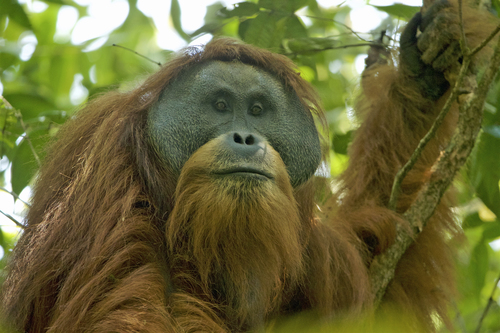
Species that share its range

Sources
Conservation status, range description and population estimate come from the IUCN Red List assessment for Pan troglodytes. Countries are derived from that range description, not from a mapped country list. Last refreshed on .
The distribution map is drawn from the IUCN Red List spatial data compiled in 2018. IUCN (International Union for Conservation of Nature)