
Vervet Monkey
Chlorocebus pygerythrus
Red List assessment
Least Concernon the IUCN Red List
- EXExtinct
- EWExtinct in the Wild
- CRCritically Endangered
- ENEndangered
- VUVulnerable
- NTNear Threatened
- LCLeast Concern
The Vervet Monkey is recorded in 9 countries across Africa. The IUCN Red List assesses the Vervet Monkey as Least Concern. Population size is not precisely quantified but considered large and stable across its extensive range, with some local declines in fragmented habitats.
- Family
- Cercopithecidae
- Order
- Primates
- Genus
- Chlorocebus
- Countries recorded
- 9
- Continents
- Africa
- Red List category
- Least Concern
- Data updated
- August 9, 2026
What is the Vervet Monkey?
The vervet monkey is a medium-sized Old World monkey native to eastern and southern Africa, easily recognized by its greyish-green coat, black face, and pale belly. It thrives in a wide variety of habitats from savanna to riverine forest and is highly adaptable to human-altered environments. Known for its complex social structure and alarm call system, it is one of the most studied primates in behavioral ecology.
Where does the Vervet Monkey live?
Eastern and Southern Africa, including Kenya, Tanzania, Uganda, Zambia, Zimbabwe, Botswana, and South Africa
Ranges widely across sub-Saharan Africa from Ethiopia and Somalia through East Africa (Kenya, Tanzania, Uganda) down to Southern Africa (Zambia, Zimbabwe, Botswana, South Africa).
Altitude and depth
Sea level up to approximately 4,000 meters in some highland areas, though most commonly found below 2,000 meters.
Seasonal movements
No true migration or hibernation; breeding is often seasonal, coinciding with periods of food abundance, particularly during rainy seasons.
Habitat of the Vervet Monkey
Found in savanna woodlands, riverine forests, forest edges, and increasingly in agricultural and urban areas where they raid crops and gardens.
Adaptations to its environment
Vervets have cheek pouches for storing food, strong limbs for both terrestrial and arboreal locomotion, and a sophisticated alarm call system that distinguishes between different predator types (eagles, snakes, leopards).
Conservation status and numbers
Listed as Least Concern by IUCN due to wide distribution and large, stable population, though localized declines occur due to habitat loss and human conflict.
Estimated population
Population size is not precisely quantified but considered large and stable across its extensive range, with some local declines in fragmented habitats.
What threatens the Vervet Monkey?
Habitat destruction from agriculture and urbanization, hunting for bushmeat in some regions, human-wildlife conflict due to crop raiding, and capture for biomedical research.
Diseases and parasites
Susceptible to simian immunodeficiency virus (SIV), intestinal parasites, and have historically been used in research on herpes B virus and other zoonotic diseases.
What is being done to protect it?
Protected in numerous national parks and reserves across their range; some countries regulate trade and capture for research purposes.
Recommended actions
Mitigate human-wildlife conflict through community education, protect riverine and savanna habitats from fragmentation, and regulate capture for biomedical use.
What the Vervet Monkey looks like
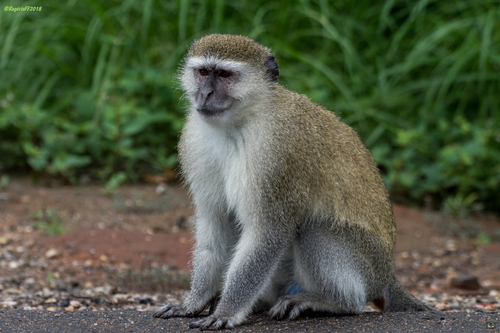
Grey-green to olive fur on the back, with a white or pale belly, black face fringed with white fur, and long limbs suited for both climbing and ground movement. Adult males display a distinctive bright blue scrotum.
Size
Body length (head and body) typically 40-60 cm, with a tail of similar or greater length (50-70 cm).
Weight
Males weigh 4-8 kg; females are smaller, typically weighing 3.5-5 kg.
Distinctive features
The vivid blue scrotal coloration in males and black face with white fur ruff are key distinguishing features from other Chlorocebus species.
Differences between males and females
Males are notably larger than females and possess the characteristic blue scrotum and red perineum used in social and sexual signaling.
Behaviour and diet of the Vervet Monkey
Highly social, living in troops of 10-50 individuals with a matrilineal hierarchy; males typically emigrate at sexual maturity while females remain in their natal group.
When it is active
Diurnal, with peak activity in early morning and late afternoon; they rest during the hottest parts of the day.
Diet
Omnivorous diet including fruits, seeds, flowers, leaves, insects, small birds, and eggs; they also raid crops such as maize and vegetables near human settlements.
How it feeds and hunts
Opportunistic foragers rather than active hunters; they may catch insects and small vertebrates by hand while foraging on the ground or in trees.
Communication
Vervets are famous for their referential alarm calls that differentiate between predator types (leopard, eagle, snake), along with grunts, screams, and grooming for social bonding.
Interactions with other species
Natural predators include leopards, eagles, and pythons; vervets often share habitat with baboons and other primates, sometimes competing for food resources.
Role in its ecosystem
Play an important role as seed dispersers for various plant species and serve as prey for large carnivores and raptors, contributing to ecosystem balance.
Reproduction and lifecycle
Breeding often peaks during the rainy season; gestation lasts about 5.5 months, typically resulting in a single offspring per birth.
Raising the young
Mothers provide primary care, nursing and carrying infants for several months; allomothering by related females is common, aiding social bonding within the troop.
Maturity and lifespan
Females reach sexual maturity around 3-4 years, males slightly later; lifespan in the wild is about 11-13 years, up to 24 years in captivity.
Taxonomy and naming of the Vervet Monkey
Classification
Class Mammalia > Order Primates > Family Cercopithecidae > Genus Chlorocebus > Species Chlorocebus pygerythrus
Subspecies
Several recognized subspecies including C. p. pygerythrus (South Africa), C. p. hilgerti (East Africa), C. p. rufoviridis (Somalia, Ethiopia), C. p. cloeti, and C. p. excubitor, differing mainly in fur color and geographic range.
Scientific synonyms
Cercopithecus pygerythrus; formerly included within a broader Cercopithecus aethiops complex before genus Chlorocebus was split.
What research says
Recent studies
Recent studies focus on their alarm call cognition, social learning behaviors (such as food preference transmission across generations), and their use as models for metabolic and neurological research.
Genome and DNA
Vervet monkeys have 2n=60 chromosomes and have been extensively used in genomic studies due to genetic similarities relevant to human disease models, especially SIV research.
Compared with similar species
Closely related to other Chlorocebus species such as the green monkey (C. sabaeus) and grivet (C. aethiops), differing mainly in coat color, facial markings, and geographic range.
The Vervet Monkey and people
Vervets have distinct alarm calls for different predators, essentially forming a basic 'language.' They also show cultural food preferences that are socially transmitted across generations, similar to primitive traditions.
Where and how to see it
Best observed in East African savanna parks like Serengeti or South African reserves such as Kruger National Park during early morning or late afternoon when they are most active.
Risks to humans
Generally low risk, but they can become aggressive when habituated to humans, especially when raiding food, and may carry zoonotic diseases like SIV.
Human uses
Widely used in biomedical research due to genetic similarities to humans, particularly for studies on HIV/SIV, metabolism, and behavioral neuroscience.
Myths and legends
In some African folklore, vervet monkeys are seen as clever tricksters, often featured in traditional stories symbolizing cunning and social intelligence.
Countries where the Vervet Monkey is recorded
The 9 countries named in the range description of its IUCN Red List assessment.
Questions about the Vervet Monkey
Where does the Vervet Monkey live?
The Vervet Monkey is recorded in Botswana, Ethiopia, Kenya, Somalia and South Africa, among 9 countries in total across Africa. These countries come from the range description of its IUCN Red List assessment, and they are what place the species on the interactive map.
Is the Vervet Monkey endangered?
The IUCN Red List assesses the Vervet Monkey as Least Concern. The species is widespread and abundant enough not to qualify for any threatened category. It does not mean the species is safe forever, only that nothing in the current data raises an alarm.
How many are left in the wild?
Population size is not precisely quantified but considered large and stable across its extensive range, with some local declines in fragmented habitats. This figure comes from the species assessment on the IUCN Red List; population estimates for wild mammals are ranges, not counts, and are revised at each assessment.
What habitat does the Vervet Monkey live in?
Found in savanna woodlands, riverine forests, forest edges, and increasingly in agricultural and urban areas where they raid crops and gardens.
What is the scientific name of the Vervet Monkey?
The Vervet Monkey is Chlorocebus pygerythrus, in the family Cercopithecidae, order Primates.
Other species in the genus Chlorocebus

Other species in the family Cercopithecidae
Sources
Conservation status, range description and population estimate come from the IUCN Red List assessment for Chlorocebus pygerythrus. Countries are derived from that range description, not from a mapped country list. Last refreshed on .
The distribution map is drawn from the IUCN Red List spatial data compiled in 2024. IUCN (International Union for Conservation of Nature)