
Dryas Monkey
Chlorocebus dryas
Red List assessment
Endangeredon the IUCN Red List
- EXExtinct
- EWExtinct in the Wild
- CRCritically Endangered
- ENEndangered
- VUVulnerable
- NTNear Threatened
- LCLeast Concern
The Dryas Monkey is recorded in one country, Democratic Republic of the Congo across Africa. The IUCN Red List assesses the Dryas Monkey as Endangered. Unknown precise number; believed to be very small and fragmented, with population trend presumed declining due to habitat loss
- Family
- Cercopithecidae
- Order
- Primates
- Genus
- Chlorocebus
- Countries recorded
- 1
- Continents
- Africa
- Red List category
- Endangered
- Data updated
- August 9, 2026
What is the Dryas Monkey?
The Dryas Monkey is a small, poorly known guenon endemic to the Congo Basin rainforest of the Democratic Republic of the Congo. It is one of the rarest and least studied African primates, with very few confirmed sightings since its description. Its cryptic behavior and restricted range in dense swamp forest make it exceptionally elusive. It is considered one of the most endangered primates in Africa.
Where does the Dryas Monkey live?
Democratic Republic of the Congo (central Congo Basin)
Restricted to a small area of the central Congo Basin in the Democratic Republic of the Congo, primarily around the Lomami and Congo River basins in Tshuapa and Maniema provinces.
Altitude and depth
Approximately 350-500 meters above sea level
Habitat of the Dryas Monkey
Lowland tropical rainforest, particularly swamp forest and dense understory vegetation near rivers and seasonally flooded areas. It appears to favor liana tangles and thick undergrowth that provide cover from predators.
Adaptations to its environment
Its small body size and secretive, low-canopy behavior allow it to move stealthily through dense vegetation while avoiding predators. Cryptic coloration helps it blend into shadowy swamp forest understory.
Conservation status and numbers
Endangered (EN) according to IUCN, due to an extremely restricted range, ongoing habitat loss, and very low, poorly documented population numbers. The species' rarity and lack of sightings raise concern about undetected population declines.
Estimated population
Unknown precise number; believed to be very small and fragmented, with population trend presumed declining due to habitat loss
What threatens the Dryas Monkey?
Deforestation and habitat degradation from logging and agricultural expansion, bushmeat hunting, and civil unrest in the region limiting conservation access. Its restricted range makes it highly vulnerable to any habitat disturbance.
What is being done to protect it?
Some protection exists within the Lomami National Park and surrounding conservation landscape in DRC, which was established partly due to the presence of this and other rare species. Research expeditions by organizations like the Lukuru Foundation have worked to document its range and ecology.
Recommended actions
Expand protected area coverage in the Congo Basin swamp forests, conduct further surveys to clarify population size and distribution, and strengthen anti-poaching and anti-logging enforcement in known habitat.
What the Dryas Monkey looks like
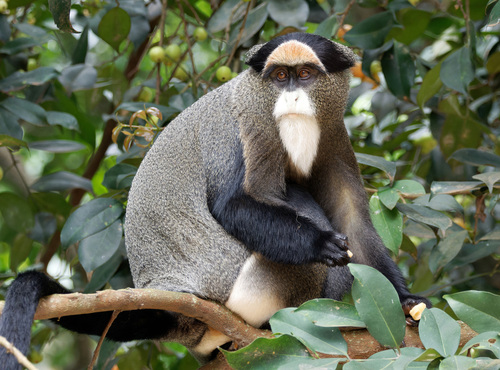
Small guenon with a dark grayish-brown coat, a distinctive black face mask, and a pale brow band; underparts are lighter, often whitish or pale gray.
Size
Body length approximately 32-37 cm, with a tail of similar or greater length
Weight
Estimated 2-4.5 kg, with males typically slightly larger than females
Distinctive features
Distinguished from other Chlorocebus species by its darker coloration, smaller size, and distinctive facial markings including a black mask contrasting with lighter fur around the eyes.
Differences between males and females
Males are generally somewhat larger than females, though detailed sexual dimorphism data is limited due to scarcity of specimens.
Behaviour and diet of the Dryas Monkey
Presumed to live in small social groups similar to other Chlorocebus species, though direct observations are extremely limited; behavior is inferred largely from related vervet monkeys.
When it is active
Diurnal, active during daylight hours, foraging in the dense understory and lower canopy.
Diet
Omnivorous, likely feeding on fruits, leaves, seeds, and invertebrates, similar to other Chlorocebus species, though specific dietary data for this species is scarce.
Communication
Presumed to use vocalizations, facial expressions, and body postures similar to related vervet and guenon species, though specific communication behaviors have not been documented.
Interactions with other species
Likely predated upon by forest raptors, snakes, and possibly leopards; may compete with other small primates for food resources in its habitat.
Role in its ecosystem
As a frugivore-omnivore, it likely contributes to seed dispersal within its swamp forest habitat, playing a role in maintaining forest plant diversity.
Reproduction and lifecycle
Reproductive biology is largely unknown; presumed similar to related Chlorocebus species with single births after a gestation of about 5-6 months.
Raising the young
Likely maternal care similar to other guenons, with mothers carrying and nursing infants for several months, though specific data for this species is lacking.
Maturity and lifespan
Sexual maturity likely reached around 3-4 years based on related species; lifespan in the wild is unknown but may resemble other small guenons living 10-15 years.
Taxonomy and naming of the Dryas Monkey
Classification
Mammalia > Primates > Cercopithecidae > Chlorocebus > Chlorocebus dryas
Scientific synonyms
Formerly classified as Cercopithecus dryas; also historically associated with Cercopithecus salongo, now considered the same species
What research says
Recent studies
Recent camera-trap and field survey efforts by researchers such as those from the Lukuru Foundation have provided some of the first photographic evidence and ecological data on this species in the wild, helping clarify its habitat preferences.
Compared with similar species
Similar in size to other Chlorocebus species like the vervet monkey but distinguished by darker fur and unique facial markings; considered more elusive and restricted in range than its congeners.
The Dryas Monkey and people
The Dryas Monkey was long known mainly from a handful of museum specimens and was rarely seen alive until recent camera-trap studies confirmed its continued existence. It is sometimes called one of the 'lost' primates of Africa due to its extreme rarity and secretive nature.
Where and how to see it
Extremely difficult to observe in the wild; best chances are within protected areas like Lomami National Park in DRC with experienced local guides and researchers familiar with recent sighting locations.
Risks to humans
No notable risk to humans
Countries where the Dryas Monkey is recorded
The 1 countries named in the range description of its IUCN Red List assessment.
Questions about the Dryas Monkey
Where does the Dryas Monkey live?
The Dryas Monkey is recorded in Democratic Republic of the Congo across Africa. These countries come from the range description of its IUCN Red List assessment, and they are what place the species on the interactive map.
Is the Dryas Monkey endangered?
Yes. The IUCN Red List assesses the Dryas Monkey as Endangered, one of the three threatened categories. The species faces a very high risk of extinction in the wild — a step below Critically Endangered, but still on a trajectory that ends badly without intervention.
How many are left in the wild?
Unknown precise number; believed to be very small and fragmented, with population trend presumed declining due to habitat loss This figure comes from the species assessment on the IUCN Red List; population estimates for wild mammals are ranges, not counts, and are revised at each assessment.
What habitat does the Dryas Monkey live in?
Lowland tropical rainforest, particularly swamp forest and dense understory vegetation near rivers and seasonally flooded areas.
What is the scientific name of the Dryas Monkey?
The Dryas Monkey is Chlorocebus dryas, in the family Cercopithecidae, order Primates.
Other species in the genus Chlorocebus

Other species in the family Cercopithecidae
Sources
Conservation status, range description and population estimate come from the IUCN Red List assessment for Chlorocebus dryas. Countries are derived from that range description, not from a mapped country list. Last refreshed on .
The distribution map is drawn from the IUCN Red List spatial data compiled in 2021. IUCN (International Union for Conservation of Nature)