
Topi
Damaliscus lunatus
Red List assessment
Least Concernon the IUCN Red List
- EXExtinct
- EWExtinct in the Wild
- CRCritically Endangered
- ENEndangered
- VUVulnerable
- NTNear Threatened
- LCLeast Concern
The Topi is recorded in 7 countries across Africa. The IUCN Red List assesses the Topi as Least Concern. Estimated total population of several hundred thousand individuals across Africa, though the overall trend is declining due to habitat conversion and hunting pressure in many range states.
- Family
- Bovidae
- Order
- Artiodactyla
- Genus
- Damaliscus
- Countries recorded
- 7
- Continents
- Africa
- Red List category
- Least Concern
- Data updated
- August 9, 2026
What is the Topi?
The topi is a medium-large African antelope known for its distinctive purplish-red coat with dark blue-black patches on the upper legs. It is one of the fastest antelope species and is famous for its habit of standing sentinel on termite mounds to survey territory and watch for predators. Topi are highly social grazers found across grassland and savanna ecosystems, playing a key role in African plains ecology.
Where does the Topi live?
Sub-Saharan Africa, primarily East Africa (Kenya, Tanzania) and parts of Central and Southern Africa
Widely distributed across sub-Saharan Africa from Senegal in West Africa through Central Africa to East Africa (Kenya, Tanzania, Uganda) and south to Botswana, Zimbabwe, and South Africa, though populations are fragmented and declining in many regions.
Altitude and depth
Typically found at elevations from sea level to about 2000m, most commonly in lowland savanna plains
Seasonal movements
Topi undertake seasonal movements linked to rainfall patterns and grass availability, often following migratory routes similar to wildebeest in some ecosystems like the Serengeti-Mara.
Habitat of the Topi
Open grasslands, savannas, and floodplains, often preferring areas with a mix of short and medium-height grasses. They favor habitats near water sources and areas with scattered termite mounds used for vigilance.
Adaptations to its environment
Topi have excellent eyesight and use elevated termite mounds as vantage points to detect predators from a distance. Their long legs and lean build enable them to reach speeds up to 70 km/h, and their digestive system is adapted to process fibrous grasses efficiently.
Conservation status and numbers
Listed as Least Concern by IUCN, though some subspecies and regional populations have experienced significant declines and are of greater conservation concern; overall species status masks serious regional depletions.
Estimated population
Estimated total population of several hundred thousand individuals across Africa, though the overall trend is declining due to habitat conversion and hunting pressure in many range states.
What threatens the Topi?
Habitat loss due to agricultural expansion, competition with livestock for grazing land, poaching for bushmeat, and fragmentation of migratory corridors are the primary threats.
Diseases and parasites
Topi can be affected by various tick-borne diseases, gastrointestinal parasites, and occasionally rinderpest historically, though modern veterinary surveillance has reduced major disease outbreaks.
What is being done to protect it?
Topi are protected within numerous national parks and reserves including Serengeti, Masai Mara, Kruger, and various West African protected areas; some regional subspecies benefit from targeted conservation programs.
Recommended actions
Priority actions include maintaining habitat connectivity for migration, strengthening anti-poaching enforcement, and monitoring fragmented populations especially in West and Central Africa where subspecies face greater risk.
What the Topi looks like
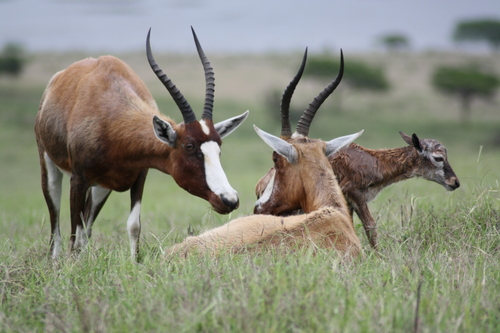
The topi has a reddish-brown to purplish coat with distinctive dark blackish-blue patches on the upper front and hind legs, giving a striking two-toned appearance. The face often has a darker mask-like pattern, and both sexes carry ridged, lyre-shaped horns.
Size
Shoulder height ranges from 104-126 cm; body length typically 150-205 cm
Weight
Males typically weigh 108-147 kg, while females are slightly smaller at 84-119 kg
Distinctive features
Distinguished from related species like the hartebeest by its more vivid coloration, characteristic dark leg patches, and more robust horn shape; the glossy purple-red sheen of its coat is particularly notable in good light.
Differences between males and females
Males are generally larger and more robust than females, with thicker horn bases, though both sexes possess horns of similar overall shape.
Behaviour and diet of the Topi
Topi form complex social structures including territorial males, female-juvenile herds, and bachelor groups; herd sizes vary from small family groups to large aggregations of hundreds during migration.
When it is active
Primarily diurnal, with peak activity during cooler morning and late afternoon hours, resting during the heat of midday.
Diet
Topi are exclusively grazers, feeding on a variety of grass species and showing preference for medium-length green grasses, though they can adapt to drier vegetation during dry seasons.
Communication
Topi communicate through vocalizations such as snorts and grunts, visual displays including head-tossing and stance postures, and scent marking via preorbital glands to establish territory.
Interactions with other species
Major predators include lions, cheetahs, hyenas, and wild dogs; topi often associate with other grazers like wildebeest and zebra, benefiting from shared vigilance against predators.
Role in its ecosystem
As grazers, topi play an important role in shaping grassland structure and nutrient cycling, and serve as a significant prey base supporting large carnivore populations in African ecosystems.
Reproduction and lifecycle
Breeding is seasonal in many populations with peak calving aligned to rainy seasons; gestation lasts approximately 7.5-8 months, and females typically give birth to a single calf.
Raising the young
Calves are precocial and can stand shortly after birth; mothers keep calves hidden in vegetation for the first few weeks before they join the herd, providing protection and nursing for several months.
Maturity and lifespan
Sexual maturity is reached around 2-3 years of age; lifespan in the wild is typically 12-15 years, with slightly longer lifespans possible in protected environments.
Taxonomy and naming of the Topi
Classification
Class Mammalia > Order Artiodactyla > Family Bovidae > Genus Damaliscus > Species Damaliscus lunatus
Subspecies
Several subspecies recognized including D. l. jimela (Kenya, Tanzania), D. l. topi (East Africa), D. l. korrigum (West Africa, now rare), D. l. tiang (South Sudan), and D. l. lunatus (Southern Africa, sometimes called tsessebe). Taxonomy is debated with some authorities splitting these into separate species.
Scientific synonyms
Damaliscus korrigum (sometimes used for West African populations); previously classified under various regional names like tiang and tsessebe
What research says
Recent studies
Recent research has focused on using topi as an indicator species for grassland ecosystem health and studying their migratory patterns via GPS tracking in relation to changing rainfall patterns and human land use.
Genome and DNA
Diploid chromosome number reported as 2n=38; genetic studies have been used to clarify subspecies boundaries and migratory population connectivity.
Compared with similar species
Topi are closely related to the tsessebe and korrigum, sometimes considered conspecific; they differ from hartebeest by having more vivid coloring, different horn shape, and generally smaller body size.
The Topi and people
Topi males famously stand atop termite mounds for hours to guard territory and spot predators, a behavior that has made them iconic subjects in wildlife photography. They are considered among the fastest antelope in Africa, capable of outrunning most predators over short distances.
Where and how to see it
Best observed in East African parks such as Masai Mara and Serengeti during the dry season when large herds gather near water sources; early morning or late afternoon offers optimal viewing when animals are most active.
Risks to humans
No notable risk to humans, as topi are herbivorous and non-aggressive, typically fleeing from human presence.
Human uses
Topi are hunted for bushmeat in some regions and are also a popular species for photographic safari tourism; they hold minor significance in local subsistence hunting traditions across their range.
Myths and legends
In some East African cultures, the topi's habit of standing sentinel has led to associations with vigilance and watchfulness in local folklore, though specific detailed legends are not widely documented in written sources.
Countries where the Topi is recorded
The 7 countries named in the range description of its IUCN Red List assessment.
Questions about the Topi
Where does the Topi live?
The Topi is recorded in Botswana, Kenya, Senegal, South Africa and Tanzania, among 7 countries in total across Africa. These countries come from the range description of its IUCN Red List assessment, and they are what place the species on the interactive map.
Is the Topi endangered?
The IUCN Red List assesses the Topi as Least Concern. The species is widespread and abundant enough not to qualify for any threatened category. It does not mean the species is safe forever, only that nothing in the current data raises an alarm.
How many are left in the wild?
Estimated total population of several hundred thousand individuals across Africa, though the overall trend is declining due to habitat conversion and hunting pressure in many range states. This figure comes from the species assessment on the IUCN Red List; population estimates for wild mammals are ranges, not counts, and are revised at each assessment.
What habitat does the Topi live in?
Open grasslands, savannas, and floodplains, often preferring areas with a mix of short and medium-height grasses.
What is the scientific name of the Topi?
The Topi is Damaliscus lunatus, in the family Bovidae, order Artiodactyla.
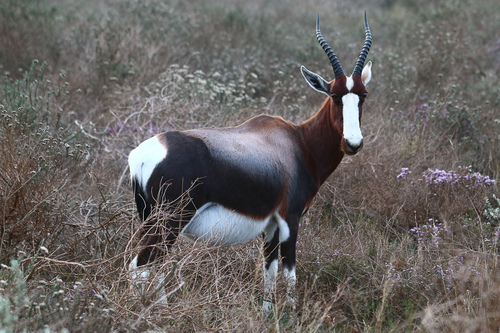
Other species in the genus Damaliscus
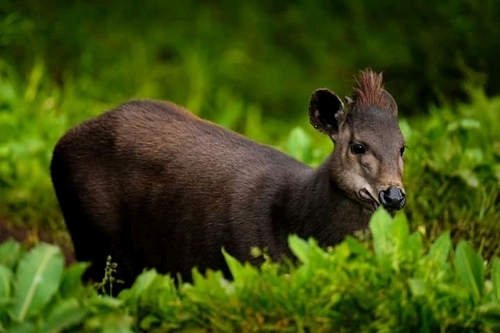
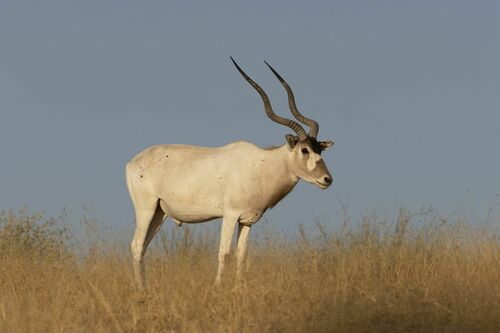
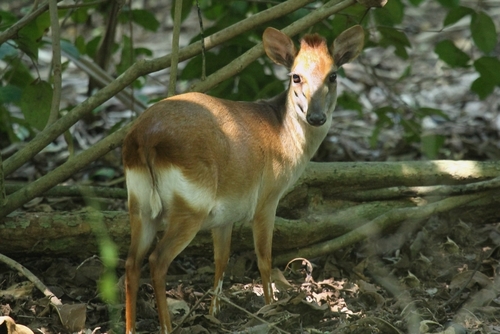
Other species in the family Bovidae
Species that share its range

Sources
Conservation status, range description and population estimate come from the IUCN Red List assessment for Damaliscus lunatus. Countries are derived from that range description, not from a mapped country list. Last refreshed on .
The distribution map is drawn from the IUCN Red List spatial data compiled in 2016. IUCN (International Union for Conservation of Nature)