
Tinfields Rock Rat
Aethomys stannarius
Red List assessment
Data Deficienton the IUCN Red List
- EXExtinct
- EWExtinct in the Wild
- CRCritically Endangered
- ENEndangered
- VUVulnerable
- NTNear Threatened
- LCLeast Concern
Data Deficient has no position on the scale above — it records the absence of an assessment, not a degree of risk.
The Tinfields Rock Rat is recorded in 2 countries across Africa. The IUCN Red List records the Tinfields Rock Rat as Data Deficient. Unknown. No population estimates exist.
- Family
- Muridae
- Order
- Rodentia
- Genus
- Aethomys
- Countries recorded
- 2
- Continents
- Africa
- Red List category
- Data Deficient
- Data updated
- August 9, 2026
What is the Tinfields Rock Rat?
Aethomys stannarius is a small to medium-sized murid rodent endemic to the rocky landscapes of the Jos Plateau in north-central Nigeria. Its common name 'Tinfields Rock Rat' and its specific epithet stannarius (from Latin stannum, meaning tin) directly reference the region's historically famous tin-mining fields, near which the type specimens were collected in 1912. Like other members of the genus Aethomys, it is a rock-dwelling species adapted to granitic outcrops and boulder-strewn savanna terrain. It remains one of the least-known African rodents, placed in the Data Deficient category by the IUCN due to a severe scarcity of field records and ecological data.
Where does the Tinfields Rock Rat live?
Nigeria (primarily the Jos Plateau) and possibly adjacent areas of Cameroon in west-central Africa.
The known range is essentially restricted to the Jos Plateau in Plateau State, north-central Nigeria, at elevations above the surrounding lowlands. The precise extent of its range is unconfirmed; it may extend marginally into the Adamawa highlands or the border regions of Cameroon, but no confirmed records outside Nigeria exist.
Altitude and depth
Approximately 1,000–1,800 m above sea level, corresponding to the elevation range of the Jos Plateau and associated highland terrain.
Seasonal movements
No documented seasonal migrations or hibernation. Activity patterns are likely influenced by the bimodal wet-dry seasonality of the Jos Plateau, potentially shifting foraging behaviour during the dry season (November–March) when food resources become scarcer.
Habitat of the Tinfields Rock Rat
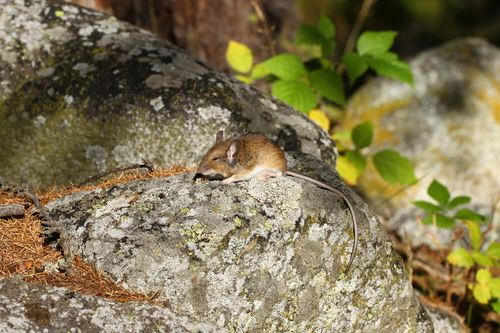
Rocky outcrops, granite inselbergs, and boulder-strewn hillsides set within Guinea savanna woodland and derived grassland are the presumed primary habitats. The Jos Plateau's characteristic laterite and granite terrain, interspersed with open woodland, appears central to its ecology. Like congeners, it likely uses rock crevices for shelter and nesting.
Adaptations to its environment
Rocky habitat specialists in Aethomys typically have strong hindlimbs and agile bodies suited for navigating boulder fields, as well as relatively large eyes for low-light foraging. Their dense, somewhat coarse pelage provides insulation during cool highland nights. Crevice use for shelter offers protection from both predators and temperature extremes.
Conservation status and numbers
Data Deficient (DD) on the IUCN Red List. This status reflects an absence of sufficient data on population size, distribution, ecology, and trends rather than confirmed low numbers. The species has not been adequately surveyed since its original description over a century ago.
Estimated population
Unknown. No population estimates exist. Population trend is undetermined due to complete absence of systematic surveys.
What threatens the Tinfields Rock Rat?
Extensive land conversion on the Jos Plateau for subsistence agriculture, urban expansion around Jos city, and decades of open-cast tin mining have substantially altered and fragmented the rocky habitat. Overgrazing by livestock also degrades the ground cover around rocky outcrops. These cumulative pressures are suspected threats even in the absence of quantified data.
Diseases and parasites
No documented disease or parasite data specific to A. stannarius. African Aethomys species in general are known to host ectoparasites (fleas, mites, ticks) and endoparasites (nematodes, cestodes), and may serve as reservoir hosts for various zoonotic pathogens.
What is being done to protect it?
No species-specific conservation programmes are known. The Jos Plateau falls partly within areas of general biodiversity concern in Nigeria, but there are no protected areas specifically managed for this species. Nigerian national wildlife legislation technically covers all rodents, but enforcement is limited.
Recommended actions
Priority actions include targeted field surveys on the Jos Plateau to establish current distribution and population status, ecological studies to characterise habitat requirements, and formal assessment for potential reclassification on the IUCN Red List. Habitat protection for rocky inselbergs and restriction of further mining expansion would be prudent precautionary measures.
What the Tinfields Rock Rat looks like
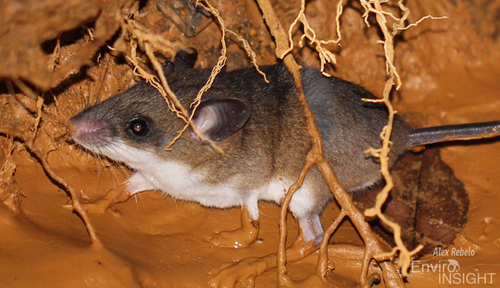
Fur on the dorsal surface is likely sandy-brown to greyish-brown, typical of highland Aethomys species, while the ventral surface is paler, whitish or pale buff. The tail is relatively long, lightly haired, and approximately equal to or exceeding body length. The ears are moderately large and rounded.
Size
Estimated head-body length approximately 110–145 mm, tail length approximately 130–165 mm, based on comparisons with closely related Aethomys species of similar size.
Weight
Estimated 50–100 g, with females possibly slightly smaller than males, consistent with general Aethomys body mass ranges. No published weight data specific to this species.
Distinctive features
Distinguishing Aethomys stannarius from congeners such as A. hindei requires detailed morphometric and cranial measurements as well as molecular analysis. Its highland Jos Plateau distribution, specific cranial dimensions (as described by Thomas 1912), and relatively slender build are considered diagnostic.
Differences between males and females
No documented sexual dimorphism specific to this species. As with most small murids, differences between sexes are likely minimal in external morphology.
Behaviour and diet of the Tinfields Rock Rat
Unknown in detail. Rock rats of the genus Aethomys are generally solitary or form small family groups centred on a rocky shelter site. Territorial behaviour around burrow or crevice entrances is reported in congeners.
When it is active
Presumed to be nocturnal or crepuscular, consistent with the activity patterns of all known Aethomys species, which are active primarily after sunset to reduce predation risk.
Diet
Presumed omnivorous, feeding on seeds, plant material (grasses, herbs, roots), invertebrates, and possibly small vertebrates opportunistically. Congeners rely heavily on seeds and dry plant matter, particularly during the dry season.
How it feeds and hunts
Likely forages opportunistically on the ground and among rocks, using olfaction to locate seeds and invertebrates. No specific hunting techniques documented.
Communication
Likely uses ultrasonic vocalisations, olfactory signals (urine and faecal marking), and tactile communication as in other murids. No published species-specific data on communication.
Interactions with other species
Likely predated upon by owls (e.g., Barn Owl Tyto alba, Spotted Eagle-Owl Bubo africanus), small carnivores (mongooses, genets, servals), and snakes. Competes for rocky shelters and food resources with other small mammals sharing the Jos Plateau, such as other rodents and elephant shrews.
Role in its ecosystem
As a seed-eater and omnivore in savanna-rocky habitats, it likely plays a role in seed dispersal and invertebrate population regulation. It also serves as prey for mesopredators and raptors, contributing to plateau food webs.
Reproduction and lifecycle
No specific data available. Aethomys species generally breed seasonally, often timed to the wet season when food is most abundant. Litter sizes in the genus range from 2 to 6 young, with a gestation period of approximately 21–26 days.
Raising the young
Presumed to follow the general murid pattern where the female provides primary parental care, nursing young in a concealed nest within a rock crevice until weaning at approximately 3–4 weeks of age.
Maturity and lifespan
No species-specific data available. Congeners typically reach sexual maturity at 6–10 weeks of age. Wild lifespan is likely 1–3 years; captive longevity may extend to 4–5 years.
Taxonomy and naming of the Tinfields Rock Rat
Classification
Mammalia > Rodentia > Muridae > Aethomys > Aethomys stannarius (Thomas, 1912)
Scientific synonyms
No widely recognised synonyms are currently documented, though it has occasionally been treated as a close relative or near-synonym of Aethomys hindei in older literature.
What research says
Recent studies
No notable recent scientific publications are specifically dedicated to Aethomys stannarius. The species has essentially not been the subject of targeted research since Thomas's original 1912 description.
Genome and DNA
No published chromosome count or molecular genetic studies specific to Aethomys stannarius. Chromosome numbers in the genus range from 2n=44 to 2n=56 depending on species.
Compared with similar species
Aethomys stannarius is most closely related to other West and Central African members of the genus, particularly A. hindei from Kenya and Tanzania. It differs from the more widespread and studied A. chrysophilus (Red Rock Rat) of southern Africa in its highland West African distribution and morphological details. Molecular phylogenetic placement of stannarius within the genus has not been published.
The Tinfields Rock Rat and people
The species' very name is a fossil record of the colonial tin-mining industry: both its English name 'Tinfields Rock Rat' and its Latin epithet stannarius (from stannum, Latin for tin) commemorate the Jos Plateau tin fields that dominated Nigerian colonial commerce in the early 20th century. It is so poorly known that over 110 years after its formal description no photograph of a live wild specimen has been published in the scientific literature. The Jos Plateau where it lives is one of West Africa's biodiversity hotspots, hosting numerous endemic or near-endemic species due to its island-like elevation above the surrounding lowlands.
Where and how to see it
The best chance of encountering this species is on rocky granite outcrops and inselbergs on the Jos Plateau in Plateau State, Nigeria, particularly around dusk and at night. Night surveys using cage traps or spotlight searches near boulder fields would be the recommended method. Very few naturalists have specifically targeted this species, making any observation potentially scientifically significant.
Risks to humans
No notable risk to humans. As with all wild rodents, it may carry ectoparasites or zoonotic pathogens, so appropriate precautions should be taken when handling trapped individuals.
Countries where the Tinfields Rock Rat is recorded
The 2 countries named in the range description of its IUCN Red List assessment.
Questions about the Tinfields Rock Rat
Where does the Tinfields Rock Rat live?
The Tinfields Rock Rat is recorded in Cameroon and Nigeria across Africa. These countries come from the range description of its IUCN Red List assessment, and they are what place the species on the interactive map.
Is the Tinfields Rock Rat endangered?
The IUCN Red List assesses the Tinfields Rock Rat as Data Deficient. There is not enough information to judge the risk of extinction, usually because the species is rarely seen or has never been surveyed. It is not a reassuring category: several species were Data Deficient right up to the point they were found to be Critically Endangered.
How many are left in the wild?
Unknown. No population estimates exist. This figure comes from the species assessment on the IUCN Red List; population estimates for wild mammals are ranges, not counts, and are revised at each assessment.
What habitat does the Tinfields Rock Rat live in?
Rocky outcrops, granite inselbergs, and boulder-strewn hillsides set within Guinea savanna woodland and derived grassland are the presumed primary habitats.
What is the scientific name of the Tinfields Rock Rat?
The Tinfields Rock Rat is Aethomys stannarius, in the family Muridae, order Rodentia.
Other species in the genus Aethomys
Other species in the family Muridae
Sources
Conservation status, range description and population estimate come from the IUCN Red List assessment for Aethomys stannarius. Countries are derived from that range description, not from a mapped country list. Last refreshed on .
The distribution map is drawn from the IUCN Red List spatial data compiled in 2008. IUCN (International Union for Conservation of Nature)