
Tarim Red Deer
Cervus hanglu
Red List assessment
Least Concernon the IUCN Red List
- EXExtinct
- EWExtinct in the Wild
- CRCritically Endangered
- ENEndangered
- VUVulnerable
- NTNear Threatened
- LCLeast Concern
The Tarim Red Deer is recorded in 6 countries across Asia. The IUCN Red List assesses the Tarim Red Deer as Least Concern. Global population across all subspecies is estimated at a few thousand individuals, with the Kashmir stag numbering fewer than 300 and the Yarkand deer around 1,000-1,500 individuals; overall trend is declining in most subpopulations.
- Family
- Cervidae
- Order
- Artiodactyla
- Genus
- Cervus
- Countries recorded
- 6
- Continents
- Asia
- Red List category
- Least Concern
- Data updated
- August 9, 2026
What is the Tarim Red Deer?
The Tarim Red Deer represents a group of Central Asian red deer subspecies adapted to arid mountain valleys and riverine desert habitats rather than the temperate forests typical of most red deer. It is remarkable for its isolated, fragmented populations that have evolved distinct morphological and genetic traits after long separation from other red deer lineages. Some subspecies, like the Kashmir stag, are critically endangered with only a few hundred individuals remaining, while others like the Yarkand deer persist in small, scattered oases. The species as a whole is a flagship for Central Asian riparian and montane conservation.
Where does the Tarim Red Deer live?
Central and South Asia, including the Tarim Basin of Xinjiang (China), the Kashmir Valley (India), and riverine areas of Central Asia (Uzbekistan, Tajikistan, Turkmenistan, Afghanistan)
Historically ranged across Central Asia and western China, now reduced to isolated pockets: the Kashmir Valley in India, the Tarim Basin and surrounding oases in Xinjiang, China, and river valleys of the Amu Darya and Syr Darya in Uzbekistan, Tajikistan, and Turkmenistan.
Altitude and depth
Ranges from near sea-level riverine lowlands (around 200-500m in Tarim Basin) up to mountain valleys at 1600-3500m in Kashmir.
Seasonal movements
Populations undergo seasonal altitudinal movements in mountainous areas, moving to higher pastures in summer and descending to sheltered valleys in winter; rutting occurs in autumn (September-October).
Habitat of the Tarim Red Deer
Riparian tugai forests, poplar and tamarisk thickets along rivers, mountain valleys with mixed coniferous and broadleaf forest, and semi-arid scrublands bordering desert basins.
Adaptations to its environment
Thick winter coats and stocky builds help endure cold winters and hot, dry summers typical of continental climates. Their ability to browse on tough desert shrubs and tolerate saline or sparse vegetation allows survival in fragmented, resource-poor habitats.
Conservation status and numbers
Listed as Least Concern (LC) by the IUCN for the species complex overall, but this masks severe declines in specific subspecies; the Kashmir stag (hanglu) is Critically Endangered and the Bactrian deer is Endangered due to habitat loss and poaching.
Estimated population
Global population across all subspecies is estimated at a few thousand individuals, with the Kashmir stag numbering fewer than 300 and the Yarkand deer around 1,000-1,500 individuals; overall trend is declining in most subpopulations.
What threatens the Tarim Red Deer?
Habitat destruction from agricultural expansion and water diversion, poaching for meat and antlers, livestock competition, and habitat fragmentation limiting gene flow between isolated populations.
Diseases and parasites
Susceptible to parasitic infections such as ticks and gastrointestinal worms, as well as diseases like foot-and-mouth disease that can spread from domestic livestock.
What is being done to protect it?
Conservation programs include Dachigam National Park protection for the Kashmir stag, captive breeding and reintroduction efforts in Xinjiang for the Yarkand deer, and protected riverine reserves in Central Asia for the Bactrian deer under national wildlife laws.
Recommended actions
Strengthen anti-poaching enforcement, restore and connect fragmented riparian habitats, expand captive breeding and genetic management programs, and promote transboundary cooperation for Central Asian deer conservation.
What the Tarim Red Deer looks like
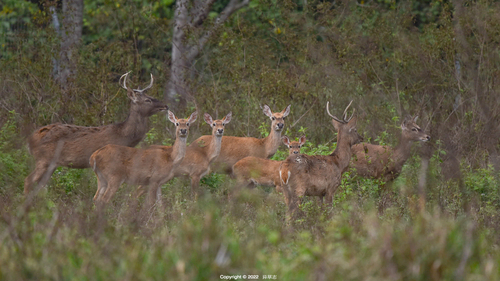
Coat color varies from reddish-brown in summer to grayish-brown in winter, with a pale rump patch; males possess large branching antlers shed and regrown annually.
Size
Shoulder height ranges from 100-130 cm; body length typically 160-210 cm depending on subspecies.
Weight
Males typically weigh 150-250 kg, while females are smaller at 90-150 kg.
Distinctive features
Distinguished from other red deer subspecies by smaller body size, paler winter coats adapted to arid climates, and antler shapes with fewer but robust tines suited to open habitats.
Differences between males and females
Males are notably larger and heavier than females and possess prominent multi-tined antlers, while females are hornless and more slender.
Behaviour and diet of the Tarim Red Deer
Generally social, forming small herds of females and young, while males are more solitary or form bachelor groups outside the rutting season; larger aggregations may occur near water or feeding grounds.
When it is active
Primarily crepuscular, most active during dawn and dusk to avoid heat and human disturbance, resting in cover during midday.
Diet
Herbivorous, grazing on grasses, sedges, and browsing on shrubs, tree bark, and leaves, particularly poplar and tamarisk in riparian zones.
Communication
Communication includes vocal roaring and bugling calls during the rut, scent marking via glandular secretions, and visual displays such as antler posturing.
Interactions with other species
Natural predators include wolves and occasionally leopards or snow leopards in mountainous areas; deer also compete with domestic livestock for forage in shared rangelands.
Role in its ecosystem
As herbivores, they play a role in shaping vegetation structure through grazing and browsing, and serve as prey for large carnivores, contributing to predator-prey dynamics in fragile desert and mountain ecosystems.
Reproduction and lifecycle
Breeding season (rut) occurs in autumn, with males competing vocally and physically for access to females; gestation lasts about 240-260 days, typically resulting in a single calf born in late spring.
Raising the young
Females provide sole parental care, nursing and protecting calves for several months until weaning, with calves remaining close to their mothers through the first year.
Maturity and lifespan
Sexual maturity is reached around 2-3 years of age; lifespan in the wild is typically 10-15 years, extending to 18-20 years in captivity.
Taxonomy and naming of the Tarim Red Deer
Classification
Class Mammalia > Order Artiodactyla > Family Cervidae > Genus Cervus > Species Cervus hanglu
Subspecies
Cervus hanglu hanglu (Kashmir stag/Hangul, restricted to Dachigam National Park, Kashmir); Cervus hanglu yarkandensis (Yarkand or Tarim deer, Tarim Basin, Xinjiang, China); Cervus hanglu bactrianus (Bactrian deer, riparian forests along the Amu Darya and Syr Darya in Central Asia)
Scientific synonyms
Cervus elaphus hanglu, Cervus elaphus yarkandensis, Cervus elaphus bactrianus (formerly classified as subspecies of the widespread Cervus elaphus)
What research says
Recent studies
Recent phylogenetic research using mitochondrial DNA has clarified the taxonomic status of Central Asian deer populations, prompting reclassification and highlighting the urgent conservation needs of isolated subspecies like the Kashmir stag.
Genome and DNA
Genetic studies have confirmed that Central Asian red deer subspecies form a distinct clade separate from European and North American red deer, supporting their classification as Cervus hanglu rather than Cervus elaphus.
Compared with similar species
Compared to the European red deer (Cervus elaphus), the Tarim Red Deer group is generally smaller, paler, and adapted to arid or semi-arid habitats rather than temperate woodlands.
The Tarim Red Deer and people
The Kashmir stag is the only surviving red deer subspecies in the Indian subcontinent, and the Yarkand deer inhabits some of the most remote desert oases in the world, surviving temperatures ranging from scorching summers to freezing winters.
Where and how to see it
Best observed in Dachigam National Park, India, during early morning or late afternoon in autumn when rutting activity increases visibility; patience and quiet observation from designated trails improve chances of sightings.
Risks to humans
No notable risk to humans; these deer are shy and avoid contact, though males can become aggressive during the rutting season if approached closely.
Human uses
Historically hunted for meat and antlers, some populations have also been subject to traditional medicine trade for antler velvet, though this is now heavily restricted due to conservation status.
Myths and legends
The Hangul (Kashmir stag) holds cultural significance as the state animal of Jammu and Kashmir and is often referenced in local folklore as a symbol of the region's natural heritage.
Countries where the Tarim Red Deer is recorded
The 6 countries named in the range description of its IUCN Red List assessment.
Questions about the Tarim Red Deer
Where does the Tarim Red Deer live?
The Tarim Red Deer is recorded in Afghanistan, China, India, Tajikistan and Turkmenistan, among 6 countries in total across Asia. These countries come from the range description of its IUCN Red List assessment, and they are what place the species on the interactive map.
Is the Tarim Red Deer endangered?
The IUCN Red List assesses the Tarim Red Deer as Least Concern. The species is widespread and abundant enough not to qualify for any threatened category. It does not mean the species is safe forever, only that nothing in the current data raises an alarm.
How many are left in the wild?
Global population across all subspecies is estimated at a few thousand individuals, with the Kashmir stag numbering fewer than 300 and the Yarkand deer around 1,000-1,500 individuals; overall trend is declining in most subpopulations. This figure comes from the species assessment on the IUCN Red List; population estimates for wild mammals are ranges, not counts, and are revised at each assessment.
What habitat does the Tarim Red Deer live in?
Riparian tugai forests, poplar and tamarisk thickets along rivers, mountain valleys with mixed coniferous and broadleaf forest, and semi-arid scrublands bordering desert basins.
What is the scientific name of the Tarim Red Deer?
The Tarim Red Deer is Cervus hanglu, in the family Cervidae, order Artiodactyla.
Other species in the genus Cervus
Other species in the family Cervidae
Species that share its range
Sources
Conservation status, range description and population estimate come from the IUCN Red List assessment for Cervus hanglu. Countries are derived from that range description, not from a mapped country list. Last refreshed on .
The distribution map is drawn from the IUCN Red List spatial data compiled in 2017. IUCN (International Union for Conservation of Nature)