
Sun Bear
Helarctos malayanus
Red List assessment
Vulnerableon the IUCN Red List
- EXExtinct
- EWExtinct in the Wild
- CRCritically Endangered
- ENEndangered
- VUVulnerable
- NTNear Threatened
- LCLeast Concern
The Sun Bear is recorded in 8 countries across Asia. The IUCN Red List assesses the Sun Bear as Vulnerable. Population size is difficult to estimate precisely due to their solitary and elusive nature, but it is believed to be declining, with total numbers likely in the tens of thousands and still decreasing.
- Family
- Ursidae
- Order
- Carnivora
- Genus
- Helarctos
- Countries recorded
- 8
- Continents
- Asia
- Red List category
- Vulnerable
- Data updated
- August 9, 2026
What is the Sun Bear?
The Sun Bear is the smallest bear species in the world, native to the dense tropical rainforests of Southeast Asia. Known for its short sleek black fur and distinctive golden-orange chest patch resembling a rising sun, it is highly arboreal and possesses an unusually long tongue for extracting insects and honey. It plays a vital ecological role as a seed disperser and forest engineer by digging for insects. Despite its small size, it has a fierce reputation and is sometimes called the 'dog bear' due to its compact build.
Where does the Sun Bear live?
Southeast Asia, including Borneo, Sumatra, Malay Peninsula, Thailand, Myanmar, Cambodia, Laos, Vietnam
Found across Southeast Asia including Brunei, Cambodia, Indonesia (Sumatra and Borneo), Laos, Malaysia, Myanmar, Thailand, and Vietnam. Historically more widespread but now fragmented due to habitat loss.
Altitude and depth
0-1500m, though typically found in lowland forests below 1000m
Seasonal movements
No true hibernation due to tropical climate with stable year-round food availability; breeding can occur at any time of year.
Habitat of the Sun Bear
Primarily lowland tropical and subtropical moist forests, including primary and secondary rainforests. Also found in swamp forests and montane forests up to certain elevations, favoring areas with dense canopy cover.
Adaptations to its environment
Extremely long tongue (up to 25cm) for extracting honey and insects from tree cavities and logs. Strong curved claws and flexible ankle joints allow exceptional climbing ability. Loose skin around the neck allows it to twist and bite predators even when grabbed.
Conservation status and numbers
Vulnerable (VU) according to IUCN, primarily due to an estimated population decline of at least 30% over the past three generations (approximately 30 years) caused by habitat loss and poaching.
Estimated population
Population size is difficult to estimate precisely due to their solitary and elusive nature, but it is believed to be declining, with total numbers likely in the tens of thousands and still decreasing.
What threatens the Sun Bear?
Deforestation for palm oil plantations and logging, poaching for bile and body parts used in traditional medicine, illegal pet trade, and human-wildlife conflict.
Diseases and parasites
Susceptible to various internal parasites (nematodes, cestodes) and external parasites like ticks; captive bears have shown susceptibility to diseases common in captive carnivores.
What is being done to protect it?
Protected under CITES Appendix I, with conservation programs including the Bornean Sun Bear Conservation Centre (BSBCC) in Sabah, Malaysia. Various protected areas and national parks across their range provide habitat protection.
Recommended actions
Strengthen anti-poaching enforcement, expand and connect protected forest habitats, reduce demand for bear bile products through education, and support rehabilitation and reintroduction programs for confiscated bears.
What the Sun Bear looks like
Short, sleek black fur covers most of the body, with a distinctive crescent-shaped golden, orange, or cream patch on the chest. The muzzle is typically light grey or orange, and the bear has small rounded ears and a stocky build.
Size
Body length 100-140 cm, shoulder height approximately 50-70 cm
Weight
Males typically 30-60 kg, females slightly smaller at 20-40 kg
Distinctive features
Smallest bear species with the shortest fur of any bear, an unusually long tongue relative to body size, and the iconic chest patch that gives it the name 'sun bear.' Its bowed legs and inward-turned feet are adaptations for climbing.
Differences between males and females
Males are generally 10-20% larger than females, but coloration and markings are similar between sexes.
Behaviour and diet of the Sun Bear
Primarily solitary, with individuals maintaining home ranges that may overlap. Occasional mother-cub groups are the main social units, though rare unaggressive encounters between adults have been observed.
When it is active
Both diurnal and nocturnal, showing flexible activity patterns likely influenced by human disturbance, with more nocturnal behavior noted in areas with high human activity.
Diet
Omnivorous diet consisting mainly of insects (especially termites and ants), honey, fruits, and small vertebrates. Also consumes bird eggs, earthworms, and occasionally small mammals.
How it feeds and hunts
Uses powerful claws to tear open logs and termite mounds, and its long tongue to extract insects and honey from crevices; climbs trees to access bee hives and fruit.
Communication
Communicates through vocalizations including grunts, huffs, and roars, as well as scent marking via urine and claw marks on trees to establish territory boundaries.
Interactions with other species
Adult sun bears have few natural predators aside from tigers and clouded leopards, which may prey on cubs. They may compete with other omnivores for food resources like fruit and insects.
Role in its ecosystem
Plays a crucial ecological role as a seed disperser through fruit consumption and as an ecosystem engineer by breaking apart rotting logs, which aids nutrient cycling and creates microhabitats for other species.
Reproduction and lifecycle
Breeding can occur year-round with no fixed season; gestation lasts approximately 95-96 days (with possible delayed implantation extending this period), and females typically give birth to 1-2 cubs.
Raising the young
Mothers provide sole parental care, nursing and protecting cubs in a den for the first few months. Cubs remain with their mother for up to 2-3 years, learning foraging and survival skills.
Maturity and lifespan
Sexual maturity reached around 3-4 years; lifespan in the wild is approximately 20-25 years, while captive individuals can live up to 30 years.
Taxonomy and naming of the Sun Bear
Classification
Mammalia > Carnivora > Ursidae > Helarctos > Helarctos malayanus
Subspecies
Two recognized subspecies: Helarctos malayanus malayanus (mainland Southeast Asia) and Helarctos malayanus euryspilus (Borneo, smaller in size).
Scientific synonyms
Ursus malayanus (original classification before genus Helarctos was established)
What research says
Recent studies
Recent camera trap studies have revealed complex facial expressions used in communication between sun bears, suggesting more sophisticated social communication than previously thought.
Genome and DNA
Diploid chromosome number is 2n=74, similar to other bear species; genetic studies have confirmed its distinct evolutionary lineage as the earliest diverging member of the bear family alongside other ursids.
Compared with similar species
Compared to the American black bear, sun bears are significantly smaller with shorter fur and a distinctive chest patch; unlike most bear species, they do not hibernate due to their tropical habitat.
The Sun Bear and people
Sun bears have the longest tongue relative to body size of any bear species, sometimes reaching 20-25 cm. They are excellent climbers and can even sleep in trees. Their facial expressions are surprisingly complex, with recent studies showing they can mimic each other's facial movements similar to primates.
Where and how to see it
Best observed in rehabilitation centers such as the Bornean Sun Bear Conservation Centre in Sabah, Malaysia, since wild sightings are rare due to their elusive and solitary nature; early morning visits increase chances of activity.
Risks to humans
Generally avoid humans but can become aggressive if cornered or threatened; attacks on humans are rare but have been recorded, particularly involving captive or habituated individuals.
Human uses
Historically hunted for bile extracted for traditional Asian medicine, as well as for meat and paws considered delicacies in some regions; also captured illegally for the exotic pet trade.
Myths and legends
In some Southeast Asian cultures, sun bears are associated with folklore about forest spirits, and their body parts have long been used in traditional medicine practices despite lack of scientific evidence for efficacy.
Countries where the Sun Bear is recorded
The 8 countries named in the range description of its IUCN Red List assessment.
Questions about the Sun Bear
Where does the Sun Bear live?
The Sun Bear is recorded in Brunei, Cambodia, Indonesia, Laos and Malaysia, among 8 countries in total across Asia. These countries come from the range description of its IUCN Red List assessment, and they are what place the species on the interactive map.
Is the Sun Bear endangered?
Yes. The IUCN Red List assesses the Sun Bear as Vulnerable, one of the three threatened categories. The species faces a high risk of extinction in the wild. It is the first of the three threatened categories: numbers are falling, the range is shrinking, or the population is small enough that a single bad event could do lasting damage.
How many are left in the wild?
Population size is difficult to estimate precisely due to their solitary and elusive nature, but it is believed to be declining, with total numbers likely in the tens of thousands and still decreasing. This figure comes from the species assessment on the IUCN Red List; population estimates for wild mammals are ranges, not counts, and are revised at each assessment.
What habitat does the Sun Bear live in?
Primarily lowland tropical and subtropical moist forests, including primary and secondary rainforests.
What is the scientific name of the Sun Bear?
The Sun Bear is Helarctos malayanus, in the family Ursidae, order Carnivora.
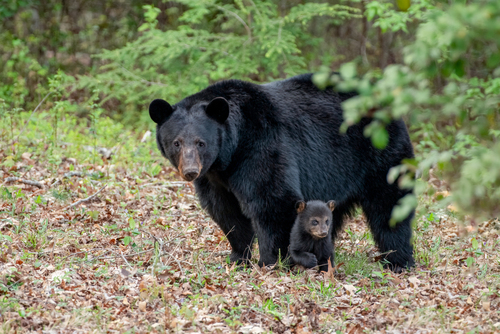
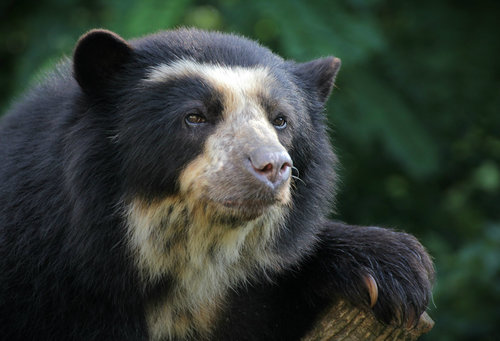
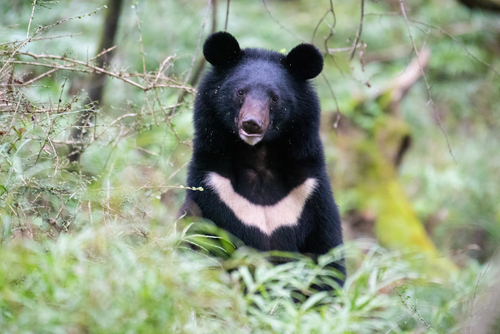
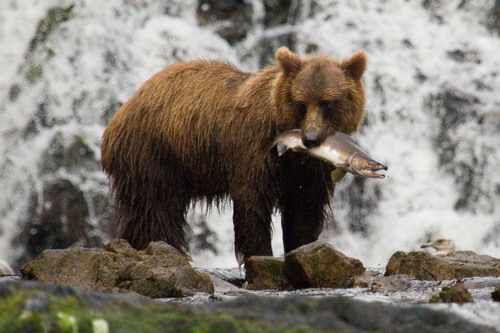
Other species in the family Ursidae
Species that share its range
Sources
Conservation status, range description and population estimate come from the IUCN Red List assessment for Helarctos malayanus. Countries are derived from that range description, not from a mapped country list. Last refreshed on .
The distribution map is drawn from the IUCN Red List spatial data compiled in 2017. Scotson, L. and Fredriksson, G. 2016