
Asiatic Brush-tailed Porcupine
Atherurus macrourus
Red List assessment
Least Concernon the IUCN Red List
- EXExtinct
- EWExtinct in the Wild
- CRCritically Endangered
- ENEndangered
- VUVulnerable
- NTNear Threatened
- LCLeast Concern
The Asiatic Brush-tailed Porcupine is recorded in 10 countries across Asia. The IUCN Red List assesses the Asiatic Brush-tailed Porcupine as Least Concern. No precise global population estimate is available.
- Family
- Hystricidae
- Order
- Rodentia
- Genus
- Atherurus
- Countries recorded
- 10
- Continents
- Asia
- Red List category
- Least Concern
- Data updated
- August 9, 2026
What is the Asiatic Brush-tailed Porcupine?
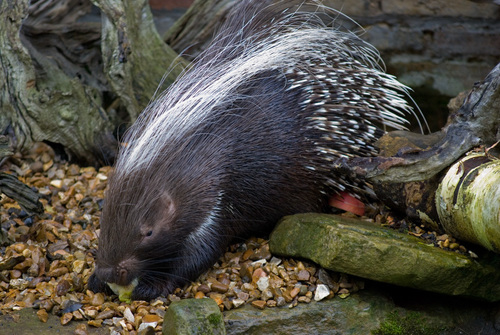
The Asiatic Brush-tailed Porcupine is a medium-sized rodent belonging to the Old World porcupine family Hystricidae, characterized by a body densely covered in flat, overlapping quills and spines. Its most remarkable feature is its tail, which terminates in a distinctive brush or rattle of hollow, flattened, petal-like quills that can be shaken to produce a loud rattling sound as a warning. It is strictly terrestrial, nocturnal, and inhabits dense tropical and subtropical forests across a broad range in South and Southeast Asia. Unlike its larger relatives in Hystrix, it is more slender and agile, with a proportionally longer tail.
Where does the Asiatic Brush-tailed Porcupine live?
Northeast India (Assam, Nagaland, Manipur), Bangladesh, Myanmar, Thailand, Laos, Vietnam, Cambodia, southern China (Yunnan, Guangxi, Hainan), Malay Peninsula, Sumatra, and Borneo
Ranges from northeast India and Bangladesh eastward through Myanmar, Thailand, Indochina (Laos, Vietnam, Cambodia), and southern China (Yunnan, Guangxi, Guangdong, Fujian, Hainan Island), extending south through the Malay Peninsula to Sumatra and Borneo (Malaysia and Indonesia).
Altitude and depth
Found from sea level up to approximately 2,500 m elevation. Most common in lowland and foothill forests below 1,500 m, though it has been recorded at higher elevations in suitable montane forest habitats.
Seasonal movements
No true hibernation or long-distance migration reported. Activity patterns and foraging behavior may shift subtly with seasonal changes in food availability (e.g., fruiting seasons). Generally resident year-round in its home range.
Habitat of the Asiatic Brush-tailed Porcupine
Primarily dense tropical and subtropical moist broadleaf forests, including lowland rainforests and hill forests. It also occurs in bamboo thickets, scrublands, and forest edges near agricultural areas. It shelters in burrows it digs itself, in natural rock crevices, hollow logs, or caves.
Adaptations to its environment
The body is armored with dense, flattened spines and quills providing effective anti-predator defense; when threatened, it erects its quills, stamps its feet, and rattles its tail brush to deter attackers. Its strong, curved claws are well-suited for digging burrows and excavating roots and tubers. Large, sensitive whiskers and well-developed olfaction compensate for relatively poor eyesight in nocturnal foraging. Its digestive system is adapted to processing fibrous plant material and gnawing hard substrates.
Conservation status and numbers
Listed as Least Concern (LC) on the IUCN Red List, as the species is broadly distributed and presumed to maintain adequate population sizes across its range. However, populations are declining locally due to hunting pressure and habitat loss, and continued monitoring is recommended.
Estimated population
No precise global population estimate is available. The overall population trend is considered declining, driven by hunting and habitat loss, particularly in Vietnam, China, and parts of Indochina where market demand for wild meat is high.
What threatens the Asiatic Brush-tailed Porcupine?
Primary threats include extensive hunting for bushmeat throughout Southeast Asia and southern China, where it is heavily traded in local wildlife markets. Habitat destruction through deforestation, agricultural expansion, and logging reduces suitable forest cover. It is also captured for use in traditional medicine (particularly bezoar stones) and occasionally the pet trade.
Diseases and parasites
Susceptible to various ecto- and endoparasites common to forest rodents, including nematodes, cestodes, and ectoparasitic mites and ticks. In Southeast Asia, porcupines have been identified as potential reservoirs or carriers of zoonotic pathogens, though specific studies on A. macrourus are limited.
What is being done to protect it?
The species benefits from legal protection within national parks and wildlife sanctuaries across its range, including protected areas in Thailand, Malaysia, and India. It is listed on CITES Appendix III in India. Some range countries have national wildlife protection legislation, though enforcement is inconsistent.
Recommended actions
Strengthened enforcement against illegal wildlife trade and bushmeat hunting is a priority. Expansion and effective management of protected area networks, combined with community-based conservation programs to reduce hunting demand, are recommended. Long-term population monitoring and genetic studies across the range would clarify subspecies boundaries and local conservation needs.
What the Asiatic Brush-tailed Porcupine looks like
The body is covered with flat, dark brown to blackish overlapping spines and quills on the back and flanks, with shorter, softer underfur on the belly. The head is rounded with small eyes and inconspicuous ears, and the muzzle is blunt and whiskered. The tail is slender and ends in a characteristic cluster of hollow, whitish or yellowish flattened quills forming the distinctive 'brush' or rattle.
Size
Body length 40–55 cm; tail length 15–25 cm. Shoulder height approximately 15–20 cm. The tail brush adds a conspicuous visual and acoustic element despite being relatively short.
Weight
Typically 1.5–4 kg. Males and females are similar in weight, though slight male-biased size differences may occur.
Distinctive features
Distinguished from the African Brush-tailed Porcupine (Atherurus africanus) by geographic range and slight morphological differences. Distinguished from larger Asian porcupines (Hystrix spp.) by its much smaller size, slender body form, and the uniquely elongated rattling brush at the tail tip rather than long erect quills. Its flattened quill profile rather than cylindrical quills is also diagnostic.
Differences between males and females
Sexual dimorphism is minimal in this species. Males and females are similar in size and coloration. Females possess three pairs of lateral mammae. External genitalia are the primary distinguishing feature.
Behaviour and diet of the Asiatic Brush-tailed Porcupine
Typically lives in small family groups of 2–8 individuals, often a breeding pair and their offspring, sharing a communal burrow system. May also be encountered solitarily foraging at night. Social bonds are maintained through scent marking and mutual grooming.
When it is active
Strictly nocturnal. Emerges after dark to forage and returns to its burrow or den before dawn. Daytime hours are spent resting in the burrow, rock crevice, or hollow log.
Diet
Herbivorous, with a diet consisting primarily of roots, tubers, rhizomes, fallen fruits, seeds, bark, and plant stems. Known to gnaw on bones and antlers (osteophagy) to supplement calcium and phosphorus intake. Occasionally raids agricultural crops such as cassava, sweet potato, and corn.
How it feeds and hunts
Not applicable as a strict herbivore. Forages by rooting in soil with its snout and claws to uncover underground plant parts, following olfactory cues to locate food. May travel several kilometers per night within its home range.
Communication
The hollow tail-rattle quills are shaken vigorously as a primary acoustic warning signal to predators and rivals. Vocalizations include grunts, hisses, and tooth-chattering when alarmed. Scent marking via anal glands, urine, and feces is important for territorial demarcation and social communication.
Interactions with other species
Natural predators include large felids (tigers, leopards, clouded leopards), large constrictors (reticulated python, Burmese python), and dholes. When threatened, the porcupine raises its quills and reverses rapidly into the predator, potentially injuring it. Competes with other frugivorous and root-feeding rodents for food resources. May play a minor role in seed dispersal by caching food.
Role in its ecosystem
Functions as an important seed predator and, incidentally, a seed disperser within tropical forest ecosystems. Its burrowing activity aerates soil and contributes to nutrient cycling. As prey, it is a significant food source for apex predators in Southeast Asian forests.
Reproduction and lifecycle
Breeding can occur year-round in tropical regions, though peaks may coincide with seasons of food abundance. Gestation lasts approximately 100–110 days. Litter size is small, typically 1–3 young (most commonly 1–2). Young are born well-developed (precocial) with soft quills that harden within hours.
Raising the young
Both parents, and sometimes older siblings in the family group, participate in caring for the young within the communal burrow. Young are suckled for approximately 13–16 weeks and gradually introduced to solid foods. Juveniles may remain with the family group for an extended period before dispersing.
Maturity and lifespan
Sexual maturity is reached at approximately 1.5–2 years of age. Wild lifespan is estimated at 5–10 years; in captivity, individuals may survive up to 15 years with proper care.
Taxonomy and naming of the Asiatic Brush-tailed Porcupine
Classification
Mammalia > Rodentia > Hystricidae > Atherurus > Atherurus macrourus
Subspecies
Several subspecies are recognized, including A. m. macrourus (mainland Southeast Asia), A. m. assamensis (northeast India and Assam), and A. m. subcaudatus (Borneo and Sumatra), though their boundaries remain subject to ongoing taxonomic review.
Scientific synonyms
Hystrix macroura Linnaeus, 1758 (basionym); Acanthion macroura; Acanthion macrourus. The species was originally placed in the genus Hystrix before being reclassified into Atherurus.
What research says
Recent studies
Camera-trap surveys across Southeast Asia have refined our understanding of its habitat preferences and activity patterns. Recent phylogeographic studies have highlighted significant genetic structure across its range, suggesting cryptic diversity. Trade monitoring studies have documented it as one of the most frequently seized porcupine species in Southeast Asian wildlife markets.
Genome and DNA
The karyotype of Atherurus macrourus is reported as 2n = 48. Molecular phylogenetic studies place the genus Atherurus as a basal lineage within Hystricidae, divergent from both Hystrix and the African brush-tailed porcupine. Detailed genomic studies for this species remain limited.
Compared with similar species
Most closely related to the African Brush-tailed Porcupine (Atherurus africanus) of Central and West Africa, sharing the characteristic rattling tail brush but separated by continental range and slight morphological differences. Compared to Old World porcupines of genus Hystrix (e.g., Himalayan porcupine H. brachyura), A. macrourus is considerably smaller, lacks the spectacular long crest quills, and is more agile. Unlike New World porcupines (Erethizontidae), it is entirely terrestrial.
The Asiatic Brush-tailed Porcupine and people
The hollow, flattened quills at the tail tip function like a natural maraca — when shaken rapidly they produce a loud rattling sound audible from several meters away, effectively mimicking the warning rattle of a snake. Unlike common belief, no porcupine — including this species — can 'shoot' its quills; the quills detach on contact and their backward-pointing barbs make removal extremely painful for the attacker. This species is known to gnaw on discarded bones and even visit mineral licks to obtain essential minerals lacking in its plant diet.
Where and how to see it
Best observed at night in dense tropical forest using red-light torches to avoid disturbing the animal. Wildlife sanctuaries and national parks in western Thailand (e.g., Kaeng Krachan, Huai Kha Khaeng), northern Peninsular Malaysia (Taman Negara), and northeastern India (Namdapha) offer good opportunities. Setting up camera traps along forest trails near rocky outcrops or riverbanks increases detection chances.
Risks to humans
No venom or direct lethal risk to humans. However, the quills are sharp and barbed and can cause painful puncture wounds and secondary infections if the animal is handled carelessly or cornered. It may bite if restrained. No significant disease transmission risk under normal circumstances, though it may carry ectoparasites.
Human uses
Widely hunted across its range as bushmeat and sold in local wildlife markets. The quills are used decoratively and in traditional crafts. Most significantly, intestinal bezoar stones ('porcupine dates') are traded at very high prices in traditional medicine markets in China, Vietnam, Malaysia, and Singapore, purportedly for treating various illnesses. Occasionally kept as exotic pets, though this is generally illegal without permits.
Myths and legends
In parts of Southeast Asia and southern China, a calcified mass (bezoar stone or 'porcupine date') occasionally found in the gastrointestinal tract of porcupines is highly prized in traditional Chinese and Malaysian medicine as a cure for cancer, fever, and poisoning, commanding very high prices. This belief significantly drives hunting pressure on the species. In some local cultures, porcupine quills are used as protective talismans or decorative items.
Countries where the Asiatic Brush-tailed Porcupine is recorded
The 10 countries named in the range description of its IUCN Red List assessment.
Questions about the Asiatic Brush-tailed Porcupine
Where does the Asiatic Brush-tailed Porcupine live?
The Asiatic Brush-tailed Porcupine is recorded in Bangladesh, Cambodia, China, India and Indonesia, among 10 countries in total across Asia. These countries come from the range description of its IUCN Red List assessment, and they are what place the species on the interactive map.
Is the Asiatic Brush-tailed Porcupine endangered?
The IUCN Red List assesses the Asiatic Brush-tailed Porcupine as Least Concern. The species is widespread and abundant enough not to qualify for any threatened category. It does not mean the species is safe forever, only that nothing in the current data raises an alarm.
How many are left in the wild?
No precise global population estimate is available. This figure comes from the species assessment on the IUCN Red List; population estimates for wild mammals are ranges, not counts, and are revised at each assessment.
What habitat does the Asiatic Brush-tailed Porcupine live in?
Primarily dense tropical and subtropical moist broadleaf forests, including lowland rainforests and hill forests.
What is the scientific name of the Asiatic Brush-tailed Porcupine?
The Asiatic Brush-tailed Porcupine is Atherurus macrourus, in the family Hystricidae, order Rodentia.
Other species in the genus Atherurus

Other species in the family Hystricidae
Species that share its range
Sources
Conservation status, range description and population estimate come from the IUCN Red List assessment for Atherurus macrourus. Countries are derived from that range description, not from a mapped country list. Last refreshed on .
The distribution map is drawn from the IUCN Red List spatial data compiled in 2008. IUCN (International Union for Conservation of Nature)