
Side-striped Jackal
Lupulella adustus
Red List assessment
Least Concernon the IUCN Red List
- EXExtinct
- EWExtinct in the Wild
- CRCritically Endangered
- ENEndangered
- VUVulnerable
- NTNear Threatened
- LCLeast Concern
The Side-striped Jackal is recorded in 10 countries across Africa. The IUCN Red List assesses the Side-striped Jackal as Least Concern. No precise global population estimate exists, but the species is considered common to locally abundant across much of its range; population trend is thought to be stable.
- Family
- Canidae
- Order
- Carnivora
- Genus
- Lupulella
- Countries recorded
- 10
- Continents
- Africa
- Red List category
- Least Concern
- Data updated
- August 9, 2026
What is the Side-striped Jackal?
The Side-striped Jackal is a medium-sized canid native to sub-Saharan Africa, distinguished by pale stripes running along its flanks. It is the least studied of Africa's jackal species and tends to be more solitary and less vocal than its relatives. Highly adaptable, it thrives in a variety of habitats from savanna to woodland, and even peri-urban areas. Its omnivorous diet and behavioral flexibility make it remarkably resilient compared to other jackal species.
Where does the Side-striped Jackal live?
Sub-Saharan Africa, particularly Central, East, and Southern Africa
Widely distributed across sub-Saharan Africa from Senegal in West Africa through Central Africa (DRC, Cameroon) to East Africa (Kenya, Tanzania, Ethiopia) and into Southern Africa (Zambia, Zimbabwe, Mozambique, northern South Africa). Absent from the Horn of Africa's arid regions and southern African deserts.
Altitude and depth
Sea level up to approximately 2,700 meters in East African highlands
Seasonal movements
No true migration; breeding is often timed to coincide with the rainy season when food resources are more abundant, though this varies by region.
Habitat of the Side-striped Jackal
Prefers moist savanna, woodland, and forest-savanna mosaics, often near water sources; also found in agricultural land and suburban edges. Avoids arid and open grassland habitats favored by black-backed jackals. Dense vegetation cover is important for denning and shelter.
Adaptations to its environment
Omnivorous diet allows exploitation of diverse food sources including insects, fruit, and small vertebrates. Nocturnal/crepuscular activity reduces competition and predation risk from larger carnivores. Cryptic coloration and quiet behavior help avoid detection by predators and competitors like black-backed jackals and hyenas.
Conservation status and numbers
Listed as Least Concern by IUCN due to a wide distribution range and stable overall population trend. The species shows tolerance to habitat modification and human presence, unlike more specialized carnivores.
Estimated population
No precise global population estimate exists, but the species is considered common to locally abundant across much of its range; population trend is thought to be stable.
What threatens the Side-striped Jackal?
Habitat loss from agricultural expansion, persecution due to perceived livestock threats, road mortality, and disease transmission from domestic dogs (rabies, canine distemper). Bushmeat snaring can also cause incidental mortality.
Diseases and parasites
Susceptible to rabies, canine distemper virus, and mange, often transmitted through contact with domestic dogs; also hosts various ticks and intestinal parasites.
What is being done to protect it?
Present in numerous protected areas across its range including national parks and game reserves in East and Southern Africa. Some countries have implemented rabies vaccination programs for domestic dogs that indirectly benefit wild canid populations.
Recommended actions
Continued monitoring of population trends outside protected areas, disease surveillance and vaccination buffer zones near human settlements, and community education to reduce unwarranted persecution.
What the Side-striped Jackal looks like
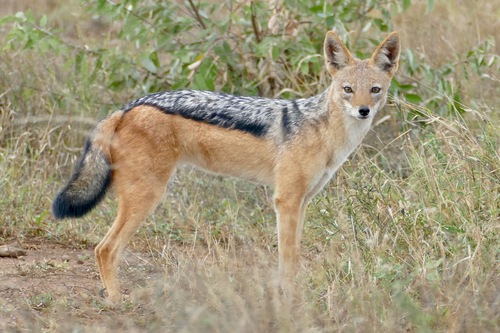
Grizzled grey-to-tawny coat with a distinctive pale horizontal stripe bordered by dark fur along each flank. The tail is bushy with a white tip, and the muzzle and legs tend to be more rufous in color. Ears are relatively short and rounded compared to other jackal species.
Size
Body length 60-100 cm, with a tail of 30-41 cm; shoulder height approximately 35-50 cm
Weight
6-14 kg, with males slightly larger than females on average
Distinctive features
The namesake pale side stripe bordered by black fur distinguishes it from the black-backed jackal (which has a dark saddle) and the golden jackal (which lacks flank markings). It also has a shorter, more robust muzzle and a white-tipped tail unique among African jackals.
Differences between males and females
Minimal sexual dimorphism; males are only slightly larger and heavier than females, with no significant color or pattern differences.
Behaviour and diet of the Side-striped Jackal
Generally monogamous and lives in mated pairs or small family groups, sometimes with offspring from previous litters assisting as helpers. Less social and more solitary in foraging behavior compared to black-backed jackals.
When it is active
Primarily nocturnal and crepuscular, resting in dense cover or dens during the heat of the day.
Diet
Omnivorous diet including insects (especially termites and beetles), small mammals, reptiles, birds, fruit, and carrion. Wild fruits can make up a significant portion of the diet seasonally, more so than in other jackal species.
How it feeds and hunts
Forages opportunistically and solitarily, using a combination of stalking small prey and scavenging; insects are often caught by digging or pouncing on the ground.
Communication
Uses a distinctive soft, owl-like hooting call rather than the yipping typical of other jackals, along with scent marking via urine and glands to establish territory boundaries.
Interactions with other species
Subordinate to larger carnivores like spotted hyenas and lions, and may compete with black-backed jackals where ranges overlap. Can fall prey to leopards and large raptors when young.
Role in its ecosystem
Functions as a mesopredator and scavenger, helping control small mammal and insect populations while also serving as a seed disperser through fruit consumption.
Reproduction and lifecycle
Breeding season varies by region but often peaks in the dry season; gestation lasts approximately 57-70 days, producing litters of 3-6 pups born in underground dens.
Raising the young
Both parents participate in raising pups, with the female nursing while the male provides food; older siblings from previous litters sometimes act as helpers. Pups are weaned around 8-10 weeks and become independent by 5-6 months.
Maturity and lifespan
Sexual maturity reached around 6-12 months; lifespan in the wild is typically 6-10 years, extending to 10-14 years in captivity.
Taxonomy and naming of the Side-striped Jackal
Classification
Class Mammalia > Order Carnivora > Family Canidae > Genus Lupulella > Species Lupulella adustus
Subspecies
Several subspecies proposed including L. a. adustus (Central Africa), L. a. bweha (East Africa), L. a. kaffensis (Ethiopia), L. a. lateralis (West Africa), and L. a. notatus (Southern Africa), though taxonomy remains debated.
Scientific synonyms
Canis adustus (former genus placement before reclassification into Lupulella)
What research says
Recent studies
Recent phylogenetic research using mitochondrial and nuclear DNA has confirmed that side-striped and black-backed jackals form a distinct evolutionary lineage separate from true Canis species, leading to their reclassification into Lupulella in 2018.
Genome and DNA
Diploid chromosome number of 2n=78, similar to other canids; genetic studies have supported reclassification from Canis to the distinct genus Lupulella alongside the black-backed jackal.
Compared with similar species
Compared to the black-backed jackal, the side-striped jackal is less vocal, more omnivorous, and prefers denser, wetter habitats rather than open savanna. It is generally considered less aggressive and more retiring in behavior.
The Side-striped Jackal and people
Unlike other jackals known for yipping calls, the side-striped jackal makes a unique hooting sound reminiscent of an owl. It is also one of the few jackal species known to readily eat large quantities of fruit, acting as an informal seed disperser in its ecosystem.
Where and how to see it
Best observed during night drives in game reserves within its range such as South Luangwa National Park in Zambia or Kruger National Park's northern regions in South Africa; using spotlights at dusk increases sighting chances.
Risks to humans
No notable risk to humans directly, though as a rabies vector species, bites should be treated with caution and any encounter with an aggressive or sick-looking individual reported to authorities.
Human uses
Occasionally hunted or trapped for its fur in some regions, though this is not widespread; in some cultures certain body parts are used in traditional medicine practices.
Myths and legends
In some African folklore traditions, jackals in general are portrayed as clever tricksters, though the side-striped jackal specifically features less prominently in mythology compared to the black-backed jackal.
Countries where the Side-striped Jackal is recorded
The 10 countries named in the range description of its IUCN Red List assessment.
Questions about the Side-striped Jackal
Where does the Side-striped Jackal live?
The Side-striped Jackal is recorded in Cameroon, Democratic Republic of the Congo, Ethiopia, Kenya and Mozambique, among 10 countries in total across Africa. These countries come from the range description of its IUCN Red List assessment, and they are what place the species on the interactive map.
Is the Side-striped Jackal endangered?
The IUCN Red List assesses the Side-striped Jackal as Least Concern. The species is widespread and abundant enough not to qualify for any threatened category. It does not mean the species is safe forever, only that nothing in the current data raises an alarm.
How many are left in the wild?
No precise global population estimate exists, but the species is considered common to locally abundant across much of its range; population trend is thought to be stable. This figure comes from the species assessment on the IUCN Red List; population estimates for wild mammals are ranges, not counts, and are revised at each assessment.
What habitat does the Side-striped Jackal live in?
Prefers moist savanna, woodland, and forest-savanna mosaics, often near water sources; also found in agricultural land and suburban edges.
What is the scientific name of the Side-striped Jackal?
The Side-striped Jackal is Lupulella adustus, in the family Canidae, order Carnivora.
Other species in the genus Lupulella
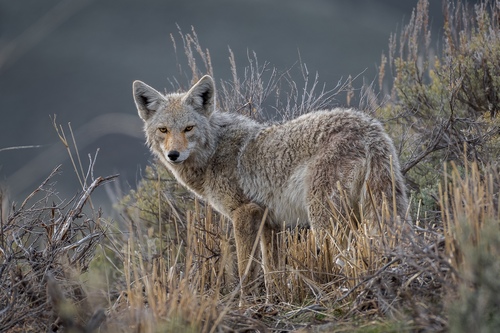
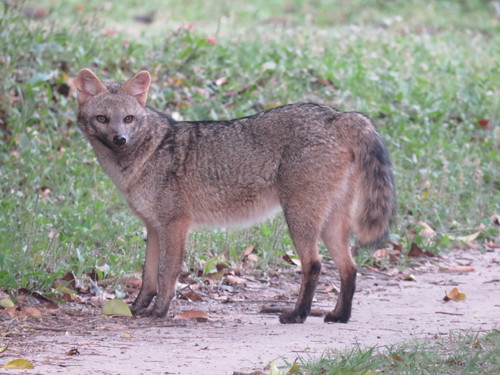
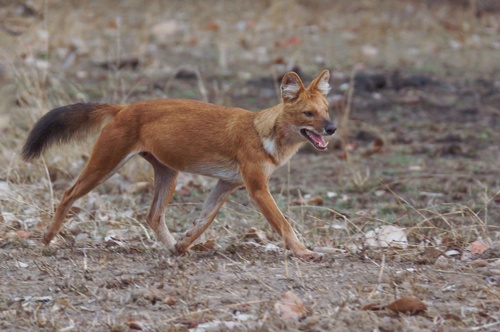
Other species in the family Canidae
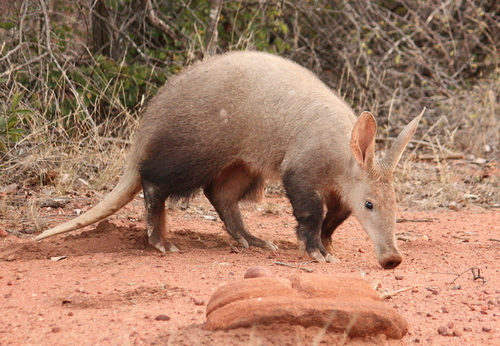
Species that share its range
Sources
Conservation status, range description and population estimate come from the IUCN Red List assessment for Lupulella adustus. Countries are derived from that range description, not from a mapped country list. Last refreshed on .
The distribution map is drawn from the IUCN Red List spatial data compiled in 2008. IUCN (International Union for Conservation of Nature)