
Scimitar-horned Oryx
Oryx dammah
Red List assessment
Endangeredon the IUCN Red List
- EXExtinct
- EWExtinct in the Wild
- CRCritically Endangered
- ENEndangered
- VUVulnerable
- NTNear Threatened
- LCLeast Concern
The Scimitar-horned Oryx is recorded in 11 countries across Africa. The IUCN Red List assesses the Scimitar-horned Oryx as Endangered. Approximately 500+ individuals now exist in the wild in Chad following reintroduction efforts, with a few thousand more in captivity and fenced reserves worldwide; wild population trend is increasing.
- Family
- Bovidae
- Order
- Artiodactyla
- Genus
- Oryx
- Countries recorded
- 11
- Continents
- Africa
- Red List category
- Endangered
- Data updated
- August 9, 2026
What is the Scimitar-horned Oryx?
The Scimitar-horned Oryx is a large desert antelope native to North Africa, famous for its long, backward-curving horns resembling scimitars. It was declared Extinct in the Wild in 2000 due to overhunting and habitat loss, but has since been reintroduced into protected areas in Chad through an intensive breeding and release program. It is remarkable for its extreme adaptations to arid desert life, including the ability to survive without drinking water for extended periods.
Where does the Scimitar-horned Oryx live?
Historically found across the Sahara and Sahel of North Africa; now reintroduced primarily in Chad (Ouadi Rimé-Ouadi Achim Faunal Reserve), with additional populations in fenced reserves in Tunisia, Morocco, and Senegal.
Formerly distributed across North Africa from Morocco and Western Sahara through Mauritania, Senegal, Mali, Niger, Chad, Sudan, Egypt, and Libya. Now reintroduced populations exist mainly in Chad's Ouadi Rimé-Ouadi Achim Reserve, with fenced populations in Tunisia, Morocco, and Senegal.
Altitude and depth
Typically found at low elevations, from sea level up to around 1000 meters in desert and semi-desert terrain.
Seasonal movements
Historically undertook nomadic movements tracking seasonal rainfall and vegetation growth across the Sahara-Sahel zone; reintroduced populations show similar tracking behavior within reserve boundaries.
Habitat of the Scimitar-horned Oryx
Arid and semi-arid desert habitats including sub-desert steppe, sandy and stony plains, and sparse grasslands on the fringes of the Sahara. Historically ranged across sahelian grasslands bordering the desert.
Adaptations to its environment
Exhibits remarkable physiological adaptations to extreme heat and water scarcity, including the ability to tolerate body temperature fluctuations, concentrate urine to conserve water, and derive moisture from plants. Its pale coat reflects sunlight, and wide hooves aid movement on sand.
Conservation status and numbers
Classified as Endangered (EN) by IUCN after being declared Extinct in the Wild in 2000; reintroduction efforts have allowed reclassification from EW to EN as wild populations reestablish in Chad.
Estimated population
Approximately 500+ individuals now exist in the wild in Chad following reintroduction efforts, with a few thousand more in captivity and fenced reserves worldwide; wild population trend is increasing.
What threatens the Scimitar-horned Oryx?
Primary historical threats included uncontrolled hunting for horns and hides, habitat loss from livestock competition, and prolonged droughts. Current threats include poaching, human-wildlife conflict, disease transmission from livestock, and political instability in range countries.
Diseases and parasites
Susceptible to diseases transmitted by domestic livestock, including foot-and-mouth disease and various parasitic infections; captive populations have also faced issues with internal parasites.
What is being done to protect it?
Major reintroduction program led by the Environment Agency Abu Dhabi and Sahara Conservation Fund has released captive-bred oryx into Chad's Ouadi Rimé-Ouadi Achim Reserve since 2016. Additional ex-situ breeding populations exist in zoos and fenced reserves across the world, supporting genetic diversity.
Recommended actions
Continued monitoring and expansion of wild populations, anti-poaching enforcement, community engagement in Chad, habitat protection, and maintaining genetic diversity through coordinated captive breeding programs.
What the Scimitar-horned Oryx looks like
The coat is white or cream-colored on the body with a reddish-brown chest and neck, and a dark stripe often visible on the face. Both sexes have long, thin, ringed horns that curve backward in a scimitar shape, reaching up to 1 meter or more in length.
Size
Body length approximately 1.5-2.4 meters, with a shoulder height of about 1.0-1.4 meters.
Weight
Adults typically weigh between 100-210 kg, with males generally larger than females.
Distinctive features
Distinguished from other oryx species by its long, thin, backward-curving horns (as opposed to straighter horns in Gemsbok or Arabian Oryx) and its predominantly white body with reddish-brown neck coloring.
Differences between males and females
Minimal sexual dimorphism; both sexes possess horns, though males tend to be slightly larger and more robust than females.
Behaviour and diet of the Scimitar-horned Oryx
Highly social, historically forming large herds of hundreds to thousands of individuals during migrations; today typically found in smaller groups of 2-40 animals with a loose hierarchical structure.
When it is active
Primarily crepuscular and nocturnal in hot desert conditions, resting during the hottest parts of the day and foraging during cooler morning, evening, and night hours.
Diet
Herbivorous, feeding on desert grasses, shrubs, foliage, and succulent plants; capable of obtaining most of its water needs from vegetation.
Communication
Communicates through body postures, horn displays for dominance, and vocalizations such as grunts and bellows; scent marking via glands may also play a role in social communication.
Interactions with other species
Historically shared habitat with other Saharan wildlife such as addax and dama gazelle; natural predators included lions and hyenas, though these are largely absent from current range areas. Competes with domestic livestock for limited desert forage.
Role in its ecosystem
As a large herbivore, plays a role in shaping desert plant communities through grazing and seed dispersal, and serves as prey for large carnivores where they still occur.
Reproduction and lifecycle
Breeding can occur year-round but often peaks with seasonal rainfall; gestation lasts approximately 8-9 months, typically resulting in a single calf.
Raising the young
Calves are precocial and can stand shortly after birth; mothers provide primary care and nursing for several months, with calves remaining close to the herd for protection.
Maturity and lifespan
Reaches sexual maturity around 2-3 years of age; lifespan in the wild is approximately 15-20 years, while captive individuals can live up to 20 years or more.
Taxonomy and naming of the Scimitar-horned Oryx
Classification
Mammalia > Artiodactyla > Bovidae > Oryx > Oryx dammah
Scientific synonyms
Oryx algazel, Oryx tao
What research says
Recent studies
Recent studies have tracked the success of reintroduced populations in Chad using GPS collars, revealing insights into movement patterns, survival rates, and reproduction in the wild post-release.
Genome and DNA
Diploid chromosome number is 58; genetic studies have been important for managing diversity in captive breeding and reintroduction programs to avoid inbreeding depression.
Compared with similar species
Similar to the Arabian Oryx and Gemsbok but distinguished by its longer, more curved horns and lack of black facial markings seen in the Gemsbok.
The Scimitar-horned Oryx and people
The Scimitar-horned Oryx was the first large mammal to be declared Extinct in the Wild and later successfully reintroduced back into its natural habitat. Its horns were historically prized and are believed to have inspired myths of the unicorn when viewed in profile.
Where and how to see it
Best observed within the Ouadi Rimé-Ouadi Achim Faunal Reserve in Chad during early morning or late afternoon when the animals are most active; guided conservation tours are occasionally available through partnering organizations.
Risks to humans
No notable risk to humans.
Human uses
Historically hunted for meat, hide, and horns; today primarily valued for ecotourism and conservation education rather than consumptive use.
Myths and legends
Some scholars suggest that the Scimitar-horned Oryx, when viewed from the side showing only one horn, may have contributed to ancient unicorn legends.
Countries where the Scimitar-horned Oryx is recorded
The 11 countries named in the range description of its IUCN Red List assessment.
Questions about the Scimitar-horned Oryx
Where does the Scimitar-horned Oryx live?
The Scimitar-horned Oryx is recorded in Chad, Egypt, Libya, Mali and Mauritania, among 11 countries in total across Africa. These countries come from the range description of its IUCN Red List assessment, and they are what place the species on the interactive map.
Is the Scimitar-horned Oryx endangered?
Yes. The IUCN Red List assesses the Scimitar-horned Oryx as Endangered, one of the three threatened categories. The species faces a very high risk of extinction in the wild — a step below Critically Endangered, but still on a trajectory that ends badly without intervention.
How many are left in the wild?
Approximately 500+ individuals now exist in the wild in Chad following reintroduction efforts, with a few thousand more in captivity and fenced reserves worldwide; wild population trend is increasing. This figure comes from the species assessment on the IUCN Red List; population estimates for wild mammals are ranges, not counts, and are revised at each assessment.
What habitat does the Scimitar-horned Oryx live in?
Arid and semi-arid desert habitats including sub-desert steppe, sandy and stony plains, and sparse grasslands on the fringes of the Sahara.
What is the scientific name of the Scimitar-horned Oryx?
The Scimitar-horned Oryx is Oryx dammah, in the family Bovidae, order Artiodactyla.
Other species in the genus Oryx
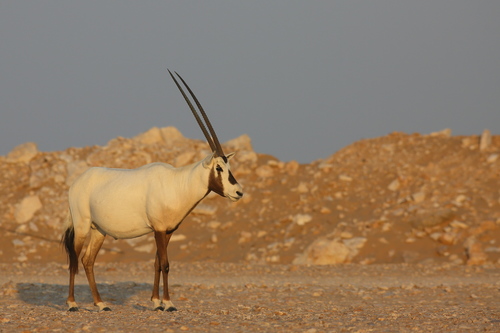
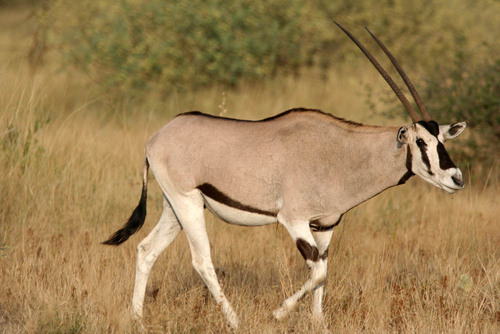
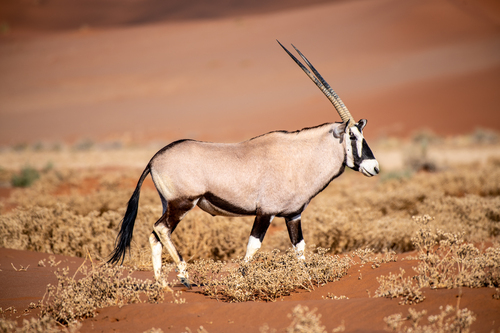
Other species in the family Bovidae
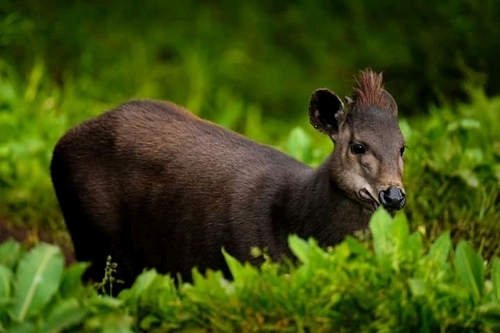
Species that share its range

Sources
Conservation status, range description and population estimate come from the IUCN Red List assessment for Oryx dammah. Countries are derived from that range description, not from a mapped country list. Last refreshed on .
The distribution map is drawn from the IUCN Red List spatial data compiled in 2023. Cooke, R.