
Gemsbok
Oryx gazella
Red List assessment
Least Concernon the IUCN Red List
- EXExtinct
- EWExtinct in the Wild
- CRCritically Endangered
- ENEndangered
- VUVulnerable
- NTNear Threatened
- LCLeast Concern
The Gemsbok is recorded in 5 countries across Africa. The IUCN Red List assesses the Gemsbok as Least Concern. Estimated at over 373,000 individuals range-wide, with populations considered stable or increasing, particularly due to widespread ranching and reintroduction efforts.
- Family
- Bovidae
- Order
- Artiodactyla
- Genus
- Oryx
- Countries recorded
- 5
- Continents
- Africa
- Red List category
- Least Concern
- Data updated
- August 9, 2026
What is the Gemsbok?
The gemsbok is a large, striking antelope native to the arid regions of southern Africa, renowned for its long, straight horns and bold black-and-white facial markings. It is exceptionally well adapted to extreme desert heat and can survive long periods without drinking water. Highly visible against desert landscapes, it is an iconic symbol of the Kalahari and Namib ecosystems and a popular subject for wildlife tourism and hunting safaris.
Where does the Gemsbok live?
Southern Africa, primarily Namibia, Botswana, and South Africa, with populations in the Kalahari and Namib Deserts
Found across Namibia, Botswana, South Africa, and parts of Angola and Zimbabwe, with the core range centered on the Kalahari and Namib Deserts of southern Africa.
Altitude and depth
Typically found from sea level up to about 2000m, favoring flat or gently undulating arid terrain
Seasonal movements
No true migration, but gemsbok may move seasonally in response to rainfall patterns and forage/water availability, forming larger aggregations after rains.
Habitat of the Gemsbok
Arid and semi-arid habitats including desert, semi-desert scrubland, dry savanna, and open grassland; thrives in areas with sparse vegetation and minimal surface water.
Adaptations to its environment
Gemsbok possess a specialized nasal counter-current heat exchange system that cools blood before it reaches the brain, allowing body temperature to rise safely during extreme heat. They can survive without drinking water for extended periods, obtaining moisture from plants, and their pale coat reflects solar radiation.
Conservation status and numbers
Least Concern (LC) according to IUCN, reflecting stable to increasing populations across much of its range due to effective management on private and protected lands.
Estimated population
Estimated at over 373,000 individuals range-wide, with populations considered stable or increasing, particularly due to widespread ranching and reintroduction efforts.
What threatens the Gemsbok?
Localized threats include habitat fragmentation from fencing, competition with livestock for forage and water, occasional poaching, and drought exacerbated by climate change.
Diseases and parasites
Susceptible to various tick-borne diseases, internal parasites such as nematodes, and occasionally anthrax outbreaks in some regions.
What is being done to protect it?
Protected within numerous national parks and reserves such as Etosha, Kalahari Gemsbok (Kgalagadi Transfrontier Park), and Namib-Naukluft; extensively bred on private game ranches which support conservation through sustainable use.
Recommended actions
Continued maintenance of transfrontier conservation areas, monitoring of genetic diversity in fragmented populations, and management of human-wildlife conflict with livestock farmers.
What the Gemsbok looks like
The gemsbok has a striking fawn-grey to brownish coat with bold black markings on the face, throat, and legs, and a black stripe running along its flanks separating the upper and lower body coloration. Both sexes have long, straight, rapier-like horns and a black tufted tail.
Size
Shoulder height approximately 120-150 cm; body length around 190-240 cm; horns can reach 85-150 cm in length.
Weight
Males typically weigh 180-240 kg, while females are slightly lighter at 100-210 kg.
Distinctive features
Distinguished from related oryx species by its more contrasting black-and-white facial mask, black flank stripe, and generally larger, heavier-set body; the horns are straighter than those of the scimitar oryx.
Differences between males and females
Sexual dimorphism is minimal; females tend to have slightly longer and thinner horns than males, while males are generally more robust and slightly heavier in body mass.
Behaviour and diet of the Gemsbok
Gemsbok are social animals typically found in small to medium herds of 10-40 individuals, often led by a dominant female, though territorial males may be solitary or accompany small bachelor groups.
When it is active
Primarily crepuscular and diurnal, though they may reduce activity during the hottest parts of the day and forage more actively in early morning and evening.
Diet
Herbivorous, feeding on grasses, leaves, roots, tubers, and wild melons; they are highly adapted to extract moisture from succulent plants like the tsamma melon in arid environments.
Communication
Gemsbok communicate through body postures, snorts, and grunts, as well as visual signals from their horns during dominance displays; scent marking via preorbital glands is also used for territorial signaling.
Interactions with other species
Natural predators include lions, spotted hyenas, and cheetahs, though the gemsbok's sharp horns make it a formidable adversary capable of fatally wounding predators; they may share habitat and forage resources with springbok and other arid-adapted ungulates.
Role in its ecosystem
As a herbivore in nutrient-poor desert ecosystems, gemsbok contribute to vegetation dynamics through grazing and seed dispersal, and serve as an important prey base for large predators in arid regions.
Reproduction and lifecycle
Breeding can occur year-round but often peaks with rainy seasons; gestation lasts approximately 260-300 days, typically resulting in a single calf.
Raising the young
Calves are hidden in vegetation for the first few weeks of life while the mother forages nearby, returning periodically to nurse; weaning occurs at around 3-4 months, though calves may stay with the herd much longer.
Maturity and lifespan
Sexual maturity is reached at around 1.5-2 years of age; lifespan in the wild is typically 15-18 years, while captive individuals can live up to 20 years or more.
Taxonomy and naming of the Gemsbok
Classification
Mammalia > Artiodactyla > Bovidae > Oryx > Oryx gazella
Subspecies
Historically some authorities recognized subspecies, but Oryx gazella is now generally considered monotypic; the East African oryx (Oryx beisa) and scimitar oryx (Oryx dammah) are now treated as separate species rather than subspecies.
Scientific synonyms
Oryx gazella gazella; formerly sometimes lumped with Oryx beisa as conspecific
What research says
Recent studies
Recent research has focused on the physiological mechanisms of thermoregulation in gemsbok as a model for climate change resilience in arid-adapted mammals, as well as population genetics across fragmented ranges.
Genome and DNA
Diploid chromosome number is 2n=58; genetic studies have been used to clarify taxonomic boundaries between Oryx gazella and closely related East African oryx populations.
Compared with similar species
Compared to the East African oryx (Oryx beisa), the gemsbok has bolder black-and-white facial patterns and a more prominent black flank stripe; it is larger and more robust than the scimitar oryx (Oryx dammah), which is now extinct in the wild.
The Gemsbok and people
Gemsbok can survive for weeks without drinking water by relying on moisture from plants and metabolic water production. Their horns, sometimes mistaken for a single horn from certain angles, may have inspired unicorn legends. They can run at speeds up to 60 km/h to escape predators.
Where and how to see it
Best observed in Etosha National Park (Namibia), Kgalagadi Transfrontier Park (South Africa/Botswana), or the Namib-Naukluft area, particularly during early morning or late afternoon when they are most active near waterholes.
Risks to humans
No notable risk to humans under normal circumstances, though the gemsbok's sharp horns can inflict serious injury if the animal feels threatened or cornered.
Human uses
Widely farmed for meat and hides on private game ranches in Namibia and South Africa; also a popular species for trophy hunting and ecotourism due to its striking appearance and desert-adapted resilience.
Myths and legends
Some scholars suggest that sightings of oryx species, with their long straight horns appearing as one when viewed in profile, may have contributed to ancient unicorn myths.
Countries where the Gemsbok is recorded
The 5 countries named in the range description of its IUCN Red List assessment.
Questions about the Gemsbok
Where does the Gemsbok live?
The Gemsbok is recorded in Angola, Botswana, Namibia, South Africa and Zimbabwe across Africa. These countries come from the range description of its IUCN Red List assessment, and they are what place the species on the interactive map.
Is the Gemsbok endangered?
The IUCN Red List assesses the Gemsbok as Least Concern. The species is widespread and abundant enough not to qualify for any threatened category. It does not mean the species is safe forever, only that nothing in the current data raises an alarm.
How many are left in the wild?
Estimated at over 373,000 individuals range-wide, with populations considered stable or increasing, particularly due to widespread ranching and reintroduction efforts. This figure comes from the species assessment on the IUCN Red List; population estimates for wild mammals are ranges, not counts, and are revised at each assessment.
What habitat does the Gemsbok live in?
Arid and semi-arid habitats including desert, semi-desert scrubland, dry savanna, and open grassland; thrives in areas with sparse vegetation and minimal surface water.
What is the scientific name of the Gemsbok?
The Gemsbok is Oryx gazella, in the family Bovidae, order Artiodactyla.
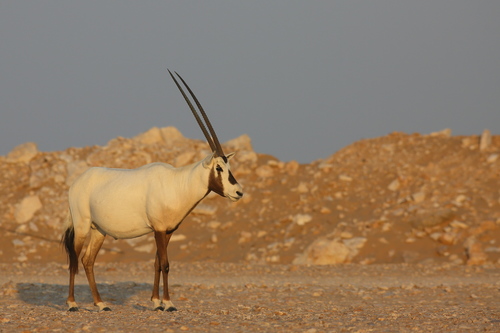
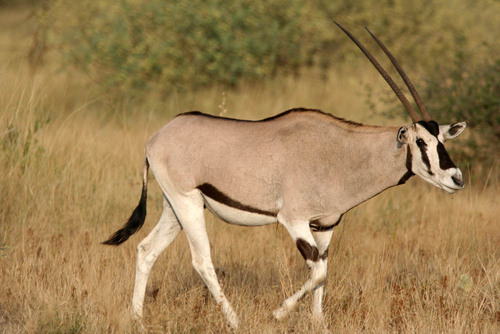
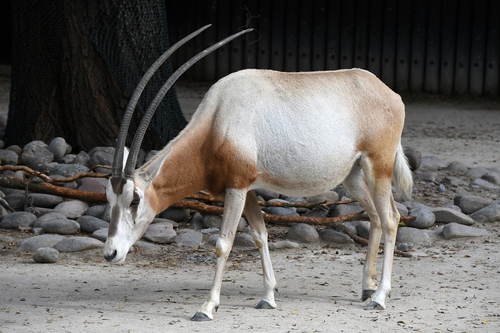
Other species in the genus Oryx
Other species in the family Bovidae
Species that share its range
Sources
Conservation status, range description and population estimate come from the IUCN Red List assessment for Oryx gazella. Countries are derived from that range description, not from a mapped country list. Last refreshed on .
The distribution map is drawn from the IUCN Red List spatial data compiled in 2008. IUCN (International Union for Conservation of Nature)