
Robert's Snow Vole
Chionomys roberti
Red List assessment
Least Concernon the IUCN Red List
- EXExtinct
- EWExtinct in the Wild
- CRCritically Endangered
- ENEndangered
- VUVulnerable
- NTNear Threatened
- LCLeast Concern
The Robert's Snow Vole is recorded in 4 countries across Asia. The IUCN Red List assesses the Robert's Snow Vole as Least Concern. Population size is not precisely quantified but is believed to be stable; the species is considered common within its suitable habitat range in the Caucasus
- Family
- Cricetidae
- Order
- Rodentia
- Genus
- Chionomys
- Countries recorded
- 4
- Continents
- Asia
- Red List category
- Least Concern
- Data updated
- August 9, 2026
What is the Robert's Snow Vole?
Robert's Snow Vole is a small alpine rodent endemic to the Caucasus mountain range, closely related to other snow voles in the genus Chionomys. It inhabits high-altitude rocky and grassy habitats, often near forest edges and subalpine meadows. This species is notable for its adaptation to cold montane environments and its role as an indicator species for Caucasian mountain ecosystems.
Where does the Robert's Snow Vole live?
Mountainous regions of the Caucasus, including Georgia, Armenia, Azerbaijan, Turkey, and parts of Iran
Restricted to the Caucasus ecoregion, spanning Georgia, Armenia, Azerbaijan, northeastern Turkey, and northern Iran, primarily in the Greater and Lesser Caucasus mountain ranges.
Altitude and depth
1000-3000 meters above sea level, with highest population densities typically between 1500-2500m
Seasonal movements
Remains active year-round without true hibernation, though activity levels decrease significantly during harsh winter months when the species relies on cached food and subnivean spaces
Habitat of the Robert's Snow Vole
Found in subalpine and alpine meadows, rocky screes, forest edges, and montane forests, typically in areas with scattered boulders and dense vegetation cover for shelter.
Adaptations to its environment
Possesses dense fur for insulation against cold mountain temperatures, strong claws for digging burrows in rocky substrates, and behavioral adaptations including nesting under snow cover (subnivean life) to escape extreme cold and predators.
Conservation status and numbers
Listed as Least Concern by IUCN due to a relatively wide distribution across suitable Caucasian montane habitats and presumed stable population, though localized threats exist.
Estimated population
Population size is not precisely quantified but is believed to be stable; the species is considered common within its suitable habitat range in the Caucasus
What threatens the Robert's Snow Vole?
Habitat degradation from overgrazing by livestock, climate change affecting alpine ecosystems, and potential habitat fragmentation from human development in mountain regions.
Diseases and parasites
Susceptible to various ectoparasites including fleas and mites, as well as endoparasites such as nematodes, though specific disease studies for this species are limited
What is being done to protect it?
Protected within several nature reserves and national parks across the Caucasus region, including areas in Georgia and Armenia, though no species-specific conservation programs are currently in place.
Recommended actions
Continued habitat monitoring in alpine zones, research into climate change impacts on Caucasian montane species, and maintenance of protected area networks in the region.
What the Robert's Snow Vole looks like
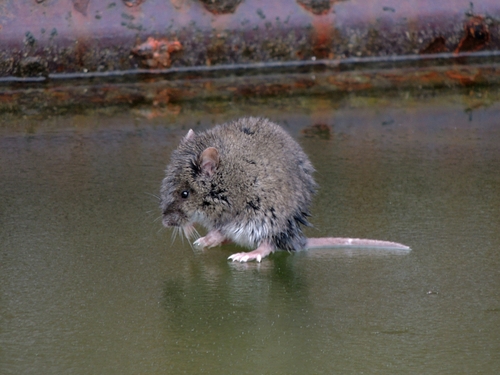
Has grayish-brown to dark brown dorsal fur with a paler grayish-white underside, small rounded ears partially hidden in fur, and a moderately long tail relative to body size typical of Chionomys species.
Size
Body length typically 9-12 cm, with a tail length of 4-6 cm
Weight
Approximately 20-35 grams, with minimal difference between sexes
Distinctive features
Distinguished from other Chionomys species by subtle differences in skull morphology, tooth pattern, and slightly darker coloration compared to the more widespread Chionomys nivalis (European snow vole).
Differences between males and females
Minimal sexual dimorphism; males and females are similar in size and coloration with only slight variation in body mass
Behaviour and diet of the Robert's Snow Vole
Generally solitary or living in loose family groups, with individuals maintaining separate burrow systems though sometimes sharing habitat in favorable areas with high food availability.
When it is active
Primarily active during crepuscular and daytime hours, though some nocturnal activity has been observed, particularly during warmer months.
Diet
Herbivorous diet consisting mainly of grasses, herbs, seeds, and green vegetation found in alpine and subalpine meadows, supplemented by roots and occasionally fungi.
Communication
Communicates through scent marking via glandular secretions to establish territory boundaries, along with limited vocalizations and tactile interactions during social encounters.
Interactions with other species
Preyed upon by mountain-dwelling raptors such as kestrels and buzzards, as well as mustelids and foxes; competes with other small rodents for food resources in shared alpine habitats.
Role in its ecosystem
Plays an important ecological role as a primary consumer in alpine ecosystems, contributing to seed dispersal and serving as a crucial prey base for mountain predators, while its burrowing activity aids in soil aeration.
Reproduction and lifecycle
Breeding season occurs primarily from spring to early autumn, with gestation lasting approximately 20-21 days and litters typically containing 2-6 pups, allowing for multiple litters per season in favorable conditions.
Raising the young
Females provide all parental care, nursing young in nest burrows for approximately 3 weeks until weaning, after which juveniles become independent and disperse to establish their own territories.
Maturity and lifespan
Reaches sexual maturity at approximately 2-3 months of age; lifespan in the wild is typically 1-2 years due to high predation pressure, though captive individuals may live slightly longer
Taxonomy and naming of the Robert's Snow Vole
Classification
Class Mammalia > Order Rodentia > Family Cricetidae > Genus Chionomys > Species Chionomys roberti
Scientific synonyms
Microtus roberti (original combination), Chionomys robertoides
What research says
Recent studies
Recent phylogenetic studies have helped clarify the taxonomic relationships within the Chionomys genus, confirming Robert's Snow Vole as a distinct species separate from the more widespread Chionomys nivalis based on molecular and morphological data.
Genome and DNA
Limited genetic studies exist, though the species has a diploid chromosome number typical of Chionomys genus voles, believed to be around 2n=54
Compared with similar species
Closely resembles Chionomys nivalis (European snow vole) but can be distinguished by cranial features and is restricted to the Caucasus, whereas C. nivalis has a broader Eurasian mountain distribution extending into the Alps and other ranges.
The Robert's Snow Vole and people
Despite being called a 'snow vole,' this species is active even in winter beneath snow cover in specialized subnivean tunnels; it is one of several endemic small mammals that make the Caucasus a biodiversity hotspot for rodent species.
Where and how to see it
Best observed in rocky alpine meadows of Georgia's Caucasus mountains during summer months (June-August) during early morning or late afternoon when activity levels peak; patience and quiet observation near rock piles increase sighting chances.
Risks to humans
No notable risk to humans
Countries where the Robert's Snow Vole is recorded
The 4 countries named in the range description of its IUCN Red List assessment.
Questions about the Robert's Snow Vole
Where does the Robert's Snow Vole live?
The Robert's Snow Vole is recorded in Armenia, Azerbaijan, Georgia and Iran across Asia. These countries come from the range description of its IUCN Red List assessment, and they are what place the species on the interactive map.
Is the Robert's Snow Vole endangered?
The IUCN Red List assesses the Robert's Snow Vole as Least Concern. The species is widespread and abundant enough not to qualify for any threatened category. It does not mean the species is safe forever, only that nothing in the current data raises an alarm.
How many are left in the wild?
Population size is not precisely quantified but is believed to be stable; the species is considered common within its suitable habitat range in the Caucasus This figure comes from the species assessment on the IUCN Red List; population estimates for wild mammals are ranges, not counts, and are revised at each assessment.
What habitat does the Robert's Snow Vole live in?
Found in subalpine and alpine meadows, rocky screes, forest edges, and montane forests, typically in areas with scattered boulders and dense vegetation cover for shelter.
What is the scientific name of the Robert's Snow Vole?
The Robert's Snow Vole is Chionomys roberti, in the family Cricetidae, order Rodentia.
Other species in the genus Chionomys
Other species in the family Cricetidae
Species that share its range

Sources
Conservation status, range description and population estimate come from the IUCN Red List assessment for Chionomys roberti. Countries are derived from that range description, not from a mapped country list. Last refreshed on .
The distribution map is drawn from the IUCN Red List spatial data compiled in 2008. IUCN (International Union for Conservation of Nature)