
Pygmy Three-toed Sloth
Bradypus pygmaeus
Red List assessment
Critically Endangeredon the IUCN Red List
- EXExtinct
- EWExtinct in the Wild
- CRCritically Endangered
- ENEndangered
- VUVulnerable
- NTNear Threatened
- LCLeast Concern
The Pygmy Three-toed Sloth is recorded in one country, Panama across North America. The IUCN Red List assesses the Pygmy Three-toed Sloth as Critically Endangered. Estimated at fewer than 500 individuals, with some surveys suggesting numbers as low as 100; population trend is considered declining or at best stable under conservation pressure.
- Family
- Bradypodidae
- Order
- Pilosa
- Genus
- Bradypus
- Countries recorded
- 1
- Continents
- North America
- Red List category
- Critically Endangered
- Data updated
- August 9, 2026
What is the Pygmy Three-toed Sloth?
The Pygmy Three-toed Sloth is the smallest and most geographically restricted of all sloth species, found only on the tiny island of Isla Escudo de Veraguas off Panama. It evolved through insular dwarfism after being isolated from mainland Bradypus variegatus populations roughly 9,000 years ago. This species is remarkable for its extremely limited range, entire population confined to a single mangrove-fringed island of about 4-5 km2. It is considered one of the most endangered mammals on Earth due to its minuscule habitat and population size.
Where does the Pygmy Three-toed Sloth live?
Isla Escudo de Veraguas, a small island off the Caribbean coast of Panama
Endemic to Isla Escudo de Veraguas, a small island in the Bocas del Toro Archipelago, Caribbean coast of Panama, Central America. This is the only known location where the species exists in the wild.
Altitude and depth
Sea level to a few meters above sea level, restricted to the low-lying coastal mangrove zone of the island
Seasonal movements
No significant seasonal migration; sloths remain within small home ranges year-round, though minor shifts in activity may occur with wet and dry season changes in food availability
Habitat of the Pygmy Three-toed Sloth
Primarily inhabits red mangrove forests along the island's coastline, occasionally venturing into adjacent lowland tropical forest patches. The mangroves provide both food and cover, with the sloths rarely straying far from this specialized habitat.
Adaptations to its environment
Smaller body size compared to mainland relatives is an adaptation to limited food resources on the island (insular dwarfism). Its slow metabolism and low-energy lifestyle allow survival on a nutrient-poor folivorous diet, and specialized claws enable it to move efficiently through mangrove branches.
Conservation status and numbers
Critically Endangered (IUCN) due to its extremely restricted range confined to a single small island, ongoing habitat degradation, and a very small total population that makes it highly vulnerable to any environmental disturbance or human encroachment.
Estimated population
Estimated at fewer than 500 individuals, with some surveys suggesting numbers as low as 100; population trend is considered declining or at best stable under conservation pressure.
What threatens the Pygmy Three-toed Sloth?
Habitat destruction from tourism development and illegal logging of mangroves, hunting by visiting fishermen despite legal protection, inbreeding depression due to small population size, and vulnerability to hurricanes or sea-level rise given its low-lying island habitat.
Diseases and parasites
Specific disease data is limited, but like other sloths, it likely hosts various ectoparasites (moths, mites) and endoparasites; small population size raises concern about susceptibility to disease outbreaks.
What is being done to protect it?
The species is protected under Panamanian law, and Isla Escudo de Veraguas has been proposed for stricter protected status; conservation organizations have conducted population surveys and genetic studies, though enforcement of protections on the remote island remains limited.
Recommended actions
Establish a formally enforced protected area covering the entire island and surrounding mangroves, increase anti-poaching patrols, conduct regular population monitoring, and implement community-based conservation and ecotourism programs that provide alternatives to habitat-damaging activities.
What the Pygmy Three-toed Sloth looks like
Small, compact body covered in coarse grayish-brown fur, often tinged with green from symbiotic algae growth; rounded head with a flattened face, small ears hidden in fur, and long curved claws on each of three toes per limb.
Size
Body length approximately 48-53 cm, making it noticeably smaller than mainland three-toed sloth species
Weight
Approximately 2.5-3.5 kg, roughly 40% lighter than the mainland Brown-throated Three-toed Sloth
Distinctive features
Distinguished from mainland Bradypus variegatus primarily by its notably smaller body size, proportionally shorter limbs, and restricted island distribution; skull and dental measurements also differ subtly from mainland relatives.
Differences between males and females
Minimal sexual dimorphism; males and females are similar in size and coloration, with only slight average size differences reported
Behaviour and diet of the Pygmy Three-toed Sloth
Solitary and largely non-territorial, with individuals maintaining small overlapping home ranges within the mangrove habitat; social interactions are limited mostly to brief mating encounters.
When it is active
Primarily nocturnal to crepuscular, though some daytime activity has been observed; spends the majority of its time resting motionless in tree branches to conserve energy.
Diet
Strict herbivore, feeding almost exclusively on the leaves of red mangrove trees (Rhizophora mangle), supplemented occasionally by leaves of other nearby plant species.
Communication
Communication is limited and includes soft bleating or hissing vocalizations, along with scent marking near defecation sites (as in other sloths) to signal presence or reproductive status.
Interactions with other species
Few natural predators exist on the island due to the absence of large mainland predators, though birds of prey may occasionally take young sloths; the species has a symbiotic relationship with algae growing in its fur, providing camouflage.
Role in its ecosystem
Plays a minor role in nutrient cycling within the mangrove ecosystem through leaf consumption and defecation; its algae-covered fur also supports a micro-ecosystem of invertebrates and algae, similar to other sloth species.
Reproduction and lifecycle
Breeding likely occurs year-round as in other Bradypus species; gestation is estimated at around 6 months, with females typically giving birth to a single offspring.
Raising the young
Young cling to the mother's belly fur for several months after birth, being carried and nursed until weaned; there is no paternal involvement in offspring care, consistent with other sloth species.
Maturity and lifespan
Sexual maturity is estimated around 3-4 years based on related species; lifespan in the wild is unknown but likely similar to mainland relatives at 15-20 years, with no captive individuals to provide comparative data.
Taxonomy and naming of the Pygmy Three-toed Sloth
Classification
Mammalia > Pilosa > Bradypodidae > Bradypus > Bradypus pygmaeus
Scientific synonyms
Initially considered a dwarf population of Bradypus variegatus before being described as a distinct species in 2001
What research says
Recent studies
Recent research has focused on confirming the species' genetic distinctiveness and assessing population viability, with some studies raising debate about whether it should be considered a full species or a subspecies of B. variegatus.
Genome and DNA
Genetic studies have confirmed distinct mitochondrial DNA differentiating it from mainland Bradypus variegatus populations, supporting its status as a separate species, though detailed genome sequencing is limited.
Compared with similar species
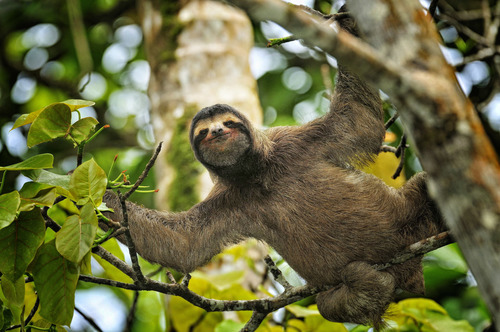
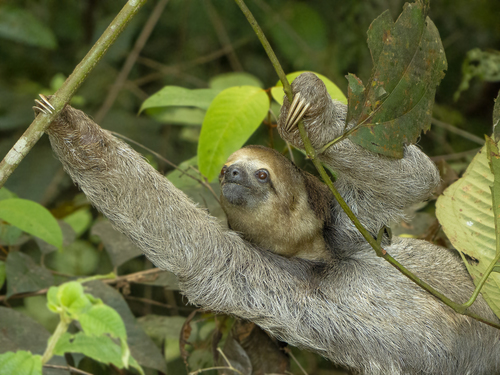
Compared to its closest relative, the Brown-throated Three-toed Sloth (Bradypus variegatus), the Pygmy Three-toed Sloth is notably smaller in body size and weight, reflecting classic island dwarfism, while sharing similar overall morphology and slow arboreal lifestyle.
The Pygmy Three-toed Sloth and people
This sloth is found nowhere else on Earth except one tiny Caribbean island smaller than most city parks; it is sometimes called the 'monkey sloth' due to its small size resembling a monkey more than typical sloths; despite being critically endangered, it was only formally described as a distinct species in 2001.
Where and how to see it
Observation is extremely difficult due to the remote location and restricted access to Isla Escudo de Veraguas; researchers and permitted ecotourists have the best chance of spotting individuals during early morning or dusk hours scanning mangrove canopies.
Risks to humans
No notable risk to humans; the species is entirely harmless, slow-moving, and poses no threat through bites or disease transmission.
Human uses
No significant traditional or commercial use; the species is primarily of interest for conservation, scientific research, and potential ecotourism value.
Countries where the Pygmy Three-toed Sloth is recorded
The 1 countries named in the range description of its IUCN Red List assessment.
Questions about the Pygmy Three-toed Sloth
Where does the Pygmy Three-toed Sloth live?
The Pygmy Three-toed Sloth is recorded in Panama across North America. These countries come from the range description of its IUCN Red List assessment, and they are what place the species on the interactive map.
Is the Pygmy Three-toed Sloth endangered?
Yes. The IUCN Red List assesses the Pygmy Three-toed Sloth as Critically Endangered, one of the three threatened categories. The species faces an extremely high risk of extinction in the wild. This is the last category before extinction, and it is reached through a very small or steeply declining population, a tiny range, or both.
How many are left in the wild?
Estimated at fewer than 500 individuals, with some surveys suggesting numbers as low as 100; population trend is considered declining or at best stable under conservation pressure. This figure comes from the species assessment on the IUCN Red List; population estimates for wild mammals are ranges, not counts, and are revised at each assessment.
What habitat does the Pygmy Three-toed Sloth live in?
Primarily inhabits red mangrove forests along the island's coastline, occasionally venturing into adjacent lowland tropical forest patches.
What is the scientific name of the Pygmy Three-toed Sloth?
The Pygmy Three-toed Sloth is Bradypus pygmaeus, in the family Bradypodidae, order Pilosa.
Other species in the genus Bradypus
Species that share its range
Sources
Conservation status, range description and population estimate come from the IUCN Red List assessment for Bradypus pygmaeus. Countries are derived from that range description, not from a mapped country list. Last refreshed on .
The distribution map is drawn from the IUCN Red List spatial data compiled in 2022. IUCN (International Union for Conservation of Nature)