
Brown-throated Sloth
Bradypus variegatus
Red List assessment
Least Concernon the IUCN Red List
- EXExtinct
- EWExtinct in the Wild
- CRCritically Endangered
- ENEndangered
- VUVulnerable
- NTNear Threatened
- LCLeast Concern
The Brown-throated Sloth is recorded in 8 countries across North America and South America. The IUCN Red List assesses the Brown-throated Sloth as Least Concern. No precise global population estimate exists, but the species is considered common and stable across much of its extensive range, though local declines occur due to habitat loss.
- Family
- Bradypodidae
- Order
- Pilosa
- Genus
- Bradypus
- Countries recorded
- 8
- Continents
- North America and South America
- Red List category
- Least Concern
- Data updated
- August 9, 2026
What is the Brown-throated Sloth?
The brown-throated sloth is one of the most widespread and commonly observed sloth species in the Neotropics, found from Central America to central South America. It is renowned for its extremely slow metabolism and movement, spending most of its life hanging upside down in the forest canopy. This species is remarkable for its symbiotic relationship with algae and moths that live in its fur, giving it a greenish tinge that aids camouflage.
Where does the Brown-throated Sloth live?
Central and South America, from Honduras through Panama to Colombia, Venezuela, Ecuador, Peru, Bolivia, and Brazil
Ranges from Honduras in Central America through Panama, Colombia, Venezuela, Ecuador, Peru, and Bolivia to Brazil in South America. Found on both sides of the Andes in various forest types across this broad range.
Altitude and depth
Sea level to approximately 2,400 meters elevation
Habitat of the Brown-throated Sloth
Primarily found in tropical and subtropical moist lowland forests, including primary and secondary rainforest, cloud forest, and gallery forest along rivers. Also tolerates disturbed and fragmented habitats, including forest edges and semi-deciduous forests.
Adaptations to its environment
Extremely low metabolic rate and body temperature conserve energy on a low-calorie leaf diet. Long curved claws and specialized limb morphology allow efficient suspension from branches, while a symbiotic algae coating provides camouflage and possibly nutritional supplementation.
Conservation status and numbers
Least Concern (LC) according to IUCN, due to its wide distribution and relatively stable population across much of its range, though localized populations face pressure from habitat loss.
Estimated population
No precise global population estimate exists, but the species is considered common and stable across much of its extensive range, though local declines occur due to habitat loss.
What threatens the Brown-throated Sloth?
Deforestation and habitat fragmentation for agriculture and urban development are the primary threats. Additional threats include road mortality, electrocution on power lines, illegal pet trade, and hunting in some regions.
Diseases and parasites
Hosts various ectoparasites including moths (Cryptoses spp.) and beetles in its fur, along with occasional endoparasites such as nematodes; generally resilient to major disease outbreaks.
What is being done to protect it?
Protected within numerous national parks and reserves throughout its range, including areas in Costa Rica, Panama, and Brazil. Conservation organizations such as the Sloth Conservation Foundation conduct research, rehabilitation, and public awareness programs.
Recommended actions
Priority actions include maintaining forest connectivity through wildlife corridors, mitigating road and powerline hazards, regulating the illegal pet trade, and supporting community-based conservation and habitat protection initiatives.
What the Brown-throated Sloth looks like
Fur is coarse and grayish-brown to beige, often tinged green from symbiotic algae growth. The face has a distinctive dark mask-like pattern around the eyes, and males often display a dorsal patch of orange-yellow fur with a black stripe (speculum).
Size
Body length typically 42-80 cm
Weight
Adults typically weigh 2.25-6.3 kg, with minimal difference between sexes
Distinctive features
Distinguished from other Bradypus species by its brownish throat patch, facial mask pattern, and the male's dorsal speculum. It has three long curved claws on each limb, distinguishing it from two-toed sloths (Choloepus).
Differences between males and females
Minimal size dimorphism, but adult males possess a distinctive dorsal speculum patch (orange-yellow fur with black stripe) that females lack
Behaviour and diet of the Brown-throated Sloth
Largely solitary and non-territorial, with individuals maintaining separate but sometimes overlapping home ranges. Social interactions are limited mainly to mating encounters and occasional vocal communication between mothers and offspring.
When it is active
Primarily nocturnal to crepuscular, though also active intermittently during the day; spends 15-20 hours per day resting or sleeping.
Diet
Primarily folivorous, feeding on leaves from a variety of canopy tree species, particularly Cecropia trees, along with some fruits and buds. Their specialized multi-chambered stomach ferments the tough, low-nutrient leaf matter over several days.
Communication
Communication is limited, consisting mainly of soft bleating or hissing vocalizations between mothers and young, along with scent marking during mating periods and defecation rituals at the base of trees.
Interactions with other species
Natural predators include harpy eagles, jaguars, ocelots, and large snakes. The species has a notable mutualistic relationship with moths and algae that live in its fur, and it descends to the forest floor roughly weekly to defecate, which fertilizes host trees and supports moth reproduction.
Role in its ecosystem
Plays a role in nutrient cycling within the forest ecosystem through its unique defecation behavior, which transfers nutrients to soil and supports specialized moth and algae communities. It is also an important prey species supporting populations of large forest predators.
Reproduction and lifecycle
Breeding can occur year-round with no strict seasonality in most regions. Gestation lasts approximately 6 months, resulting in a single offspring, which is weaned after about 4-5 weeks though it remains with the mother for several months.
Raising the young
Only females provide parental care; the single offspring clings to the mother's belly for the first several months of life, learning to navigate the canopy and select food plants before becoming independent.
Maturity and lifespan
Sexual maturity is reached around 3-5 years of age; lifespan in the wild is estimated at 15-20 years, while captive individuals have been recorded living up to 30 years.
Taxonomy and naming of the Brown-throated Sloth
Classification
Mammalia > Pilosa > Bradypodidae > Bradypus > Bradypus variegatus
Subspecies
Several subspecies proposed based on geographic range, including B. v. variegatus, B. v. brasiliensis, B. v. boliviensis, and B. v. infuscatus, though taxonomy remains debated and some are considered synonyms.
Scientific synonyms
Bradypus infuscatus, Bradypus boliviensis (formerly considered separate species, now often synonymized)
What research says
Recent studies
Recent research has focused on the unique algae-moth-sloth ecosystem within their fur, revealing complex mutualistic relationships and potential pharmaceutical compounds derived from the algae. Studies also continue to investigate their unusually low and variable body temperature regulation.
Genome and DNA
Diploid chromosome number is 2n=54; genomic studies have been conducted to understand its unusually low metabolic rate and slow evolutionary rate compared to other mammals.
Compared with similar species
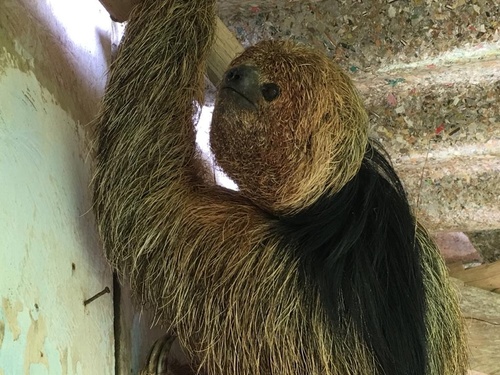
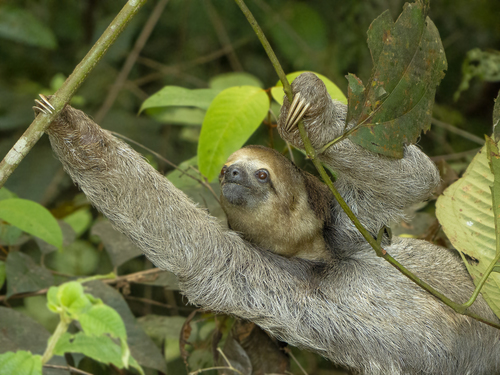
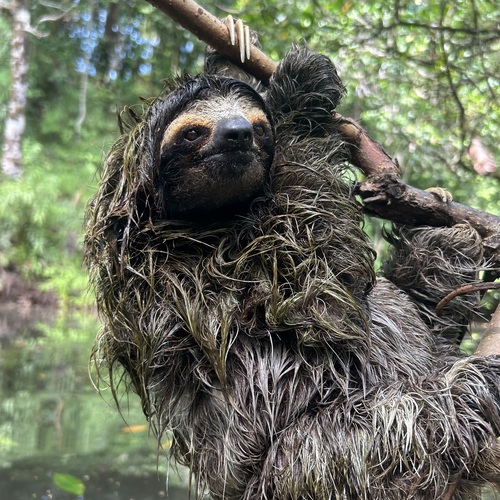
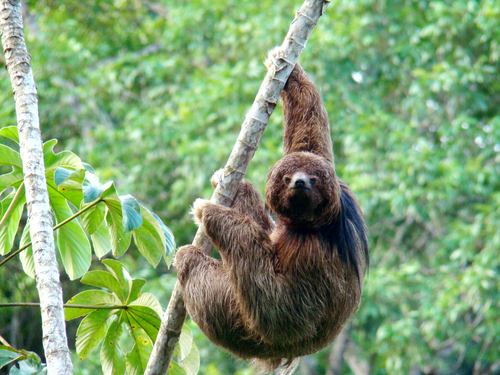
Similar to other Bradypus species like the pale-throated sloth (B. tridactylus) and maned sloth (B. torquatus), but distinguished by throat coloration and facial markings. Differs from two-toed sloths (Choloepus) by having three claws on each forelimb rather than two.
The Brown-throated Sloth and people
Brown-throated sloths only defecate about once a week, descending to the forest floor for this single vulnerable activity. Their fur hosts an entire miniature ecosystem of algae, moths, and fungi, and their extremely slow metabolism allows them to survive on a diet that would starve most mammals.
Where and how to see it
Best observed in early morning or late afternoon in protected rainforest reserves of Costa Rica, Panama, or the Amazon basin, where guides can spot them motionless in canopy trees; patience and binoculars are essential due to their camouflage and stillness.
Risks to humans
No notable risk; sloths are generally harmless to humans, though they can scratch or bite defensively if handled or threatened.
Human uses
Occasionally kept illegally as exotic pets despite legal protections, and increasingly valued for ecotourism, drawing wildlife viewers to rainforest lodges throughout Central and South America.
Myths and legends
In some Indigenous South American cultures, sloths are viewed as symbols of patience and tranquility, though in colonial-era writings they were often mischaracterized as lazy or stupid due to their slow movements.
Countries where the Brown-throated Sloth is recorded
The 8 countries named in the range description of its IUCN Red List assessment.
Questions about the Brown-throated Sloth
Where does the Brown-throated Sloth live?
The Brown-throated Sloth is recorded in Bolivia, Brazil, Colombia, Ecuador and Honduras, among 8 countries in total across North America and South America. These countries come from the range description of its IUCN Red List assessment, and they are what place the species on the interactive map.
Is the Brown-throated Sloth endangered?
The IUCN Red List assesses the Brown-throated Sloth as Least Concern. The species is widespread and abundant enough not to qualify for any threatened category. It does not mean the species is safe forever, only that nothing in the current data raises an alarm.
How many are left in the wild?
No precise global population estimate exists, but the species is considered common and stable across much of its extensive range, though local declines occur due to habitat loss. This figure comes from the species assessment on the IUCN Red List; population estimates for wild mammals are ranges, not counts, and are revised at each assessment.
What habitat does the Brown-throated Sloth live in?
Primarily found in tropical and subtropical moist lowland forests, including primary and secondary rainforest, cloud forest, and gallery forest along rivers.
What is the scientific name of the Brown-throated Sloth?
The Brown-throated Sloth is Bradypus variegatus, in the family Bradypodidae, order Pilosa.
Other species in the genus Bradypus
Species that share its range
Sources
Conservation status, range description and population estimate come from the IUCN Red List assessment for Bradypus variegatus. Countries are derived from that range description, not from a mapped country list. Last refreshed on .
The distribution map is drawn from the IUCN Red List spatial data compiled in 2022. IUCN (International Union for Conservation of Nature)