
Neumann's Arvicanthis
Arvicanthis neumanni
Red List assessment
Least Concernon the IUCN Red List
- EXExtinct
- EWExtinct in the Wild
- CRCritically Endangered
- ENEndangered
- VUVulnerable
- NTNear Threatened
- LCLeast Concern
The Neumann's Arvicanthis is recorded in 4 countries across Africa. The IUCN Red List assesses the Neumann's Arvicanthis as Least Concern. No precise global population estimate is available.
- Family
- Muridae
- Order
- Rodentia
- Genus
- Arvicanthis
- Countries recorded
- 4
- Continents
- Africa
- Red List category
- Least Concern
- Data updated
- August 9, 2026
What is the Neumann's Arvicanthis?
Neumann's Arvicanthis is a medium-sized African grass rat belonging to the diverse murid family, named after the German collector and zoologist Oscar Neumann. It inhabits open grasslands and savanna-woodland mosaics of East Africa, particularly in Kenya around the Mount Kenya foothills and Laikipia Plateau. Like other members of its genus, it is notably diurnal, making it unusual among rodents. It plays a significant ecological role as an abundant small herbivore and prey base species in East African savanna ecosystems.
Where does the Neumann's Arvicanthis live?
East Africa, primarily Kenya and northern Tanzania, with possible records in southern Ethiopia and Uganda border regions
Mainly found in central and southern Kenya (including the Mount Kenya region, Laikipia Plateau, and Rift Valley areas) and extending into northern Tanzania. Its precise range boundaries with closely related congeners remain incompletely defined due to historical taxonomic confusion.
Altitude and depth
Typically found between approximately 1000 and 2500 meters above sea level, consistent with the highland grassland zones of East Africa.
Seasonal movements
No evidence of hibernation or long-distance migration. Activity patterns and breeding may be influenced by East Africa's bimodal rainfall seasons (long rains March–May, short rains October–December), with reproductive peaks likely associated with periods of increased grass and seed availability.
Habitat of the Neumann's Arvicanthis
Primarily open grasslands, wooded savannas, and scrubby areas at mid to higher altitudes. It favors areas with dense grass cover for foraging and refuge, and may also colonize agricultural margins, field edges, and roadsides where grass and grain crops are present.
Adaptations to its environment
Its diurnal activity cycle is a key adaptation, allowing exploitation of daytime food resources while relying on grass cover and agility for predator avoidance. Its teeth and digestive system are well adapted to processing tough, fibrous grasses and seeds. High reproductive rates allow rapid population recovery after local declines.
Conservation status and numbers
Least Concern (LC) on the IUCN Red List. The species is considered reasonably widespread and relatively common within its East African range, with no evidence of rapid population decline meeting threshold criteria for a more threatened category.
Estimated population
No precise global population estimate is available. The population is considered stable and locally abundant in suitable habitats, though no systematic large-scale surveys have been conducted specifically for this species.
What threatens the Neumann's Arvicanthis?
Habitat loss through agricultural conversion of native grasslands, overgrazing by livestock that degrades grass cover, and rodenticide use by farmers protecting grain crops represent the main threats. Climate-driven shifts in East African rainfall patterns may also affect habitat suitability.
Diseases and parasites
Like other Arvicanthis species, likely hosts a range of ectoparasites (fleas, ticks, mites) and endoparasites (helminths, protozoa). Members of the Arvicanthis genus are known to be reservoirs for various zoonotic pathogens in East Africa, but specific disease associations for A. neumanni are not well documented.
What is being done to protect it?
Benefits indirectly from protected areas within its range such as Mount Kenya National Park and Reserve, Laikipia conservancies, and various Tanzanian national parks and game reserves. No species-specific conservation program is known.
Recommended actions
Clarification of the species' precise range boundaries through targeted field surveys and genetic studies is a priority. Maintenance of native grassland habitats within and adjacent to protected areas, and monitoring population trends, are recommended.
What the Neumann's Arvicanthis looks like
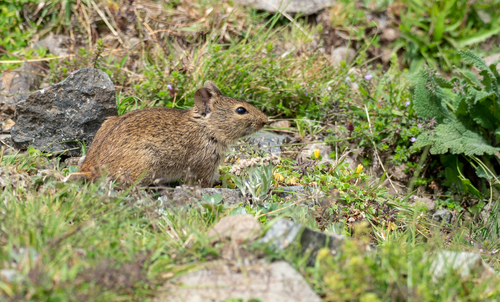
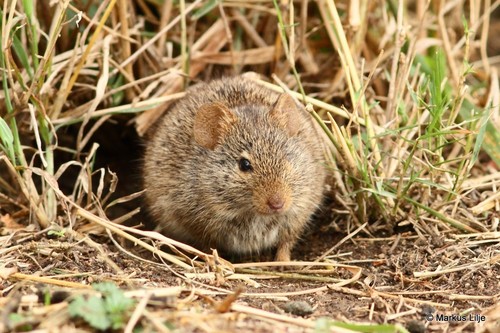
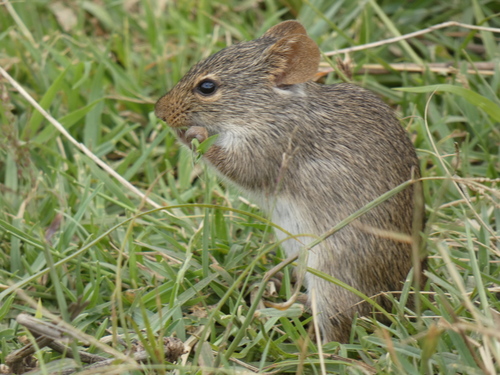
Dorsal fur is coarse and grizzled brownish to tawny-brown, often with darker guard hairs giving a speckled appearance. The underparts are paler, ranging from whitish to buff. The tail is bicolored, darker above and paler below, and relatively sparsely haired. Ears are moderate in size and rounded.
Size
Body length approximately 110–160 mm; tail length approximately 90–130 mm. Similar in proportions to other Arvicanthis species.
Weight
Typically between 50 and 120 grams, with variation depending on season, sex, and habitat quality.
Distinctive features
Distinguished from the closely related Arvicanthis niloticus primarily by geographic range, slightly smaller average body size, and subtle craniometric and molecular differences. It lacks the bold dorsal striping seen in some other African murid genera such as Lemniscomys.
Differences between males and females
Sexual dimorphism is minimal, as is typical for the genus. Males may be marginally larger on average but the difference is not pronounced.
Behaviour and diet of the Neumann's Arvicanthis
Typically lives in small social groups or loose colonies centered around burrow systems, though it can also be found as solitary individuals. Group sizes are generally small, and there is no evidence of complex dominance hierarchies as found in larger mammals.
When it is active
Strongly diurnal, with peak activity in the morning and late afternoon. This is one of the defining characteristics of the genus Arvicanthis, making these grass rats conspicuous and relatively easy to observe by day.
Diet
Primarily herbivorous, feeding on grasses (seeds, stems, and leaves), forbs, and other plant material. Will also consume cultivated grains and occasionally invertebrates, making it effectively a granivore-herbivore. Seeds and green vegetative matter form the core of its diet.
How it feeds and hunts
Not a predator; forages by moving through grass cover, clipping grass stems and collecting seeds on the ground. It may cache food occasionally, as is common in grass-eating rodents.
Communication
Uses ultrasonic and audible vocalizations for intraspecific communication, particularly during mating and territorial interactions. Scent marking via urine and specialized glands likely plays a role in territory delineation and mate attraction, as in other murid rodents.
Interactions with other species
Serves as important prey for numerous East African predators including birds of prey (e.g., kestrels, harriers), snakes, small carnivorous mammals (mongooses, genets, African wild cats), and larger raptors. Competes with other granivorous rodents and birds for grass seeds. May carry ectoparasites shared with other small mammals.
Role in its ecosystem
Functions as a primary consumer and important prey species (mesofaunal herbivore) in East African grassland food webs. Contributes to seed dispersal and, through burrowing, to soil aeration and turnover.
Reproduction and lifecycle
Breeds throughout the year in suitable conditions, with peaks likely correlating with the rainy seasons when food is abundant. Litter sizes typically range from 2 to 6 young per birth, with a gestation period of approximately 21–23 days, consistent with closely related congeners.
Raising the young
Females provide primary parental care, nursing young in a grass-lined nest within a burrow. Young are altricial at birth (eyes closed, hairless) and develop rapidly, becoming independent within 3–4 weeks.
Maturity and lifespan
Sexual maturity is likely reached at 5–8 weeks of age, consistent with other Arvicanthis species. Lifespan in the wild is typically 1–2 years due to high predation pressure; captive individuals may live up to 3–4 years.
Taxonomy and naming of the Neumann's Arvicanthis
Classification
Mammalia > Rodentia > Muridae > Arvicanthis > Arvicanthis neumanni
Scientific synonyms
Originally described by Matschie in 1894; historically confused or lumped with Arvicanthis nairobae and Arvicanthis niloticus in some older literature.
What research says
Recent studies
Phylogeographic and molecular systematic studies of the genus Arvicanthis conducted in the 2000s–2010s have helped establish A. neumanni as a valid species distinct from A. niloticus and A. nairobae, although its precise range and relationship to neighboring taxa remain topics of ongoing research.
Genome and DNA
The diploid chromosome number for the genus Arvicanthis is generally reported as 2n = 62, though confirmation specifically for A. neumanni is limited. Molecular phylogenetic studies have helped clarify the species boundaries within Arvicanthis, placing neumanni as a distinct East African lineage.
Compared with similar species
Most similar to Arvicanthis nairobae (Nairobi grass rat) and Arvicanthis niloticus (African grass rat). A. niloticus is more widely distributed across sub-Saharan Africa and is larger on average. A. nairobae is restricted to a smaller area around the Nairobi region. A. neumanni occupies the montane and highland grassland niche of central Kenya and northern Tanzania.
The Neumann's Arvicanthis and people
Unlike the vast majority of rodents, Neumann's Arvicanthis and its relatives are fully diurnal, making them among the few grass rats active in broad daylight. The genus Arvicanthis has been used as a model organism in circadian rhythm research precisely because of this unusual day-active lifestyle. Despite being a wild rodent, its abundance in grasslands makes it one of the most frequently seen small mammals by visitors to East African highland parks.
Where and how to see it
Best observed in open highland grasslands and savanna edges of central Kenya, including the foothills of Mount Kenya and the Laikipia Plateau, during morning or late afternoon hours. Its diurnal activity and habit of perching upright on grass stems or termite mounds to survey its surroundings make it relatively conspicuous compared to most rodents.
Risks to humans
Low direct risk to humans. May bite if handled roughly. As with other wild rodents in East Africa, there is a potential but poorly quantified risk of zoonotic disease transmission (e.g., via ectoparasites); standard precautions when handling wild rodents are advised.
Human uses
Can be a minor agricultural pest where it raids grain crops and stored food. Not known to be systematically harvested for food or traditional medicine. Occasionally used as a model species in laboratory research on African rodent biology.
Countries where the Neumann's Arvicanthis is recorded
The 4 countries named in the range description of its IUCN Red List assessment.
Questions about the Neumann's Arvicanthis
Where does the Neumann's Arvicanthis live?
The Neumann's Arvicanthis is recorded in Ethiopia, Kenya, Tanzania and Uganda across Africa. These countries come from the range description of its IUCN Red List assessment, and they are what place the species on the interactive map.
Is the Neumann's Arvicanthis endangered?
The IUCN Red List assesses the Neumann's Arvicanthis as Least Concern. The species is widespread and abundant enough not to qualify for any threatened category. It does not mean the species is safe forever, only that nothing in the current data raises an alarm.
How many are left in the wild?
No precise global population estimate is available. This figure comes from the species assessment on the IUCN Red List; population estimates for wild mammals are ranges, not counts, and are revised at each assessment.
What habitat does the Neumann's Arvicanthis live in?
Primarily open grasslands, wooded savannas, and scrubby areas at mid to higher altitudes.
What is the scientific name of the Neumann's Arvicanthis?
The Neumann's Arvicanthis is Arvicanthis neumanni, in the family Muridae, order Rodentia.
Other species in the genus Arvicanthis
Other species in the family Muridae
Sources
Conservation status, range description and population estimate come from the IUCN Red List assessment for Arvicanthis neumanni. Countries are derived from that range description, not from a mapped country list. Last refreshed on .
The distribution map is drawn from the IUCN Red List spatial data compiled in 2008. IUCN (International Union for Conservation of Nature)