
Berdmore's Berylmys
Berylmys berdmorei
Red List assessment
Least Concernon the IUCN Red List
- EXExtinct
- EWExtinct in the Wild
- CRCritically Endangered
- ENEndangered
- VUVulnerable
- NTNear Threatened
- LCLeast Concern
The Berdmore's Berylmys is recorded in 5 countries across Asia. The IUCN Red List assesses the Berdmore's Berylmys as Least Concern. No precise population estimate exists, but the species is considered common throughout much of its range with a presumed stable population trend.
- Family
- Muridae
- Order
- Rodentia
- Genus
- Berylmys
- Countries recorded
- 5
- Continents
- Asia
- Red List category
- Least Concern
- Data updated
- August 9, 2026
What is the Berdmore's Berylmys?
Berdmore's Berylmys is a large-bodied murid rodent native to the lowlands and forested regions of mainland Southeast Asia. It is one of several species in the genus Berylmys, known for their large size and distinctive white feet. This species is relatively common within its range and plays an important ecological role in seed dispersal and as a prey species for various predators. It is primarily associated with forest edges, agricultural areas, and disturbed habitats.
Where does the Berdmore's Berylmys live?
Southeast Asia including Thailand, Cambodia, Laos, Vietnam, and Myanmar
Distributed across mainland Southeast Asia, including Thailand, Cambodia, Laos, Vietnam, and parts of Myanmar. The species occupies lowland and hill regions throughout this range, with populations relatively continuous across suitable habitat.
Altitude and depth
Typically found from sea level up to approximately 1000 meters elevation
Habitat of the Berdmore's Berylmys
Found in tropical and subtropical moist lowland forests, forest edges, agricultural fields, and secondary growth areas. Often associated with human-modified landscapes including rice paddies and plantations near forest margins.
Adaptations to its environment
Possesses strong burrowing capabilities and a robust body suited for terrestrial locomotion through dense vegetation and agricultural areas. Its omnivorous diet and habitat flexibility allow it to thrive in both natural forest and human-disturbed environments.
Conservation status and numbers
Listed as Least Concern by the IUCN due to its wide distribution, presumed large population, and tolerance of habitat modification, including agricultural areas. No significant population decline has been documented that would warrant a higher threat category.
Estimated population
No precise population estimate exists, but the species is considered common throughout much of its range with a presumed stable population trend.
What threatens the Berdmore's Berylmys?
Habitat loss from deforestation and agricultural expansion poses some threat, though the species shows tolerance to disturbed habitats. Rodent control programs in agricultural areas may also impact local populations.
Diseases and parasites
Like many rodents, likely hosts various ectoparasites (fleas, mites) and endoparasites (helminths), and may serve as a reservoir for zoonotic diseases, though specific studies are limited.
What is being done to protect it?
No specific conservation programs target this species directly, as it is not considered threatened. It may benefit incidentally from protected areas within its range that preserve forest habitat.
Recommended actions
Continued monitoring of population trends and habitat status is recommended, along with further taxonomic and ecological studies to better understand its role in agricultural pest dynamics and forest ecosystems.
What the Berdmore's Berylmys looks like
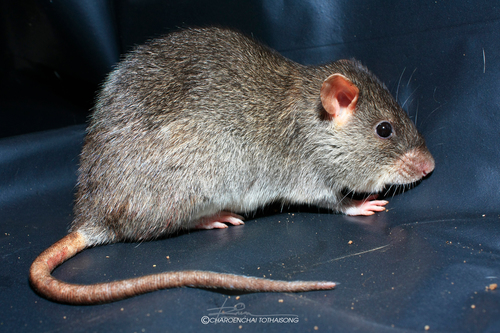
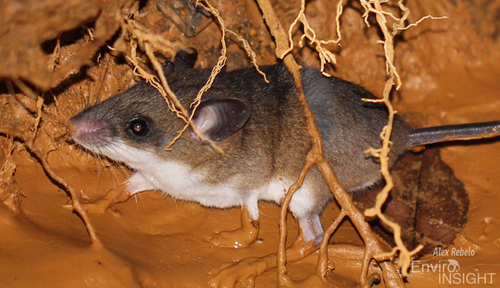
The dorsal fur is grayish-brown to dark brown, while the ventral fur is paler, often grayish-white. It has distinctive white or pale feet, a long scaly tail, and relatively large ears typical of murid rodents.
Size
Head-body length typically ranges from 150-220mm, with tail length often exceeding body length at 180-250mm
Weight
Adults typically weigh between 150-300 grams
Distinctive features
Distinguished from other Berylmys species by specific cranial and dental characteristics, as well as subtle differences in fur coloration and tail length ratios. The white feet are a notable genus-level characteristic shared with congeners.
Differences between males and females
Minimal sexual dimorphism has been documented, with males and females showing similar size and coloration.
Behaviour and diet of the Berdmore's Berylmys
Generally considered solitary or living in loose family groups, consistent with many murid rodent species. Detailed social structure studies are limited.
When it is active
Primarily nocturnal, being most active during nighttime hours when foraging for food and avoiding diurnal predators.
Diet
Omnivorous diet consisting of seeds, fruits, plant matter, and invertebrates. Known to forage in agricultural fields, potentially consuming crops such as rice.
How it feeds and hunts
Forages opportunistically on the ground and in low vegetation, using keen olfactory senses to locate food sources including seeds, fruits, and insects.
Communication
Communication likely includes vocalizations, scent marking through urine and glandular secretions, and tactile interactions, consistent with typical murid rodent behavior.
Interactions with other species
Serves as prey for various predators including snakes, birds of prey, and small carnivores. May compete with other rodent species for food resources and habitat.
Role in its ecosystem
Plays a role in seed dispersal and as a prey item within forest and agricultural ecosystems, contributing to nutrient cycling and food web dynamics.
Reproduction and lifecycle
Breeding likely occurs throughout the year in tropical climates, with females producing multiple litters annually. Gestation period is estimated at around 21-24 days, typical for murid rodents, with litter sizes ranging from 4-8 offspring.
Raising the young
Females provide primary care for offspring, including nursing and protection in the nest until weaning, which typically occurs within a few weeks after birth.
Maturity and lifespan
Sexual maturity likely reached within 2-3 months, typical for murid rodents. Lifespan in the wild is probably 1-2 years, potentially longer in captivity.
Taxonomy and naming of the Berdmore's Berylmys
Classification
Mammalia > Rodentia > Muridae > Berylmys > Berylmys berdmorei
Scientific synonyms
Mus berdmorei (Blyth, 1851); previously placed in genus Rattus
What research says
Recent studies
Recent taxonomic revisions within the genus Berylmys have helped clarify species boundaries using molecular and morphological data, though specific recent studies on B. berdmorei are limited in the literature.
Compared with similar species
Similar to other Berylmys species such as B. bowersi and B. mackenziei, but distinguished by size differences, dental morphology, and geographic distribution. Generally smaller than B. bowersi, the largest member of the genus.
The Berdmore's Berylmys and people
This species is named after Thomas Berdmore, a naturalist collector in colonial Burma. Despite being relatively obscure, it belongs to a genus notable for containing some of the largest murid rodents in Southeast Asia.
Where and how to see it
Best observed at night using spotlighting techniques in forested or agricultural areas within its range in Thailand, Cambodia, Laos, or Vietnam. Local wildlife guides familiar with small mammal surveys may assist in locating this elusive nocturnal species.
Risks to humans
No notable risk to humans directly, though as with many rodents, there is a theoretical possibility of disease transmission through contact with feces or urine.
Human uses
Not commonly utilized by humans, though it may be considered an agricultural pest in some rice-growing regions due to crop consumption.
Countries where the Berdmore's Berylmys is recorded
The 5 countries named in the range description of its IUCN Red List assessment.
Questions about the Berdmore's Berylmys
Where does the Berdmore's Berylmys live?
The Berdmore's Berylmys is recorded in Cambodia, Laos, Myanmar, Thailand and Vietnam across Asia. These countries come from the range description of its IUCN Red List assessment, and they are what place the species on the interactive map.
Is the Berdmore's Berylmys endangered?
The IUCN Red List assesses the Berdmore's Berylmys as Least Concern. The species is widespread and abundant enough not to qualify for any threatened category. It does not mean the species is safe forever, only that nothing in the current data raises an alarm.
How many are left in the wild?
No precise population estimate exists, but the species is considered common throughout much of its range with a presumed stable population trend. This figure comes from the species assessment on the IUCN Red List; population estimates for wild mammals are ranges, not counts, and are revised at each assessment.
What habitat does the Berdmore's Berylmys live in?
Found in tropical and subtropical moist lowland forests, forest edges, agricultural fields, and secondary growth areas.
What is the scientific name of the Berdmore's Berylmys?
The Berdmore's Berylmys is Berylmys berdmorei, in the family Muridae, order Rodentia.
Other species in the genus Berylmys


Other species in the family Muridae
Species that share its range
Sources
Conservation status, range description and population estimate come from the IUCN Red List assessment for Berylmys berdmorei. Countries are derived from that range description, not from a mapped country list. Last refreshed on .
The distribution map is drawn from the IUCN Red List spatial data compiled in 2008. IUCN (International Union for Conservation of Nature)