
Blick's Grass Rat
Arvicanthis blicki
Red List assessment
Near Threatenedon the IUCN Red List
- EXExtinct
- EWExtinct in the Wild
- CRCritically Endangered
- ENEndangered
- VUVulnerable
- NTNear Threatened
- LCLeast Concern
The Blick's Grass Rat is recorded in one country, Ethiopia across Africa. The IUCN Red List assesses the Blick's Grass Rat as Near Threatened. No precise global population estimate is available.
- Family
- Muridae
- Order
- Rodentia
- Genus
- Arvicanthis
- Countries recorded
- 1
- Continents
- Africa
- Red List category
- Near Threatened
- Data updated
- August 9, 2026
What is the Blick's Grass Rat?
Blick's Grass Rat is a medium-sized murid rodent endemic to the Ethiopian highlands. It inhabits high-altitude montane grasslands and moorlands, making it one of the few Arvicanthis species adapted to cool, afroalpine environments. It is notable for its restricted range and its ecological role in highland ecosystems dominated by Afroalpine grasses. Its taxonomic distinctiveness from related Ethiopian grass rats has been a subject of ongoing scientific interest.
Where does the Blick's Grass Rat live?
Endemic to the Ethiopian highlands, particularly the Bale Mountains and surrounding montane regions of southern and central Ethiopia.
Strictly endemic to Ethiopia. Its range centers on the Bale Mountains (Oromia region) and extends into adjacent highland areas of southern and central Ethiopia. It does not occur outside Ethiopian territory.
Altitude and depth
Typically found between approximately 2,000 and 4,000 m above sea level, with core populations in the Afroalpine and sub-Afroalpine zones of the Bale Mountains.
Seasonal movements
No documented long-distance seasonal migrations. Activity and reproductive patterns may shift slightly with Ethiopia's wet and dry seasons, but the species appears to be a year-round resident of its highland habitat.
Habitat of the Blick's Grass Rat
Primarily occupies montane and Afroalpine grasslands, moorlands, and heathlands at high elevations. It is often associated with tussock grasses and shrubby heath vegetation typical of Ethiopian highlands above 2,000 m. Rocky outcrops and the edges of cultivated fields near natural grassland are also used.
Adaptations to its environment
Its relatively dense, coarse fur provides insulation against the cold temperatures of the Afroalpine zone. Like other Arvicanthis, it constructs burrow systems that offer shelter from temperature extremes and predators. Its digestive physiology is adapted to a fibrous, grass-dominated diet.
Conservation status and numbers
Near Threatened (NT) on the IUCN Red List. The species qualifies for this status due to its restricted geographic range, dependence on a fragile Afroalpine ecosystem, and ongoing habitat degradation. Population declines are suspected but not yet sufficient to meet Vulnerable thresholds.
Estimated population
No precise global population estimate is available. The population trend is suspected to be slowly declining due to habitat loss, though the species can be locally abundant within suitable habitat patches.
What threatens the Blick's Grass Rat?
The primary threats include agricultural expansion and overgrazing by livestock, which degrade the montane grasslands on which the species depends. Increasing human settlement in highland areas and potential impacts of climate change on Afroalpine habitats (upward shift or shrinkage of vegetation zones) are also concerns.
Diseases and parasites
No species-specific disease or parasite data are published. Like other murid rodents, it is likely susceptible to ectoparasites (fleas, ticks, mites) and endoparasites (helminths, protozoans). May serve as a reservoir for certain zoonotic pathogens common in African rodents.
What is being done to protect it?
The Bale Mountains National Park (Ethiopia) provides partial protection for the species' core range. The park is a UNESCO World Heritage Site candidate and benefits from conservation programs targeting the Ethiopian wolf and other endemic species, which incidentally protect the grassland habitat used by Blick's Grass Rat.
Recommended actions
Priority actions include improved monitoring of population size and trends, protection and restoration of Afroalpine grasslands within and outside protected areas, regulation of livestock grazing intensity, and further taxonomic and ecological research to clarify the species' full range and habitat requirements.
What the Blick's Grass Rat looks like
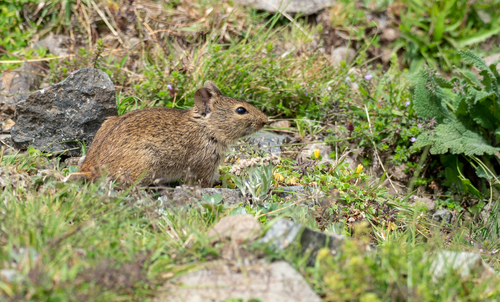
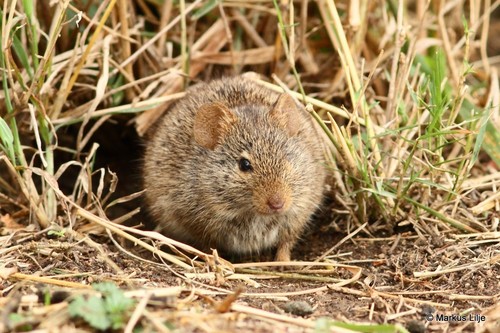
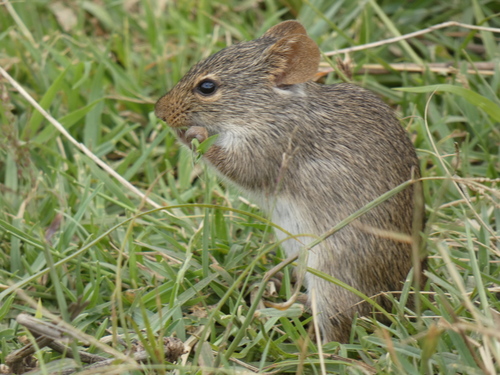
Dorsal fur is coarse and typically brownish-grey to tawny-brown, providing camouflage among dry highland grasses. The ventral surface is noticeably paler, often whitish or pale grey. The tail is bicolored (darker above, paler below) and moderately hairy. Eyes and ears are medium-sized.
Size
Body length approximately 130–175 mm; tail length approximately 95–135 mm. Total length typically 230–310 mm.
Weight
Estimated body weight between 60 and 130 g, based on comparisons with closely related Arvicanthis species. Precise weight data specific to A. blicki are limited.
Distinctive features
Distinguished from the closely related Arvicanthis abyssinicus by subtle craniometric and morphological differences, and by its more restricted high-altitude distribution. It tends to have slightly denser fur than lowland Arvicanthis species, reflecting its colder montane habitat.
Differences between males and females
Sexual dimorphism is minimal, as in most Arvicanthis species. Males may be marginally larger than females on average, but this is not pronounced and both sexes are similar in coloration.
Behaviour and diet of the Blick's Grass Rat
Likely semi-social, living in loose colonies centered on shared burrow systems, consistent with the genus Arvicanthis. Group sizes are generally small to moderate. Individuals may tolerate proximity at feeding sites.
When it is active
Primarily diurnal, which is a distinctive feature of the genus Arvicanthis relative to most other rodents. Activity peaks are typically in the morning and late afternoon, with a rest period around midday.
Diet
Herbivorous, feeding mainly on grasses, grass seeds, stems, and leaves. It may supplement its diet with roots, tubers, and occasionally invertebrates. Afroalpine grasses such as Festuca and Poa species are likely dietary staples.
How it feeds and hunts
Not applicable as a strict herbivore. Forages by cropping grasses and other plant material close to or at the entrance of burrows, or in open grassland areas.
Communication
Uses ultrasonic and audible vocalizations for intraspecific communication. Scent marking via urine and glandular secretions is likely used to delineate burrow territories. Tail flagging and body posturing are probable forms of body language during social interactions.
Interactions with other species
Predated upon by raptors (e.g., augur buzzard, long-crested eagle), snakes, and small carnivores such as the Ethiopian wolf (Canis simensis), which is known to feed on Afroalpine rodents. Competes with other sympatric rodents including Lophuromys and Muridae species for grass resources.
Role in its ecosystem
Functions as a primary consumer in Afroalpine grassland food webs, converting plant biomass into prey biomass for higher trophic levels. Burrowing activity contributes to soil aeration and seed dispersal. May play a role in regulating grass growth through grazing.
Reproduction and lifecycle
Breeding likely occurs year-round or is loosely seasonal with peaks tied to rainfall and food availability. Gestation period is estimated at approximately 21–25 days (based on congeners). Litter size is typically 3–7 pups.
Raising the young
Young are altricial at birth. The mother provides nursing and protection in the burrow. Weaning occurs at approximately 2–3 weeks. Both parents may contribute to burrow maintenance, but maternal care is primary.
Maturity and lifespan
Sexual maturity is likely reached at 4–6 weeks of age, consistent with closely related Arvicanthis species. Lifespan in the wild is estimated at 1–2 years; captive lifespans for the genus can extend to 3–4 years.
Taxonomy and naming of the Blick's Grass Rat
Classification
Mammalia > Rodentia > Muridae > Arvicanthis > Arvicanthis blicki
Scientific synonyms
Described by Frick in 1914; has at times been considered closely related to or partially synonymized with Arvicanthis abyssinicus. No widely accepted alternative scientific names are currently recognized.
What research says
Recent studies
Molecular phylogenetic studies of the genus Arvicanthis have helped clarify the relationships among Ethiopian species, reinforcing the distinctiveness of A. blicki from A. abyssinicus. Ongoing surveys in the Bale Mountains ecosystem have contributed distributional data. Broader Arvicanthis genomics work may shed light on its evolutionary history.
Genome and DNA
No published complete genome for A. blicki specifically. The genus Arvicanthis has a diploid chromosome number of 2n = 62 in several species; confirmation for A. blicki is not clearly established in the literature.
Compared with similar species
Most closely related to Arvicanthis abyssinicus (Abyssinian grass rat), with which it shares Ethiopia and similar morphology. Distinguished from the widespread Nile grass rat (A. niloticus) by its Afroalpine habitat preference, denser pelage, and more restricted distribution. The genus as a whole is distinguished from Old World rats (Rattus) by its diurnal habits and grassland specialization.
The Blick's Grass Rat and people
Blick's Grass Rat is one of very few rodents that is truly diurnal, sharing this unusual trait with other Arvicanthis species. It shares its high-altitude home with the critically endangered Ethiopian wolf, which actively hunts grass rats as a dietary staple. Despite being a small rodent, it thrives in one of the most extreme grassland environments in Africa, where nighttime temperatures can drop below freezing.
Where and how to see it
The best place to observe Blick's Grass Rat is in Bale Mountains National Park, Ethiopia, particularly in the Sanetti Plateau and surrounding Afroalpine grasslands. Visiting during the dry season (October–January) improves visibility in open terrain. Mornings and late afternoons are optimal, as the species is diurnal and most active outside the midday heat.
Risks to humans
No notable risk. As a small wild rodent, it may bite if handled, and like other wild rodents could theoretically carry zoonotic pathogens, but it poses no significant documented health risk to humans.
Countries where the Blick's Grass Rat is recorded
The 1 countries named in the range description of its IUCN Red List assessment.
Questions about the Blick's Grass Rat
Where does the Blick's Grass Rat live?
The Blick's Grass Rat is recorded in Ethiopia across Africa. These countries come from the range description of its IUCN Red List assessment, and they are what place the species on the interactive map.
Is the Blick's Grass Rat endangered?
The IUCN Red List assesses the Blick's Grass Rat as Near Threatened. The species does not qualify as threatened today, but it is close to the thresholds and likely to cross them soon. It is the category that most often changes at the next assessment.
How many are left in the wild?
No precise global population estimate is available. This figure comes from the species assessment on the IUCN Red List; population estimates for wild mammals are ranges, not counts, and are revised at each assessment.
What habitat does the Blick's Grass Rat live in?
Primarily occupies montane and Afroalpine grasslands, moorlands, and heathlands at high elevations.
What is the scientific name of the Blick's Grass Rat?
The Blick's Grass Rat is Arvicanthis blicki, in the family Muridae, order Rodentia.
Other species in the genus Arvicanthis
Other species in the family Muridae
Sources
Conservation status, range description and population estimate come from the IUCN Red List assessment for Arvicanthis blicki. Countries are derived from that range description, not from a mapped country list. Last refreshed on .
The distribution map is drawn from the IUCN Red List spatial data compiled in 2008. IUCN (International Union for Conservation of Nature)