
Mentawai Squirrel
Callosciurus melanogaster
Red List assessment
Vulnerableon the IUCN Red List
- EXExtinct
- EWExtinct in the Wild
- CRCritically Endangered
- ENEndangered
- VUVulnerable
- NTNear Threatened
- LCLeast Concern
The Mentawai Squirrel is recorded in one country, Indonesia across Asia. The IUCN Red List assesses the Mentawai Squirrel as Vulnerable. No precise global population estimate exists, but the population is considered to be declining in line with ongoing deforestation across its restricted island range.
- Family
- Sciuridae
- Order
- Rodentia
- Genus
- Callosciurus
- Countries recorded
- 1
- Continents
- Asia
- Red List category
- Vulnerable
- Data updated
- August 9, 2026
What is the Mentawai Squirrel?
The Mentawai Squirrel is a tree squirrel endemic to the Mentawai Islands archipelago off Sumatra, Indonesia. It is a member of the diverse Callosciurus genus of Southeast Asian tree squirrels, distinguished by its dark ventral coloration. Its restricted island range and dependence on tropical forest make it vulnerable to habitat loss, and it is one of several endemic species characteristic of the unique Mentawai fauna.
Where does the Mentawai Squirrel live?
Mentawai Islands, Indonesia (off the west coast of Sumatra)
Endemic to the Mentawai Islands, Indonesia, found on Siberut, Sipora, and the Pagai Islands (North and South Pagai), located west of Sumatra in the Indian Ocean.
Altitude and depth
Lowland to lower montane forest, roughly 0-600 m above sea level
Habitat of the Mentawai Squirrel
Primary and secondary lowland tropical rainforest, including mixed dipterocarp forest and forest edges; also found in some disturbed or logged forest patches with sufficient canopy cover.
Adaptations to its environment
Sharp curved claws and strong hind limbs enable agile arboreal locomotion and leaping between tree canopies. Its coloration provides camouflage against tree bark and foliage, and a flexible, opportunistic diet allows it to exploit varying food availability across seasons on a small island ecosystem.
Conservation status and numbers
Classified as Vulnerable (VU) by the IUCN due to its small, fragmented range restricted to the Mentawai Islands and ongoing habitat loss from logging and agricultural conversion. Population is inferred to be declining as forest cover continues to shrink across its limited island range.
Estimated population
No precise global population estimate exists, but the population is considered to be declining in line with ongoing deforestation across its restricted island range.
What threatens the Mentawai Squirrel?
Deforestation for logging, oil palm and other agricultural plantations, and human settlement expansion are the primary threats. Habitat fragmentation on small islands leaves little room for range shifts, and hunting pressure may also affect local populations.
What is being done to protect it?
Some populations occur within protected areas such as Siberut National Park, which offers partial habitat protection. Broader Indonesian forestry and biodiversity conservation regulations provide some legal protection, though enforcement in remote island areas remains limited.
Recommended actions
Strengthen protection and enforcement within Siberut National Park and other forested areas, curb illegal logging and unsustainable plantation expansion, and conduct population surveys to better assess status. Habitat corridors and community-based conservation programs would help maintain connectivity between forest fragments.
What the Mentawai Squirrel looks like
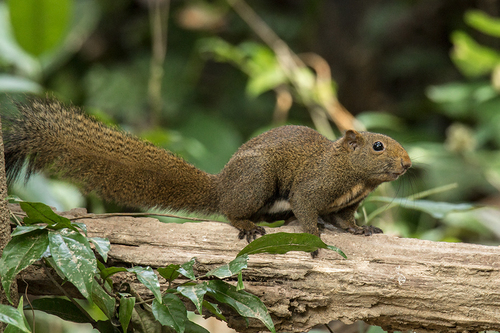
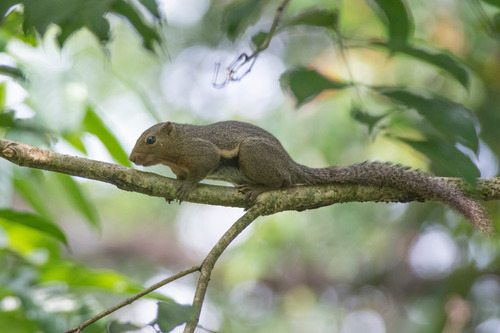
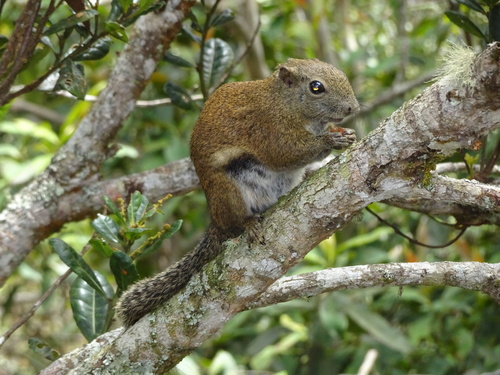
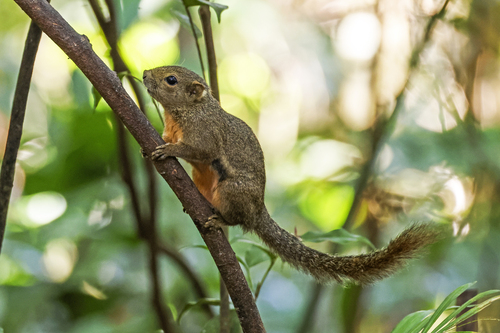
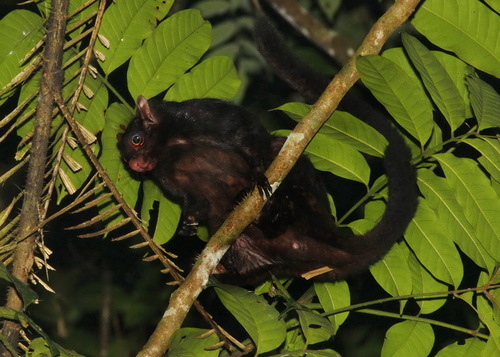
The Mentawai Squirrel has a generally brownish to olive dorsal pelage contrasted with a notably dark or blackish venter, giving rise to its species name 'melanogaster' (black-bellied). It has a long bushy tail, large eyes, and rounded ears typical of tree squirrels.
Size
Head-body length approximately 20-25 cm, with a bushy tail of similar or slightly greater length
Weight
Estimated 250-350 grams, typical for medium-sized Callosciurus species
Distinctive features
Its dark, blackish underside sharply contrasting with lighter dorsal fur distinguishes it from many other Callosciurus species, which often show more uniform or brightly colored coats. Its island endemism to the Mentawai archipelago further sets it apart geographically from mainland relatives.
Behaviour and diet of the Mentawai Squirrel
Generally solitary or seen in loose pairs, typical of many Callosciurus tree squirrels, with individuals maintaining and defending small home ranges within the forest canopy.
When it is active
Diurnal, most active during daylight hours when foraging for food in the forest canopy and understory.
Diet
Omnivorous, feeding primarily on fruits, seeds, nuts, and flowers, supplemented occasionally with insects, buds, and bark, consistent with the diet of related Callosciurus species.
Communication
Likely communicates through vocal chirps and chatters, tail-flicking displays, and scent marking, as seen in related Callosciurus species, used for territory defense and alarm signaling.
Interactions with other species
Potential predators include arboreal snakes, raptors, and small carnivores present on the Mentawai Islands; it may also compete with other endemic or introduced rodents for food resources.
Role in its ecosystem
As a frugivore-granivore, it plays a role in seed dispersal and seed predation within Mentawai forest ecosystems, contributing to forest regeneration dynamics and plant community structure.
Reproduction and lifecycle
Breeding biology is not well documented, but likely resembles other Callosciurus squirrels with litters of 1-3 young after a gestation of about 4-5 weeks, potentially breeding multiple times per year in the relatively stable tropical climate.
Raising the young
Females are presumed to be the primary caregivers, nursing and protecting young in tree nests until they are weaned and capable of independent foraging, similar to related tree squirrel species.
Maturity and lifespan
Sexual maturity is likely reached around 1 year of age, with a lifespan in the wild estimated at 5-8 years, potentially longer in captivity, consistent with similar-sized tree squirrels.
Taxonomy and naming of the Mentawai Squirrel
Classification
Class Mammalia > Order Rodentia > Family Sciuridae > Genus Callosciurus > Species Callosciurus melanogaster
Scientific synonyms
Sciurus melanogaster (original combination)
What research says
Compared with similar species
Compared to other Callosciurus species such as the Prevost's Squirrel (Callosciurus prevostii), the Mentawai Squirrel has a more subdued, less strikingly patterned coat, with its dark belly being the most notable distinguishing feature. It is smaller and more geographically restricted than many mainland Callosciurus relatives.
The Mentawai Squirrel and people
It is one of several unique mammal species endemic to the biologically distinct Mentawai Islands, an area known for its unusual island-adapted fauna. Its scientific name 'melanogaster' directly references its distinctive dark belly, a rare trait among tree squirrels of the region.
Where and how to see it
Best observed during early morning hours in the remaining forested areas of Siberut National Park, where visitors may spot it foraging in the mid to upper canopy. Patience and quiet movement through forest trails increase chances of sighting this shy, arboreal species.
Risks to humans
No notable risk to humans.
Countries where the Mentawai Squirrel is recorded
The 1 countries named in the range description of its IUCN Red List assessment.
Questions about the Mentawai Squirrel
Where does the Mentawai Squirrel live?
The Mentawai Squirrel is recorded in Indonesia across Asia. These countries come from the range description of its IUCN Red List assessment, and they are what place the species on the interactive map.
Is the Mentawai Squirrel endangered?
Yes. The IUCN Red List assesses the Mentawai Squirrel as Vulnerable, one of the three threatened categories. The species faces a high risk of extinction in the wild. It is the first of the three threatened categories: numbers are falling, the range is shrinking, or the population is small enough that a single bad event could do lasting damage.
How many are left in the wild?
No precise global population estimate exists, but the population is considered to be declining in line with ongoing deforestation across its restricted island range. This figure comes from the species assessment on the IUCN Red List; population estimates for wild mammals are ranges, not counts, and are revised at each assessment.
What habitat does the Mentawai Squirrel live in?
Primary and secondary lowland tropical rainforest, including mixed dipterocarp forest and forest edges; also found in some disturbed or logged forest patches with sufficient canopy cover.
What is the scientific name of the Mentawai Squirrel?
The Mentawai Squirrel is Callosciurus melanogaster, in the family Sciuridae, order Rodentia.
Other species in the genus Callosciurus
Other species in the family Sciuridae
Sources
Conservation status, range description and population estimate come from the IUCN Red List assessment for Callosciurus melanogaster. Countries are derived from that range description, not from a mapped country list. Last refreshed on .
The distribution map is drawn from the IUCN Red List spatial data compiled in 2016. IUCN SSC Small Mammal Specialist Group