
Common Warthog
Phacochoerus africanus
Red List assessment
Least Concernon the IUCN Red List
- EXExtinct
- EWExtinct in the Wild
- CRCritically Endangered
- ENEndangered
- VUVulnerable
- NTNear Threatened
- LCLeast Concern
The Common Warthog is recorded in 5 countries across Africa. The IUCN Red List assesses the Common Warthog as Least Concern. Population estimated in the hundreds of thousands across Africa, with overall stable to slightly declining trend depending on region
- Family
- Suidae
- Order
- Artiodactyla
- Genus
- Phacochoerus
- Countries recorded
- 5
- Continents
- Africa
- Red List category
- Least Concern
- Data updated
- August 9, 2026
What is the Common Warthog?
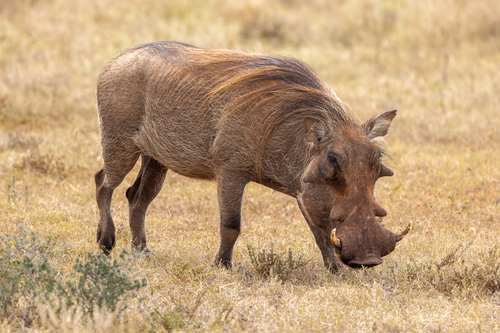
The Common Warthog is a wild member of the pig family widely distributed across sub-Saharan African grasslands and savannas. It is easily recognized by its large head, prominent facial warts, and curved tusks. Highly adaptable, it thrives in open habitats and is a common sight in African wildlife reserves. Despite its fierce appearance, it is generally a shy herbivore that flees from danger by running with its tail held straight up.
Where does the Common Warthog live?
Sub-Saharan Africa, primarily savanna regions from Senegal to Ethiopia and south to South Africa
Found across sub-Saharan Africa from Senegal and Mauritania in the west, through the Sahel and East Africa, down to South Africa. Notably absent from the Congo Basin rainforest and extreme desert regions like the Namib and Sahara.
Altitude and depth
Typically found from sea level up to 3000m in East African highlands, though most populations occur below 1500m
Seasonal movements
No true migration, but movements track seasonal water and grass availability; breeding is often synchronized with rainy seasons to ensure food abundance for piglets
Habitat of the Common Warthog
Prefers open savanna, grassland, and woodland habitats with access to water and mud wallows. Avoids dense forest and true desert, favoring areas with short grass for grazing. Often found near termite mounds and abandoned burrows which it uses for shelter.
Adaptations to its environment
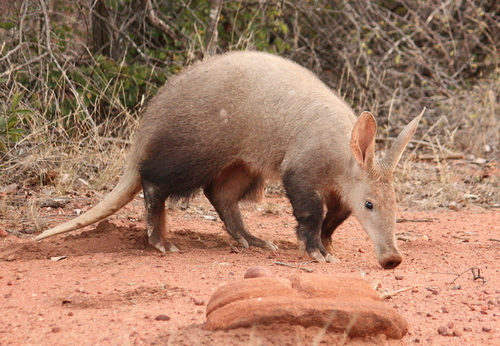
Warthogs use their snouts and tusks to dig for roots, tubers, and water during dry seasons. They kneel on calloused, padded knees while grazing on short grass, and use abandoned aardvark burrows for shelter from predators and extreme temperatures. Their sparse hair coat and wallowing behavior help regulate body temperature in hot climates.
Conservation status and numbers
Least Concern (LC) according to IUCN, reflecting its wide distribution, adaptability, and generally stable populations across most of its range. Some localized declines occur due to habitat loss and hunting.
Estimated population
Population estimated in the hundreds of thousands across Africa, with overall stable to slightly declining trend depending on region
What threatens the Common Warthog?
Habitat conversion to agriculture, hunting for bushmeat, and conflict with livestock farmers who view them as competitors for grazing land. Localized population pressure also comes from expanding human settlements.
Diseases and parasites
Susceptible to African swine fever, which it can carry asymptomatically and transmit to domestic pigs; also hosts various ticks and internal parasites
What is being done to protect it?
Protected within numerous national parks and game reserves across its range, including Serengeti, Kruger, and Maasai Mara. Benefits indirectly from broader African wildlife conservation and anti-poaching efforts targeting larger species.
Recommended actions
Maintain and expand protected savanna habitats, manage human-wildlife conflict through community education, and monitor regional population trends especially outside protected areas.
What the Common Warthog looks like
Grayish-brown, sparsely haired skin with a mane of longer bristles running down the neck and back. Large, flat head with two pairs of curved tusks and characteristic warty protrusions on the face used for protection during fights.
Size
Body length 90-150cm, shoulder height 60-85cm; tail 35-50cm
Weight
Males typically weigh 60-150kg, females 45-75kg, males being notably larger
Distinctive features
Distinguished from other warthog species and pigs by its four facial warts (versus two in the desert warthog), larger overall size, and the habit of running with tail erect like an antenna.
Differences between males and females
Males are larger than females and possess bigger, more prominent tusks and facial warts; females have smaller tusks and a less pronounced warty face
Behaviour and diet of the Common Warthog
Females and young form social groups called sounders, typically 4-16 individuals, while adult males are largely solitary except during mating season. Social bonds within sounders are maintained through grooming and shared burrow use.
When it is active
Primarily diurnal, being most active during early morning and late afternoon, retreating to burrows during the heat of midday and at night
Diet
Omnivorous but predominantly herbivorous, feeding mainly on grasses, roots, bulbs, and berries; will occasionally eat carrion, insects, and eggs when available
How it feeds and hunts
Not a hunter; forages by grazing on short grasses and using its snout and tusks to dig up roots, tubers, and bulbs, especially during dry seasons when surface vegetation is scarce
Communication
Communicates through a range of grunts, snorts, and squeals, along with body postures and tail signals; scent marking via glands helps establish territory and social bonds
Interactions with other species
Preyed upon by lions, leopards, hyenas, and crocodiles, especially piglets and young; forms mutualistic relationships with birds like oxpeckers that remove parasites from their skin
Role in its ecosystem
Plays an important role in savanna ecosystems as a grazer that helps maintain grassland structure and as a prey species supporting large African predators. Its burrowing and digging activity also aerates soil and can influence plant growth patterns.
Reproduction and lifecycle
Mating typically occurs at the end of the rainy season; gestation lasts about 170-175 days, with litters of 2-4 piglets born in the dry season in an underground burrow
Raising the young
Mothers provide sole parental care, nursing piglets for about 4 months while keeping them hidden in burrows for the first few weeks. Piglets follow their mother closely and remain with the sounder until near sexual maturity.
Maturity and lifespan
Reaches sexual maturity around 18-20 months; lifespan averages 7-11 years in the wild and up to 18 years in captivity
Taxonomy and naming of the Common Warthog
Classification
Class Mammalia > Order Artiodactyla > Family Suidae > Genus Phacochoerus > Species Phacochoerus africanus
Subspecies
Several recognized subspecies including P. a. africanus (West African warthog, Senegal to Ghana), P. a. massaicus (Maasai warthog, East Africa), P. a. sundevallii (Southern warthog, southern Africa), and P. a. aeliani (Somali warthog, Horn of Africa)
Scientific synonyms
Formerly classified under Phacochoerus aethiopicus before taxonomic revision separated the desert warthog as a distinct species
What research says
Recent studies
Recent research has focused on the warthog's role as a reservoir host for African swine fever virus, informing disease management strategies for domestic pig farming in Africa
Genome and DNA
Diploid chromosome number of 2n=34; genetic studies have helped clarify the split between common warthog and desert warthog species
Compared with similar species
Similar to the desert warthog (Phacochoerus aethiopicus) but distinguished by having four facial warts instead of two and a generally larger body size; also differs from bushpigs by its more upright tail carriage and less hairy body
The Common Warthog and people
Warthogs run with their thin tails held straight up like flagpoles, a behavior thought to help group members keep track of each other in tall grass. They famously feature as the character Pumbaa in Disney's The Lion King. Despite their tough appearance, they can sprint up to 48 km/h when fleeing predators.
Where and how to see it
Best observed in East and Southern African savanna reserves such as Serengeti, Maasai Mara, and Kruger National Park during early morning or late afternoon when they are most active and visible grazing in open areas
Risks to humans
Generally low risk to humans; however, cornered or threatened warthogs can charge and inflict injury with their tusks, so caution should be maintained at close range
Human uses
Hunted for bushmeat in parts of its range and occasionally as a game species for trophy hunting; also popular as a tourist attraction in African wildlife viewing
Myths and legends
In some African folklore, the warthog symbolizes cleverness and adaptability due to its resourceful digging and burrow-dwelling habits, though it is not as prominent in traditional mythology as some other African animals
Countries where the Common Warthog is recorded
The 5 countries named in the range description of its IUCN Red List assessment.
Questions about the Common Warthog
Where does the Common Warthog live?
The Common Warthog is recorded in Democratic Republic of the Congo, Ethiopia, Mauritania, Senegal and South Africa across Africa. These countries come from the range description of its IUCN Red List assessment, and they are what place the species on the interactive map.
Is the Common Warthog endangered?
The IUCN Red List assesses the Common Warthog as Least Concern. The species is widespread and abundant enough not to qualify for any threatened category. It does not mean the species is safe forever, only that nothing in the current data raises an alarm.
How many are left in the wild?
Population estimated in the hundreds of thousands across Africa, with overall stable to slightly declining trend depending on region This figure comes from the species assessment on the IUCN Red List; population estimates for wild mammals are ranges, not counts, and are revised at each assessment.
What habitat does the Common Warthog live in?
Prefers open savanna, grassland, and woodland habitats with access to water and mud wallows.
What is the scientific name of the Common Warthog?
The Common Warthog is Phacochoerus africanus, in the family Suidae, order Artiodactyla.
Other species in the genus Phacochoerus
Other species in the family Suidae
Species that share its range

Sources
Conservation status, range description and population estimate come from the IUCN Red List assessment for Phacochoerus africanus. Countries are derived from that range description, not from a mapped country list. Last refreshed on .
The distribution map is drawn from the IUCN Red List spatial data compiled in 2016. De Jong et al. in prep.