
Margay
Leopardus wiedii
Red List assessment
Near Threatenedon the IUCN Red List
- EXExtinct
- EWExtinct in the Wild
- CRCritically Endangered
- ENEndangered
- VUVulnerable
- NTNear Threatened
- LCLeast Concern
The Margay is recorded in 15 countries across North America and South America. The IUCN Red List assesses the Margay as Near Threatened. Population size is difficult to estimate precisely due to elusive behavior, but is believed to be declining; thought to number in the tens of thousands globally, with fragmented and low-density populations across its range.
- Family
- Felidae
- Order
- Carnivora
- Genus
- Leopardus
- Countries recorded
- 15
- Continents
- North America and South America
- Red List category
- Near Threatened
- Data updated
- August 9, 2026
What is the Margay?
The margay is a small, slender wild cat native to the forests of Central and South America, renowned for its exceptional arboreal agility. It closely resembles the ocelot but is smaller and more specialized for life in the trees, with unique ankle rotation allowing it to climb down trunks headfirst like a squirrel. This elusive nocturnal predator plays an important role in controlling small vertebrate populations in tropical forest ecosystems.
Where does the Margay live?
Central and South America, from Mexico through Central America to northern Argentina and Uruguay
Ranges from northern Mexico through Central America (Belize, Guatemala, Honduras, Nicaragua, Costa Rica, Panama) into South America, including Colombia, Venezuela, the Amazon Basin (Brazil, Peru, Ecuador, Bolivia), and south to northern Argentina and Uruguay.
Altitude and depth
Sea level up to approximately 3,000 meters in some Andean forest regions
Habitat of the Margay
Primarily dense tropical and subtropical evergreen and deciduous forests, including cloud forests and gallery forests along rivers; also found in secondary forests and shade-grown plantations with sufficient canopy cover.
Adaptations to its environment
Highly specialized for arboreal life with flexible ankle joints that rotate 180 degrees, allowing headfirst descent from trees; large eyes for excellent night vision; long tail for balance while climbing; and strong, sharp retractable claws for gripping branches.
Conservation status and numbers
Near Threatened (NT) according to IUCN, having previously been listed as Vulnerable; population continues to decline due to habitat loss and fragmentation despite legal protections in most range countries.
Estimated population
Population size is difficult to estimate precisely due to elusive behavior, but is believed to be declining; thought to number in the tens of thousands globally, with fragmented and low-density populations across its range.
What threatens the Margay?
Deforestation and habitat fragmentation for agriculture and logging, historical hunting for the fur trade, road mortality, and human-wildlife conflict; illegal pet trade also poses a localized threat.
Diseases and parasites
Susceptible to feline diseases such as feline leukemia virus and feline immunodeficiency virus, as well as various internal and external parasites including ticks and intestinal worms.
What is being done to protect it?
Protected under CITES Appendix I, banning international commercial trade; present in numerous protected areas and national parks throughout its range; conservation research includes camera-trap monitoring and habitat corridor initiatives.
Recommended actions
Expand and connect protected forest habitats through wildlife corridors, strengthen enforcement against illegal trade, conduct more population studies using camera traps and genetic sampling, and promote sustainable land-use practices in buffer zones.
What the Margay looks like
Soft, thick fur ranging from tawny yellow to grayish-brown, covered in dark rosettes, spots, and streaks similar to a small ocelot; underparts are white or cream colored; large dark eyes and rounded ears with white spots on the back.
Size
Head-body length of 48–79 cm, with a long tail measuring 33–51 cm, contributing significantly to overall body length.
Weight
Typically weighs between 2.6 and 4 kg, with males generally slightly larger than females.
Distinctive features
Distinguished from the similar ocelot by its smaller size, proportionally larger eyes, longer tail relative to body length, and more slender build adapted for arboreal locomotion.
Differences between males and females
Minimal sexual dimorphism; males are slightly larger and heavier than females but coloration and markings are similar between sexes.
Behaviour and diet of the Margay
Solitary and territorial, with individuals maintaining home ranges that may overlap slightly between males and females but rarely between same-sex individuals.
When it is active
Primarily nocturnal and crepuscular, being most active during dawn, dusk, and nighttime hours, though some daytime activity has been documented in undisturbed areas.
Diet
Carnivorous, feeding on small mammals such as rodents, opossums, and squirrels, as well as birds, lizards, frogs, and invertebrates; occasionally preys on arboreal species like monkeys and sloths' young.
How it feeds and hunts
An ambush predator that uses stealth and exceptional climbing ability to hunt both on the ground and in trees, often stalking prey silently before pouncing.
Communication
Communicates through vocalizations including mewing, growling, and hissing, as well as scent marking via urine spraying and cheek rubbing to establish territory boundaries.
Interactions with other species
Faces competition from larger sympatric felids such as ocelots and jaguars, which may also prey on margays; occasionally competes with other small carnivores for similar prey resources.
Role in its ecosystem
Functions as a mesopredator in tropical forest ecosystems, helping regulate populations of small mammals and birds, thereby contributing to ecosystem balance and biodiversity.
Reproduction and lifecycle
Breeding can occur year-round in tropical regions; gestation lasts approximately 76–85 days, typically resulting in a single kitten, though twins occasionally occur.
Raising the young
Females provide sole parental care, nursing and protecting the kitten in a den located in tree hollows or dense vegetation; young remain dependent on the mother for several months before becoming independent.
Maturity and lifespan
Reaches sexual maturity around 12–18 months of age; lifespan in the wild is estimated at 10–12 years, while captive individuals can live up to 20 years.
Taxonomy and naming of the Margay
Classification
Mammalia > Carnivora > Felidae > Leopardus > Leopardus wiedii
Subspecies
Several subspecies historically described (e.g., L. w. wiedii in South America, L. w. glauculus in Central America, L. w. cooperi in Mexico), though modern taxonomy often treats margay as monotypic or with limited valid subspecies pending further genetic study.
Scientific synonyms
Felis wiedii, Leopardus tigrinus wiedii (in some older classifications)
What research says
Recent studies
Recent camera-trap and genetic studies have provided new insights into margay population densities, habitat use, and phylogenetic relationships with closely related Leopardus species, highlighting the need for updated subspecies classification.
Genome and DNA
Diploid chromosome number of 2n=36, consistent with other members of the Leopardus genus; genetic studies have helped clarify phylogenetic relationships within small Neotropical cats.
Compared with similar species
Compared to the ocelot, the margay is smaller, more arboreal, and has proportionally larger eyes and a longer tail; it is also similar in appearance to the oncilla but larger and more specialized for tree-dwelling.
The Margay and people
The margay is one of the few cat species capable of rotating its ankles 180 degrees, enabling it to climb down trees headfirst like a squirrel; it can also leap up to 12 feet horizontally between branches, and has been observed mimicking the calls of primate prey to lure them closer.
Where and how to see it
Best observed through camera trap surveys in protected tropical forests of Costa Rica, Belize, or the Amazon Basin during nighttime hours, as direct sightings are rare due to the species' elusive and nocturnal nature.
Risks to humans
No notable risk to humans; margays are shy, avoid human contact, and there are no documented cases of unprovoked attacks on people.
Human uses
Historically hunted for its fur in the mid-20th century fur trade, though this has significantly declined due to international trade bans; occasionally kept illegally as an exotic pet despite legal restrictions.
Myths and legends
In some indigenous South American cultures, small spotted cats like the margay have been associated with forest spirits or omens, though specific folklore is less documented compared to larger cats like the jaguar.
Countries where the Margay is recorded
The 15 countries named in the range description of its IUCN Red List assessment.
Questions about the Margay
Where does the Margay live?
The Margay is recorded in Argentina, Belize, Bolivia, Brazil and Colombia, among 15 countries in total across North America and South America. These countries come from the range description of its IUCN Red List assessment, and they are what place the species on the interactive map.
Is the Margay endangered?
The IUCN Red List assesses the Margay as Near Threatened. The species does not qualify as threatened today, but it is close to the thresholds and likely to cross them soon. It is the category that most often changes at the next assessment.
How many are left in the wild?
Population size is difficult to estimate precisely due to elusive behavior, but is believed to be declining; thought to number in the tens of thousands globally, with fragmented and low-density populations across its range. This figure comes from the species assessment on the IUCN Red List; population estimates for wild mammals are ranges, not counts, and are revised at each assessment.
What habitat does the Margay live in?
Primarily dense tropical and subtropical evergreen and deciduous forests, including cloud forests and gallery forests along rivers; also found in secondary forests and shade-grown plantations with sufficient canopy cover.
What is the scientific name of the Margay?
The Margay is Leopardus wiedii, in the family Felidae, order Carnivora.
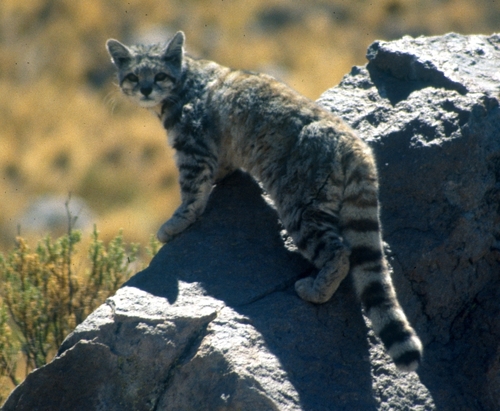
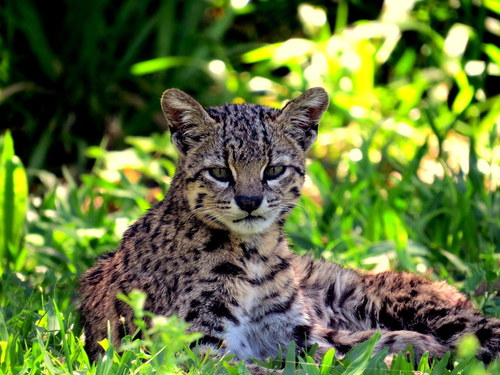
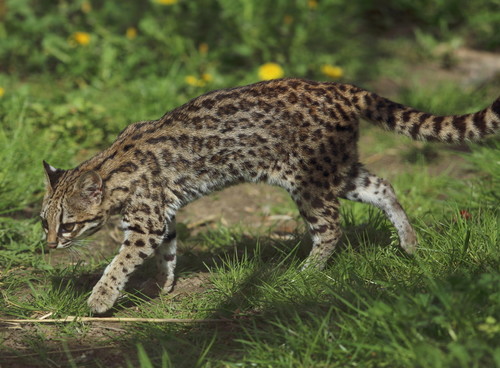
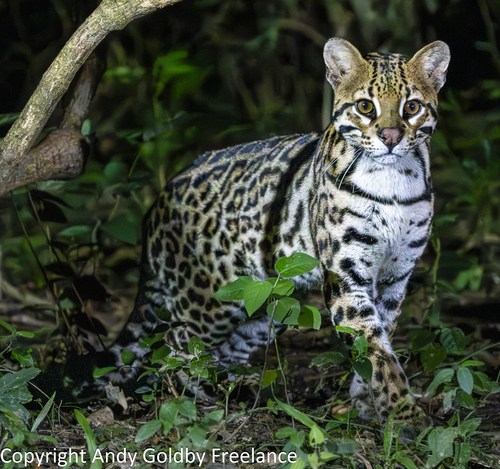
Other species in the genus Leopardus
Other species in the family Felidae
Sources
Conservation status, range description and population estimate come from the IUCN Red List assessment for Leopardus wiedii. Countries are derived from that range description, not from a mapped country list. Last refreshed on .
The distribution map is drawn from the IUCN Red List spatial data compiled in 2015. International Union for the Conservation of Nature