
Mandrill
Mandrillus sphinx
Red List assessment
Vulnerableon the IUCN Red List
- EXExtinct
- EWExtinct in the Wild
- CRCritically Endangered
- ENEndangered
- VUVulnerable
- NTNear Threatened
- LCLeast Concern
The Mandrill is recorded in 4 countries across Africa. The IUCN Red List assesses the Mandrill as Vulnerable. Global population estimated at under 100,000 individuals to potentially over 200,000, though estimates are imprecise; overall trend is declining.
- Family
- Cercopithecidae
- Order
- Primates
- Genus
- Mandrillus
- Countries recorded
- 4
- Continents
- Africa
- Red List category
- Vulnerable
- Data updated
- August 9, 2026
What is the Mandrill?
The mandrill is the world's largest monkey species, renowned for its vivid, multicolored facial and rump coloration, especially pronounced in dominant males. It inhabits dense tropical rainforests of Central Africa, living in some of the largest primate groups known, sometimes numbering in the hundreds. Its striking appearance and complex social structure have made it a subject of fascination in both science and popular culture.
Where does the Mandrill live?
Central Africa: Gabon, Cameroon, Equatorial Guinea, and Republic of Congo
Found in Central Africa across southern Cameroon, Gabon, Equatorial Guinea, and the Republic of Congo, generally between the Sanaga River in the north and the Congo River in the south.
Altitude and depth
Sea level up to approximately 1200 meters
Seasonal movements
No true migration, but movement patterns shift seasonally in response to fruiting cycles, with groups ranging more widely during periods of fruit scarcity.
Habitat of the Mandrill
Primarily lowland tropical rainforest, including primary and secondary forest, gallery forest, and dense forest with thick undergrowth; also found in forest-savanna mosaics near rivers.
Adaptations to its environment
Strong limbs and robust build aid in terrestrial foraging through dense undergrowth, while cheek pouches allow food storage during foraging bouts. Bright facial coloration in males serves as a visual signal of dominance and health, an adaptation to social communication in dim forest light.
Conservation status and numbers
Classified as Vulnerable by the IUCN due to an estimated population decline of over 30% over the past three generations, driven mainly by habitat loss and intense hunting pressure.
Estimated population
Global population estimated at under 100,000 individuals to potentially over 200,000, though estimates are imprecise; overall trend is declining.
What threatens the Mandrill?
Bushmeat hunting is the most severe threat, alongside deforestation from logging and agricultural expansion, and habitat fragmentation from road construction and human settlement expansion.
Diseases and parasites
Susceptible to various gastrointestinal parasites and has been studied for zoonotic pathogens including retroviruses; captive populations have documented cases of tuberculosis and other primate diseases.
What is being done to protect it?
Protected under CITES Appendix I and national laws in range countries, with populations occurring in protected areas such as Lopé National Park (Gabon) and Dja Faunal Reserve (Cameroon). Some conservation NGOs conduct research and anti-poaching patrols within key habitats.
Recommended actions
Strengthening anti-poaching enforcement, expanding protected area coverage and connectivity, reducing bushmeat trade through community engagement, and continued population monitoring and genetic research.
What the Mandrill looks like
Mandrills have olive-brown fur with a pale underside, and males display a strikingly colored face with a red stripe down the nose and blue ridges, along with a red and blue/purple hindquarters. Females and juveniles have much duller coloring.
Size
Head-body length approximately 75-95 cm in males, 55-65 cm in females; males are notably larger overall.
Weight
Males typically weigh 25-35 kg (occasionally up to 50 kg in captivity), while females weigh 10-15 kg.
Distinctive features
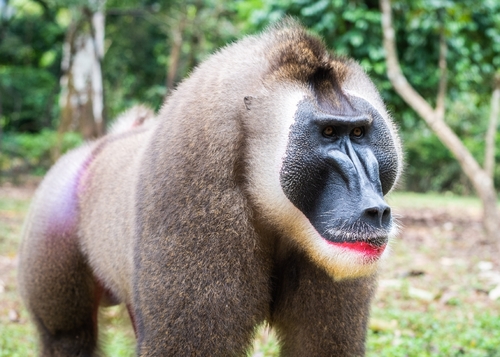
The mandrill is distinguished from its close relative the drill by its vivid facial and rump coloration; drills lack this bright coloration and have black faces. Mandrills are also generally larger and more robust than most other cercopithecid monkeys.
Differences between males and females
Pronounced sexual dimorphism: males are roughly twice the size of females, possess much larger canine teeth, and display far more vivid facial and rump coloration.
Behaviour and diet of the Mandrill
Highly social, living in large multi-male, multi-female groups called hordes that can number from a few dozen to several hundred individuals, among the largest stable groups known in non-human primates. Groups have a matrilineal core with dominant males exhibiting a strict hierarchy based on coloration and size.
When it is active
Diurnal, foraging actively during daylight hours and resting or socializing during midday heat, then settling into sleeping sites at night.
Diet
Omnivorous, feeding mainly on fruits, seeds, and fungi, supplemented with leaves, roots, invertebrates such as insects and millipedes, and occasionally small vertebrates.
How it feeds and hunts
Forages terrestrially by turning over leaf litter and digging for invertebrates and roots, using cheek pouches to store food while continuing to search; opportunistically catches small animals encountered while foraging.
Communication
Communicates through a range of vocalizations including grunts, roars, and alarm calls, along with visual displays like grinning, and scent marking via chest glands to convey dominance and reproductive status.
Interactions with other species
Adult mandrills have few natural predators aside from leopards and large raptors targeting juveniles; they may compete with other frugivorous primates for fruiting trees but often forage alongside other species with minimal conflict.
Role in its ecosystem
Mandrills play an important ecological role as seed dispersers in tropical forest ecosystems, contributing to forest regeneration and plant diversity through their frugivorous diet.
Reproduction and lifecycle
Breeding is seasonal, often peaking during the dry season, with a gestation period of about 175 days and typically a single offspring born per birth. Females may exhibit sexual swellings, and dominant males mate preferentially with receptive females.
Raising the young
Mothers provide the majority of care, nursing infants for around 6-12 months while carrying them closely; young remain within the maternal social unit and gradually integrate into group activities.
Maturity and lifespan
Females reach sexual maturity around 4-5 years, males slightly later around 6-8 years due to social maturation; lifespan is approximately 20 years in the wild and up to 30-46 years in captivity.
Taxonomy and naming of the Mandrill
Classification
Mammalia > Primates > Cercopithecidae > Mandrillus > Mandrillus sphinx
Scientific synonyms
Papio sphinx, Simia sphinx
What research says
Recent studies
Recent long-term field studies in Gabon's Lopé National Park have revealed insights into fission-fusion dynamics of mandrill hordes and the role of male coloration in signaling fitness and dominance rank.
Genome and DNA
Diploid chromosome number is 2n=42; genomic studies have explored its phylogenetic relationship to baboons and drills within the Papionini tribe.
Compared with similar species
Closely related to the drill (Mandrillus leucophaeus), with which it shares genus-level similarities but differs in facial coloration and habitat range; both are more terrestrial and robust than typical guenons or colobus monkeys.
The Mandrill and people
Mandrills form some of the largest cohesive groups of any wild primate, with hordes documented at over 800 individuals. Their facial colors intensify with social rank and testosterone levels, making them a living billboard of status within the troop.
Where and how to see it
Best observed in protected reserves such as Lopé National Park in Gabon, ideally during early morning hours when groups are actively foraging; patience and knowledgeable local guides greatly increase chances of sighting due to the species' shy, elusive nature in dense forest.
Risks to humans
Wild mandrills generally avoid humans, but large males can be dangerous if cornered or provoked due to their powerful canines; no significant disease transmission risk to humans has been widely documented.
Human uses
Hunted extensively for bushmeat in parts of its range, and occasionally kept in zoos worldwide for conservation breeding and public education programs.
Myths and legends
Mandrills gained widespread cultural recognition partly through the character Rafiki in Disney's The Lion King, though their vivid appearance had long inspired fascination in Western natural history and colonial-era African folklore as a striking forest spirit figure.
Countries where the Mandrill is recorded
The 4 countries named in the range description of its IUCN Red List assessment.
Questions about the Mandrill
Where does the Mandrill live?
The Mandrill is recorded in Cameroon, Democratic Republic of the Congo, Equatorial Guinea and Gabon across Africa. These countries come from the range description of its IUCN Red List assessment, and they are what place the species on the interactive map.
Is the Mandrill endangered?
Yes. The IUCN Red List assesses the Mandrill as Vulnerable, one of the three threatened categories. The species faces a high risk of extinction in the wild. It is the first of the three threatened categories: numbers are falling, the range is shrinking, or the population is small enough that a single bad event could do lasting damage.
How many are left in the wild?
Global population estimated at under 100,000 individuals to potentially over 200,000, though estimates are imprecise; overall trend is declining. This figure comes from the species assessment on the IUCN Red List; population estimates for wild mammals are ranges, not counts, and are revised at each assessment.
What habitat does the Mandrill live in?
Primarily lowland tropical rainforest, including primary and secondary forest, gallery forest, and dense forest with thick undergrowth; also found in forest-savanna mosaics near rivers.
What is the scientific name of the Mandrill?
The Mandrill is Mandrillus sphinx, in the family Cercopithecidae, order Primates.
Other species in the genus Mandrillus
Other species in the family Cercopithecidae
Species that share its range

Sources
Conservation status, range description and population estimate come from the IUCN Red List assessment for Mandrillus sphinx. Countries are derived from that range description, not from a mapped country list. Last refreshed on .
The distribution map is drawn from the IUCN Red List spatial data compiled in 2019. IUCN (International Union for Conservation of Nature)