
Lord Derby's Scaly-tailed Squirrel
Anomalurus derbianus
Red List assessment
Least Concernon the IUCN Red List
- EXExtinct
- EWExtinct in the Wild
- CRCritically Endangered
- ENEndangered
- VUVulnerable
- NTNear Threatened
- LCLeast Concern
The Lord Derby's Scaly-tailed Squirrel is recorded in 20 countries across Africa. The IUCN Red List assesses the Lord Derby's Scaly-tailed Squirrel as Least Concern. No precise global population estimate is available.
- Family
- Anomaluridae
- Order
- Rodentia
- Genus
- Anomalurus
- Countries recorded
- 20
- Continents
- Africa
- Red List category
- Least Concern
- Data updated
- August 9, 2026
What is the Lord Derby's Scaly-tailed Squirrel?
Lord Derby's Scaly-tailed Squirrel is the largest member of the family Anomaluridae, an ancient lineage of arboreal, gliding rodents endemic to African tropical forests. Despite its common name, it is not a true squirrel (Sciuridae) but belongs to a distinct evolutionary lineage more closely related to springhares (Pedetidae). It possesses a large patagium (gliding membrane) supported by a unique cartilaginous spur projecting from the elbow, allowing it to glide considerable distances between trees. Its common name derives from rows of overlapping keratinous scales on the underside of the tail base, which grip tree bark like crampons during landing.
Where does the Lord Derby's Scaly-tailed Squirrel live?
Sub-Saharan Africa, from Sierra Leone, Guinea, Liberia, Ivory Coast, and Ghana in the west, through Cameroon, Gabon, Republic of Congo, and the DRC in Central Africa, to Uganda, Kenya, Tanzania in the east, and south to Zambia, Zimbabwe, Malawi, and Mozambique.
Wide range across sub-Saharan Africa: West Africa (Sierra Leone, Guinea, Liberia, Ivory Coast, Ghana, Nigeria), Central Africa (Cameroon, Equatorial Guinea, Gabon, Republic of Congo, Central African Republic, DRC, Rwanda, Burundi), East Africa (Uganda, Kenya, Tanzania), and southern Africa (Zambia, Malawi, Zimbabwe, Mozambique).
Altitude and depth
Mainly a lowland species, found from sea level up to approximately 2,000 m, though most common below 1,500 m in continuous forested zones.
Seasonal movements
No significant seasonal migrations recorded. The species is largely resident year-round in its forest habitat. Foraging intensity may shift with local fruit and flower availability across seasons.
Habitat of the Lord Derby's Scaly-tailed Squirrel
Primarily inhabits lowland tropical rainforests, including primary and mature secondary forests. Also found in forest-savanna mosaics and gallery forests flanking rivers. Strictly arboreal, it depends heavily on large, old trees with hollow trunks for roosting and shelter.
Adaptations to its environment
The cartilaginous elbow spur supporting the patagium is unique among all gliding mammals globally, providing precise control of the gliding membrane during flight. Oversized dark eyes are highly adapted for nocturnal vision in forest interiors. The overlapping keratinous tail scales provide a ratchet-like grip on smooth bark surfaces upon landing. Strong, curved claws allow secure clinging to vertical trunks.
Conservation status and numbers
Listed as Least Concern (LC) by the IUCN Red List. The species has a broad distribution and no documented population decline meeting threatened thresholds. However, local populations in heavily deforested areas are under increasing pressure.
Estimated population
No precise global population estimate is available. Overall population trend is considered stable, though locally declining in regions experiencing rapid deforestation and heavy hunting pressure.
What threatens the Lord Derby's Scaly-tailed Squirrel?
Primary threats include deforestation and forest degradation driven by logging, agricultural expansion, charcoal production, and human settlement. The selective removal of large old trees eliminates essential hollow-trunk roosting sites. Hunting for bushmeat is a localized but significant threat across Central and West Africa.
Diseases and parasites
No diseases of conservation concern have been specifically documented. As an arboreal forest rodent, it likely hosts typical ectoparasites (fleas, lice, ticks, mites) and endoparasites (nematodes, protozoa) common to African forest mammals.
What is being done to protect it?
Protected within numerous national parks and forest reserves across its range, including Taï National Park (Ivory Coast), Lopé National Park (Gabon), Kibale National Park and Bwindi Impenetrable Forest (Uganda), and various DRC reserves. National wildlife protection laws in most range countries apply to this species.
Recommended actions
Priority actions include preserving old-growth forests with abundant large hollow trees, strengthening anti-logging enforcement in key habitat areas, monitoring bushmeat markets, conducting systematic population surveys to establish baseline estimates, and raising local community awareness about the species' ecological value.
What the Lord Derby's Scaly-tailed Squirrel looks like
Dorsal fur is grey to dark grey-brown, often with a faint yellowish or rufous tinge, while the ventral surface is pale grey to whitish. The large patagium is dark-fringed. Eyes are large, rounded, and dark brown. The tail is moderately bushy, and rows of rigid, overlapping keratinous scales are clearly visible on the underside of its base.
Size
Head-body length: 27–44 cm; tail length: 22–35 cm, giving a total length of up to approximately 79 cm. Wingspan of extended patagium can approach 60–70 cm.
Weight
Approximately 450–1,200 g; one of the largest anomalurids. No strong sexual dimorphism in body mass has been documented.
Distinctive features
Distinguished from other Anomalurus species by its considerably larger body size and broader, grey-brown dorsal coloration. The cartilaginous elbow spur is shared with congeners but is most robust in this species. Compared to A. pusillus (Beecroft's Scaly-tail), A. derbianus is two to three times heavier; compared to Idiurus species, it is dramatically larger.
Differences between males and females
Sexual dimorphism is minimal; males and females are similar in body size and coloration. Females possess two pairs of mammary glands on the ventral surface.
Behaviour and diet of the Lord Derby's Scaly-tailed Squirrel
Largely solitary when foraging at night. During the day, individuals roost communally in hollow tree trunks, with groups of 2–8 animals recorded sharing the same roost cavity, possibly family-related individuals.
When it is active
Strictly nocturnal. Animals emerge from hollow-tree roosts at or after dusk, conduct nocturnal foraging and gliding activity, and return to roost before dawn. They are rarely active during daylight hours.
Diet
Predominantly herbivorous. Diet consists of bark (particularly the inner cambium layer of specific tree species), leaves, flowers, fruit pulp, and seeds. Bark-gnawing is a highly characteristic and frequent feeding behavior. Insects and other invertebrates may be consumed opportunistically.
How it feeds and hunts
Primarily a forager rather than an active predator. Uses sharp, continuously growing incisors to scrape and strip bark from tree trunks and branches. Glides between foraging trees to minimize terrestrial exposure. Fruit and seeds are collected directly from branches or captured mid-glide.
Communication
Generally quiet; known to produce soft clicks, low chatters, and occasional alarm calls when threatened. Scent marking via glandular secretions likely plays a role in territory delineation and mate assessment. Body postures during gliding and landing may convey information between individuals.
Interactions with other species
Natural predators include large forest owls (e.g., Bubo species), genets, African civets, and arboreal snakes. It competes with other cavity-roosting species (hornbills, other anomalurids) for hollow trees. By consuming fruit and dispersing seeds, it functions as a minor seed disperser for certain forest tree species.
Role in its ecosystem
Contributes to forest ecosystem dynamics as a seed disperser and, through intensive bark feeding, may locally influence tree physiology and nutrient cycling. Its strict dependence on mature forest with large hollow trees makes it a valuable indicator species for old-growth forest integrity.
Reproduction and lifecycle
Breeding appears to occur year-round in equatorial zones, possibly with peaks tied to local food availability. Gestation duration is estimated at approximately 120–150 days, notably long for a rodent of this body mass. Litter size is typically 1–2 young (rarely 3), born in a relatively precocial state.
Raising the young
The female is the sole caregiver. Young are born with eyes open and a coat of fine fur, and are nursed in the roost cavity for several weeks. Juveniles begin accompanying the female on nocturnal excursions before gradually becoming independent.
Maturity and lifespan
Age at sexual maturity is estimated at approximately 1–2 years. Wild lifespan is poorly documented but estimated at 6–10 years. Captive individuals have reportedly lived beyond 10 years under optimal conditions.
Taxonomy and naming of the Lord Derby's Scaly-tailed Squirrel
Classification
Mammalia > Rodentia > Anomaluridae > Anomalurus > Anomalurus derbianus (Gray, 1842).
Subspecies
Several subspecies are recognized: A. d. derbianus (West Africa: Sierra Leone to Ghana), A. d. jacksoni (de Winton, 1898; East Africa: Uganda, Kenya, Tanzania), A. d. chrysophaeus (Ryley, 1913; Cameroon/Central Africa region), and A. d. laticaudatus (parts of southern Africa). Subspecies boundaries remain under ongoing taxonomic revision.
Scientific synonyms
Originally described as Pteromys derbianus Gray, 1842; also encountered in older literature as Anomalurus derbii. The genus Anomalurus was established by Waterhouse, 1843.
What research says
Recent studies
Recent molecular phylogenetic studies (e.g., Fabre et al., 2012; Blanga-Kanfi et al., 2009) have confirmed the placement of Anomaluridae in Anomaluromorpha, clarifying their deep evolutionary divergence from other rodent groups. Taxonomic studies using genetic and morphological data have helped refine subspecies boundaries within A. derbianus, though a comprehensive revision remains lacking.
Genome and DNA
Cytogenetic studies have suggested a diploid chromosome number (2n) in the range of 52–54 for Anomalurus species, though precise data for A. derbianus specifically remain limited. Molecular phylogenetic analyses consistently place Anomaluridae within the clade Anomaluromorpha, as sister to Pedetidae (springhares), representing an ancient divergence within Rodentia.
Compared with similar species
Among anomalurids, A. derbianus is the most widespread and one of the largest species. A. pelii (Pel's Scaly-tailed Squirrel) rivals it in size but has a restricted West African distribution. Idiurus macrotis and I. zenkeri (pygmy scaly-tails) are dramatically smaller, weighing only 14–25 g. Zenkerella insignis (cameroon scaly-tail) uniquely lacks a functional patagium entirely. Compared to true flying squirrels (Pteromyini), anomalurids are not closely related and represent a remarkable case of convergent evolution in gliding.
The Lord Derby's Scaly-tailed Squirrel and people
1) The cartilaginous elbow spur supporting its gliding membrane is unique among all gliding vertebrates on Earth — no other gliding mammal, bird, or reptile uses this structure. 2) Despite sharing the name 'squirrel,' it is phylogenetically closer to the African springhare than to any squirrel species. 3) A single glide from a tall forest tree can exceed 100 meters, and upon landing, the tail scales lock into the bark like a ratchet, preventing backward slip on vertical surfaces.
Where and how to see it
Best observed at night in mature primary rainforest. Recommended sites include Kibale National Park and Bwindi Impenetrable Forest in Uganda, Lopé National Park in Gabon, and Taï National Park in Ivory Coast. Arriving at dusk to watch animals emerge from hollow-tree roosts is the most reliable technique. A dim red-filtered headlamp minimizes disturbance while allowing the large reflective eyes to be spotted.
Risks to humans
No notable risk to humans. Like any wild rodent, it may bite defensively if handled. There are no documented cases of venom, significant disease transmission, or attacks on humans.
Human uses
Hunted for bushmeat in parts of West and Central Africa, where it is consumed locally. Occasionally represented in zoological collections worldwide. No significant use in traditional medicine has been widely documented in scientific literature.
Myths and legends
In some forest-dwelling communities of Central and West Africa, silent nocturnal gliders emerging from the canopy are associated with ancestral spirits or supernatural forest beings. However, detailed myths or legends centered specifically on A. derbianus are not well documented in the ethnozoological literature, and its cultural significance remains largely unstudied.
Countries where the Lord Derby's Scaly-tailed Squirrel is recorded
The 20 countries named in the range description of its IUCN Red List assessment.
Questions about the Lord Derby's Scaly-tailed Squirrel
Where does the Lord Derby's Scaly-tailed Squirrel live?
The Lord Derby's Scaly-tailed Squirrel is recorded in Burundi, Cameroon, Central African Republic, Democratic Republic of the Congo and Equatorial Guinea, among 20 countries in total across Africa. These countries come from the range description of its IUCN Red List assessment, and they are what place the species on the interactive map.
Is the Lord Derby's Scaly-tailed Squirrel endangered?
The IUCN Red List assesses the Lord Derby's Scaly-tailed Squirrel as Least Concern. The species is widespread and abundant enough not to qualify for any threatened category. It does not mean the species is safe forever, only that nothing in the current data raises an alarm.
How many are left in the wild?
No precise global population estimate is available. This figure comes from the species assessment on the IUCN Red List; population estimates for wild mammals are ranges, not counts, and are revised at each assessment.
What habitat does the Lord Derby's Scaly-tailed Squirrel live in?
Primarily inhabits lowland tropical rainforests, including primary and mature secondary forests.
What is the scientific name of the Lord Derby's Scaly-tailed Squirrel?
The Lord Derby's Scaly-tailed Squirrel is Anomalurus derbianus, in the family Anomaluridae, order Rodentia.
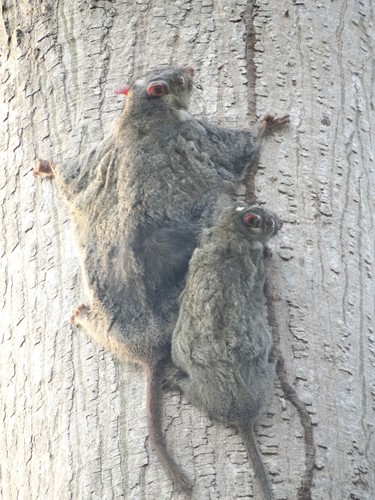
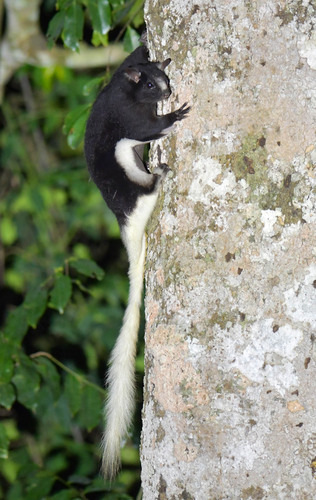
Other species in the genus Anomalurus
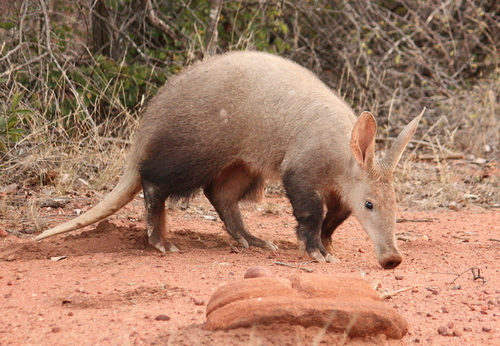
Species that share its range

Sources
Conservation status, range description and population estimate come from the IUCN Red List assessment for Anomalurus derbianus. Countries are derived from that range description, not from a mapped country list. Last refreshed on .
The distribution map is drawn from the IUCN Red List spatial data compiled in 2008. IUCN (International Union for Conservation of Nature)