
Dwarf Scaly-tailed Squirrel
Anomalurus pusillus
Red List assessment
Least Concernon the IUCN Red List
- EXExtinct
- EWExtinct in the Wild
- CRCritically Endangered
- ENEndangered
- VUVulnerable
- NTNear Threatened
- LCLeast Concern
The Dwarf Scaly-tailed Squirrel is recorded in 9 countries across Africa. The IUCN Red List assesses the Dwarf Scaly-tailed Squirrel as Least Concern. No reliable global population estimate is available.
- Family
- Anomaluridae
- Order
- Rodentia
- Genus
- Anomalurus
- Countries recorded
- 9
- Continents
- Africa
- Red List category
- Least Concern
- Data updated
- August 9, 2026
What is the Dwarf Scaly-tailed Squirrel?
The Dwarf Scaly-tailed Squirrel (Anomalurus pusillus) is the smallest species within the genus Anomalurus and belongs to the ancient, exclusively African rodent family Anomaluridae — entirely distinct from true squirrels (Sciuridae). It possesses a patagium (gliding membrane) stretching between its limbs, enabling it to glide silently between trees, and a double row of keeled scales on the ventral base of its tail that act as crampons when gripping bark. It inhabits lowland tropical rainforests of West and Central Africa, living an almost entirely arboreal lifestyle. First described by Oldfield Thomas in 1887, it remains one of the least studied members of its family.
Where does the Dwarf Scaly-tailed Squirrel live?
West and Central Africa, including Sierra Leone, Liberia, Côte d'Ivoire, Ghana, Nigeria, Cameroon, Gabon, Republic of Congo, Democratic Republic of Congo, and Central African Republic
The species ranges across West Africa (Sierra Leone, Liberia, Côte d'Ivoire, Ghana, Nigeria) and into Central Africa (Cameroon, Gabon, Republic of Congo, Democratic Republic of Congo, and possibly Central African Republic). It is patchily distributed within this broad range, following the extent of suitable closed-canopy rainforest.
Altitude and depth
Primarily found at low elevations from sea level to approximately 1,000–1,500 m. Most confirmed records are from lowland forest zones below 800 m.
Seasonal movements
No known seasonal migrations. The species is essentially resident year-round. Activity and foraging patterns may shift subtly in response to seasonal fruiting and flowering cycles of key food plant species in the forest.
Habitat of the Dwarf Scaly-tailed Squirrel
Lowland and submontane tropical rainforest is the primary habitat, including dense, humid primary forest and structurally complex secondary forest. The species is strongly dependent on large old trees with hollow cavities for communal roosting. It avoids highly degraded habitats and open landscapes.
Adaptations to its environment
The gliding membrane (patagium) allows efficient silent movement between tree crowns, reducing dangerous descents to the forest floor where terrestrial predators are more prevalent. The double row of keeled scales on the tail base functions like climbing crampons, providing grip on smooth bark when landing or climbing. Its small body size and strictly nocturnal habits further reduce predation risk.
Conservation status and numbers
Listed as Least Concern (LC) by the IUCN. The species has a wide distribution across West and Central African forests, and while local populations are impacted by habitat loss, there is no evidence of a population decline reaching the threshold for a more threatened category. Data remain limited.
Estimated population
No reliable global population estimate is available. The population trend is assumed to be stable to slowly declining owing to continuous habitat loss, but no quantitative demographic data have been published.
What threatens the Dwarf Scaly-tailed Squirrel?
The primary threat is progressive deforestation and forest fragmentation driven by commercial logging, agricultural expansion (particularly oil palm and cocoa), and charcoal production across its range. Localized bushmeat hunting may represent a secondary threat. Long-term climate change poses a potential risk through alteration of forest structure and composition.
Diseases and parasites
No parasite or disease studies have been published specifically for A. pusillus. Like other forest rodents, it is likely host to ectoparasites (mites, ticks, fleas) and endoparasites (nematodes, trypanosomes), but no data are available.
What is being done to protect it?
The species is present within several protected areas across its range, including Taï National Park (Côte d'Ivoire), Sapo National Park (Liberia), and various forest reserves in Cameroon and DRC. No conservation program targets A. pusillus specifically. It benefits indirectly from general forest protection policies.
Recommended actions
Priority actions include targeted field surveys to establish population baselines, strengthening enforcement against illegal logging in core forest areas, and inclusion of the species in biodiversity monitoring programs within protected areas. Ecological research on habitat requirements and roost-site selection is urgently needed.
What the Dwarf Scaly-tailed Squirrel looks like
The dorsal fur is typically dark gray to gray-brown, becoming paler or whitish on the ventral surface. The gliding membrane (patagium) is thinly furred and extends from the wrists to the ankles. The long bushy tail is characteristic, with two rows of raised keeled scales on its ventral base — the eponymous feature of all Anomaluridae.
Size
Head-body length approximately 10–18 cm; tail length approximately 15–22 cm. It is notably the smallest species of Anomalurus, roughly half the size of A. derbianus.
Weight
Estimated at 20–70 g, though reliable weight data are scarce. No significant sexual size dimorphism has been formally documented.
Distinctive features
Its markedly smaller body size is the primary distinguishing feature compared to congeners. Anomalurus beecrofti has a white-tipped tail and larger build; A. derbianus is considerably larger and more boldly colored; A. pelii is very large. The scale rows on the tail base are shared across the family and do not help distinguish species.
Differences between males and females
Sexual dimorphism has not been formally described for this species. Females may be temporarily heavier during pregnancy and lactation, but no consistent morphological differences between sexes are documented.
Behaviour and diet of the Dwarf Scaly-tailed Squirrel
Likely semi-colonial in roosting behavior, as observed in other anomalurids, with small groups of 2–10 individuals sharing tree hollows. Foraging may be solitary or in loose pairs. Social hierarchy within roost groups is undescribed.
When it is active
Strictly nocturnal. Individuals emerge from tree-hollow roosts after dark, forage and glide through the forest canopy, and return to communal roosts before dawn. No daytime activity has been reported.
Diet
Primarily herbivorous, feeding on bark, cambium, leaves, fruits, flowers, and possibly seeds. Bark feeding is a particularly notable dietary specialization unusual among rodents and characteristic of the Anomaluridae. Small invertebrates may be taken opportunistically when encountered on bark surfaces.
How it feeds and hunts
Forages by climbing and gliding through the canopy, using sharp incisors to strip bark and access the nutritious cambium layer beneath. Invertebrates are gleaned opportunistically from bark and leaf surfaces. No active pursuit of animal prey has been documented.
Communication
Communication is presumed to involve soft vocalizations for contact within the roost group, scent marking using glandular secretions to signal territory or reproductive status, and tactile interactions within communal roosts. Detailed ethological studies of vocal and chemical communication are lacking.
Interactions with other species
Likely predated upon by nocturnal forest owls, arboreal snakes, and small carnivorous mammals such as genets (Genetta spp.) and African palm civets. It may compete for tree hollow roost sites with other cavity-dependent species. Its bark feeding may marginally influence tree health and forest dynamics.
Role in its ecosystem
As a prey species for forest carnivores and raptors, it occupies an intermediate position in the forest food web. Its frugivory and possible seed ingestion may confer a limited secondary role as a seed disperser. Bark feeding could influence nutrient cycling and small-scale tree mortality in dense forest.
Reproduction and lifecycle
Reproductive biology is poorly known for this species. Based on closely related anomalurids, gestation is estimated at approximately 3–4 months, with small litters of 1–2 young. There may be one to two reproductive events per year, but no seasonal breeding data specific to A. pusillus have been published.
Raising the young
The female is presumed to be the primary caregiver, nursing young within tree-hollow roosts. Young anomalurids are born relatively well-developed compared to many rodents. Precise weaning age and duration of parental care are undocumented for this species.
Maturity and lifespan
Age at sexual maturity and maximum lifespan have not been documented for this species. Based on related anomalurids, sexual maturity is estimated within the first year of life, and wild lifespan may reach 3–6 years. No captive records are known.
Taxonomy and naming of the Dwarf Scaly-tailed Squirrel
Classification
Mammalia > Rodentia > Anomaluridae > Anomalurus > Anomalurus pusillus
What research says
Recent studies
A. pusillus remains among the least studied African rodents. Recent biogeographic and phylogenetic work on the Anomaluridae has helped clarify species boundaries across the family, but targeted studies focusing on A. pusillus ecology, behavior, or genetics have not been published as of the early 2020s.
Genome and DNA
No karyotype or genome sequence data have been published for A. pusillus. Molecular phylogenetic studies of Anomaluridae have included the genus Anomalurus in family-level analyses, confirming the deep divergence of this family from other rodent lineages, but species-level genomic data remain absent.
Compared with similar species
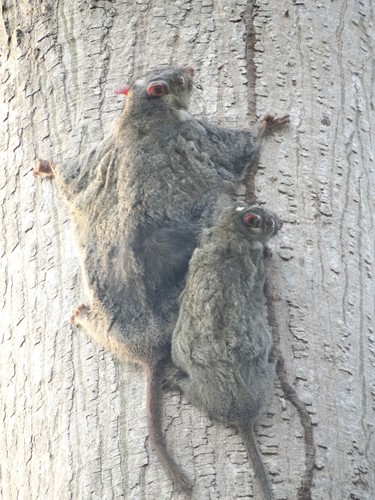
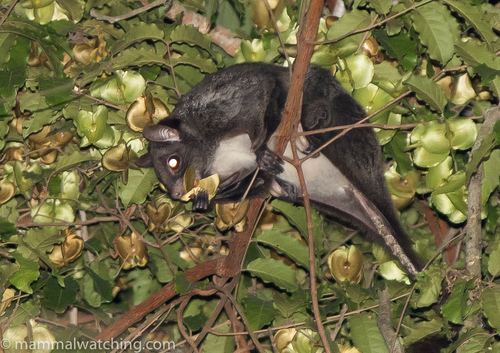
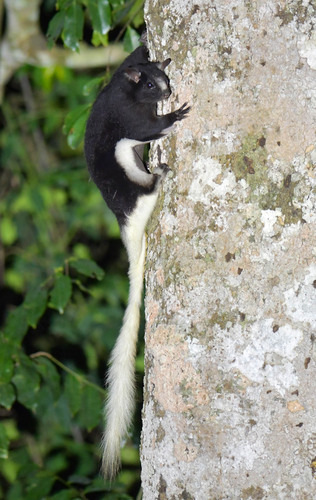
Within Anomalurus, A. pusillus is clearly the smallest species, contrasting sharply with the very large A. pelii (Pel's anomalure, up to 1 kg and 45 cm head-body length) and the medium-sized A. derbianus and A. beecrofti. The family's other genus, Idiurus (pygmy scaly-tailed squirrels), contains even smaller gliding rodents but is a distinct lineage. Unlike the unrelated flying squirrels (Pteromyini, tribe within Sciuridae), anomalurids evolved gliding independently and have the unique tail-scale adaptation.
The Dwarf Scaly-tailed Squirrel and people
Despite its common name, this animal is not a squirrel at all — Anomaluridae is an entirely separate ancient rodent family found only in sub-Saharan Africa, having evolved gliding flight independently from true flying squirrels. The two rows of rough keeled scales on its tail base function like crampons on a climber's boot, gripping smooth bark instantly upon landing after a glide. Its bark-eating habit makes it one of the few rodents in the world capable of subsisting substantially on the tough outer and inner bark of trees.
Where and how to see it
Best observed at night in intact lowland rainforest using a red-filtered headlamp or spotlight, when individuals may be spotted gliding between tree trunks or clinging to bark. Taï National Park in Côte d'Ivoire and lowland forests in Liberia (e.g., Sapo National Park) are among the most suitable locations. Local naturalist guides with knowledge of active tree-hollow roost sites dramatically increase the chance of a sighting.
Risks to humans
No notable risk to humans. This small, timid rodent poses no significant danger. As with any wild animal, a defensive bite is possible if the animal is cornered or handled; no venom or known zoonotic risks specific to this species have been identified.
Countries where the Dwarf Scaly-tailed Squirrel is recorded
The 9 countries named in the range description of its IUCN Red List assessment.
Questions about the Dwarf Scaly-tailed Squirrel
Where does the Dwarf Scaly-tailed Squirrel live?
The Dwarf Scaly-tailed Squirrel is recorded in Cameroon, Central African Republic, Democratic Republic of the Congo, Gabon and Ghana, among 9 countries in total across Africa. These countries come from the range description of its IUCN Red List assessment, and they are what place the species on the interactive map.
Is the Dwarf Scaly-tailed Squirrel endangered?
The IUCN Red List assesses the Dwarf Scaly-tailed Squirrel as Least Concern. The species is widespread and abundant enough not to qualify for any threatened category. It does not mean the species is safe forever, only that nothing in the current data raises an alarm.
How many are left in the wild?
No reliable global population estimate is available. This figure comes from the species assessment on the IUCN Red List; population estimates for wild mammals are ranges, not counts, and are revised at each assessment.
What habitat does the Dwarf Scaly-tailed Squirrel live in?
Lowland and submontane tropical rainforest is the primary habitat, including dense, humid primary forest and structurally complex secondary forest.
What is the scientific name of the Dwarf Scaly-tailed Squirrel?
The Dwarf Scaly-tailed Squirrel is Anomalurus pusillus, in the family Anomaluridae, order Rodentia.
Other species in the genus Anomalurus
Species that share its range

Sources
Conservation status, range description and population estimate come from the IUCN Red List assessment for Anomalurus pusillus. Countries are derived from that range description, not from a mapped country list. Last refreshed on .
The distribution map is drawn from the IUCN Red List spatial data compiled in 2008. IUCN (International Union for Conservation of Nature)