
Indri
Indri indri
Red List assessment
Critically Endangeredon the IUCN Red List
- EXExtinct
- EWExtinct in the Wild
- CRCritically Endangered
- ENEndangered
- VUVulnerable
- NTNear Threatened
- LCLeast Concern
The Indri is recorded in one country, Madagascar across Africa. The IUCN Red List assesses the Indri as Critically Endangered. Estimated at fewer than 10,000 mature individuals, with populations continuing to decline due to ongoing habitat destruction and fragmentation across its range.
- Family
- Indriidae
- Order
- Primates
- Genus
- Indri
- Countries recorded
- 1
- Continents
- Africa
- Red List category
- Critically Endangered
- Data updated
- August 9, 2026
What is the Indri?
The Indri is the largest living lemur, endemic to Madagascar's eastern rainforests, renowned for its haunting, far-carrying songs that echo through the canopy. It is a highly specialized folivore adapted to vertical clinging and leaping locomotion in tall trees. The species holds deep cultural significance to the Malagasy people, who consider it sacred and protected by traditional taboos (fady).
Where does the Indri live?
Eastern Madagascar rainforests, primarily in fragmented protected areas along the eastern escarpment
Restricted to a narrow band of eastern Madagascar, from the Mangoro-Onive river system in the south to the Androna region near Mananara in the north, covering a discontinuous range due to deforestation.
Altitude and depth
200-1800 meters above sea level
Seasonal movements
No migration; breeding is seasonal with mating typically occurring between December and March, aligned with resource availability.
Habitat of the Indri
Primary and secondary lowland to mid-altitude tropical rainforest with dense canopy cover, requiring large trees for locomotion and feeding. Also found in some degraded forest fragments though less optimally.
Adaptations to its environment
Powerful hind limbs enable vertical clinging and leaping between vertical tree trunks, an efficient locomotion strategy in dense forest. Specialized digestive system with an enlarged cecum allows fermentation of fibrous leaves, and loud vocalizations carry through dense foliage for long-distance communication.
Conservation status and numbers
Critically Endangered (CR) according to IUCN, with population decline exceeding 80% over the past three generations due to habitat loss and hunting. Listed on CITES Appendix I, prohibiting international commercial trade.
Estimated population
Estimated at fewer than 10,000 mature individuals, with populations continuing to decline due to ongoing habitat destruction and fragmentation across its range.
What threatens the Indri?
Severe habitat loss from slash-and-burn agriculture (tavy), illegal logging, and mining; hunting for bushmeat despite traditional taboos eroding in some areas; forest fragmentation isolating populations and reducing genetic diversity.
Diseases and parasites
Limited data exists, though intestinal parasites and stress-related conditions have been documented in captive and wild individuals; overall disease ecology remains understudied.
What is being done to protect it?
Protected within several national parks and reserves including Andasibe-Mantadia, Zahamena, and Analamazaotra Special Reserve; captive breeding attempts have largely failed as the species does not survive well outside its native habitat. NGOs and local conservation groups work on community-based forest protection and ecotourism initiatives.
Recommended actions
Strengthen enforcement of protected area boundaries and anti-logging laws, expand and connect forest corridors between fragmented populations, support community-based conservation incentives, and conduct further research into disease and genetic health of remaining populations.
What the Indri looks like
Black and white fur pattern varying by region, with a distinctive teddy-bear-like face, large tufted ears, and a very short vestigial tail unlike other lemurs. Fur is thick and woolly, providing insulation in cooler mountain forests.
Size
Body length of 60-90 cm, with no external tail (a distinguishing feature among lemurs); combined with limbs, standing height can reach up to 70 cm.
Weight
Typically 6-9.5 kg for adults, with males and females similar in size.
Distinctive features
The near-total absence of a visible tail is unique among lemurs and immediately distinguishes the Indri from other Indriidae family members like sifakas, which have long tails.
Behaviour and diet of the Indri
Lives in small monogamous family groups typically of 2-6 individuals, usually a breeding pair and their offspring, defending territories through loud vocal displays rather than physical aggression.
When it is active
Diurnal, active primarily in the morning and afternoon with rest periods during midday heat, spending most time foraging and resting in the forest canopy.
Diet
Primarily folivorous, consuming young leaves, seeds, flowers, and fruit from a wide variety of forest trees, with young leaves comprising the bulk of the diet.
Communication
Renowned for extremely loud, distinctive songs lasting up to several minutes, used for territorial defense and group cohesion, audible up to 2-3 km through dense forest. Also uses scent marking and body postures for close-range communication.
Interactions with other species
Few natural predators remain due to extinction of large Malagasy predators, though the fossa may occasionally prey on young or vulnerable individuals. Competes indirectly with other folivorous lemurs for food resources in shared habitat.
Role in its ecosystem
Plays an important role as a seed disperser for various rainforest tree species, contributing to forest regeneration and plant diversity through consumption and excretion of fruit and seeds.
Reproduction and lifecycle
Mating season occurs from December to March; gestation lasts approximately 120-150 days, with females giving birth to a single offspring every 2-3 years. Weaning occurs around 6 months of age, though juveniles remain dependent for over a year.
Raising the young
Both parents, along with older siblings, may assist in caring for the infant, which clings to the mother's belly and later back for the first several months of life. Extended parental investment reflects the species' slow reproductive rate.
Maturity and lifespan
Sexual maturity is reached around 7-9 years of age; lifespan in the wild is estimated at 15-20 years, with limited data from captivity due to poor survival outside native habitat.
Taxonomy and naming of the Indri
Classification
Mammalia > Primates > Indriidae > Indri > Indri indri
Scientific synonyms
Lichanotus indri, Indris indri, Lemur indri
What research says
Recent studies
Recent bioacoustic research has revealed that Indri songs follow rhythmic patterns similar to musical rules found in human music, suggesting a shared evolutionary basis for rhythm perception among primates.
Genome and DNA
Diploid chromosome number of 2n=48; genetic studies have highlighted low genetic diversity in fragmented populations, raising conservation concerns.
Compared with similar species
Unlike related sifakas (Propithecus species) which possess long tails and different vocal repertoires, the Indri is tailless and produces uniquely loud, wailing songs; it is also notably larger than most other lemur species.
The Indri and people
The Indri's song can be heard up to 2-3 kilometers away through dense rainforest, making it one of the loudest primate vocalizations recorded. It is the largest living lemur, and Malagasy legend holds that the Indri was once a human ancestor who chose to remain in the forest.
Where and how to see it
Best observed in Andasibe-Mantadia National Park or the nearby Analamazaotra Special Reserve, particularly in early morning hours when family groups perform their loud territorial songs. Guided tours with local rangers greatly increase chances of sighting due to their knowledge of group locations.
Risks to humans
No notable risk to humans; the species is shy and avoids close contact, posing no threat of bites or disease transmission under normal circumstances.
Human uses
Primarily valued for ecotourism, drawing visitors to eastern Madagascar's national parks; historically protected by cultural taboos rather than exploited for trade or traditional medicine.
Myths and legends
In Malagasy folklore, the Indri is often considered sacred, with legends describing it as an ancestral relative of humans; local taboos (fady) traditionally forbid hunting or harming the species in many communities.
Countries where the Indri is recorded
The 1 countries named in the range description of its IUCN Red List assessment.
Questions about the Indri
Where does the Indri live?
The Indri is recorded in Madagascar across Africa. These countries come from the range description of its IUCN Red List assessment, and they are what place the species on the interactive map.
Is the Indri endangered?
Yes. The IUCN Red List assesses the Indri as Critically Endangered, one of the three threatened categories. The species faces an extremely high risk of extinction in the wild. This is the last category before extinction, and it is reached through a very small or steeply declining population, a tiny range, or both.
How many are left in the wild?
Estimated at fewer than 10,000 mature individuals, with populations continuing to decline due to ongoing habitat destruction and fragmentation across its range. This figure comes from the species assessment on the IUCN Red List; population estimates for wild mammals are ranges, not counts, and are revised at each assessment.
What habitat does the Indri live in?
Primary and secondary lowland to mid-altitude tropical rainforest with dense canopy cover, requiring large trees for locomotion and feeding.
What is the scientific name of the Indri?
The Indri is Indri indri, in the family Indriidae, order Primates.
Other species in the family Indriidae
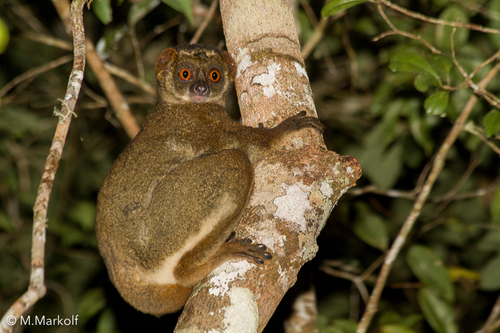
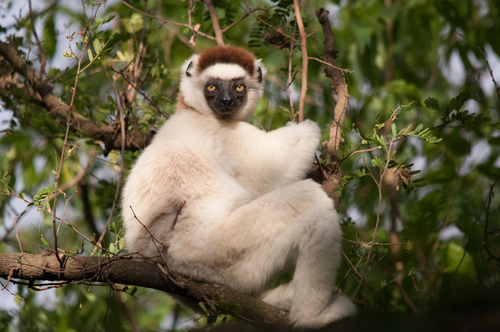
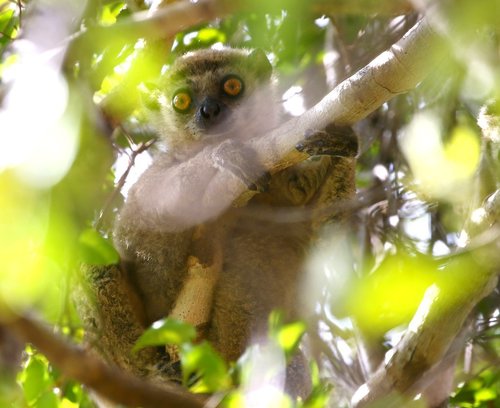
Species that share its range
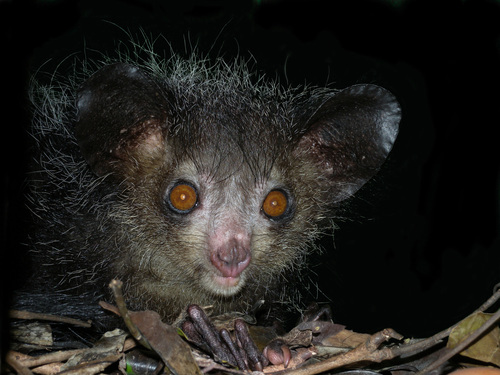


Sources
Conservation status, range description and population estimate come from the IUCN Red List assessment for Indri indri. Countries are derived from that range description, not from a mapped country list. Last refreshed on .
The distribution map is drawn from the IUCN Red List spatial data compiled in 2020. IUCN (International Union for Conservation of Nature)