
Verreaux's Sifaka
Propithecus verreauxi
Red List assessment
Critically Endangeredon the IUCN Red List
- EXExtinct
- EWExtinct in the Wild
- CRCritically Endangered
- ENEndangered
- VUVulnerable
- NTNear Threatened
- LCLeast Concern
The Verreaux's Sifaka is recorded in one country, Madagascar across Africa. The IUCN Red List assesses the Verreaux's Sifaka as Critically Endangered. Population estimates are uncertain but believed to be in the low tens of thousands, with a continuing declining trend due to ongoing habitat loss.
- Family
- Indriidae
- Order
- Primates
- Genus
- Propithecus
- Countries recorded
- 1
- Continents
- Africa
- Red List category
- Critically Endangered
- Data updated
- August 9, 2026
What is the Verreaux's Sifaka?
Verreaux's Sifaka is a medium-sized lemur endemic to the dry forests of southwestern and southern Madagascar, renowned for its striking white fur and distinctive sideways 'dancing' locomotion on the ground. It is one of the most iconic and studied lemur species, playing a key role in seed dispersal within its forest ecosystem. Highly arboreal, it is a vertical clinger and leaper adapted to a life spent almost entirely in trees.
Where does the Verreaux's Sifaka live?
Madagascar (western and southwestern regions)
Endemic to Madagascar, found primarily in the southwestern and southern parts of the island, including areas around Toliara, Morondava, and the Beza Mahafaly and Berenty reserves.
Altitude and depth
Typically found from sea level up to around 800 meters elevation.
Seasonal movements
Activity and reproduction are closely tied to Madagascar's dry and wet seasons, with births timed to coincide with the onset of the rainy season to maximize food availability for lactating females.
Habitat of the Verreaux's Sifaka
Inhabits deciduous dry forests, spiny (thorn) forests, and gallery forests along riverbanks in western and southern Madagascar. These habitats are characterized by seasonal drought and a mix of Didiereaceae and other drought-adapted vegetation.
Adaptations to its environment
Sifakas have powerful hind limbs adapted for leaping between trees and a unique sideways hopping gait for terrestrial movement due to limited quadrupedal ability. Their thick fur provides insulation against temperature extremes in the dry forest, and they can tolerate long periods of low food and water availability by relying on stored fat and diverse plant diets.
Conservation status and numbers
Critically Endangered (IUCN); the species has experienced a severe population decline (>80% over the past decades) due to habitat destruction, and its range continues to shrink dramatically.
Estimated population
Population estimates are uncertain but believed to be in the low tens of thousands, with a continuing declining trend due to ongoing habitat loss.
What threatens the Verreaux's Sifaka?
Major threats include deforestation for agriculture (slash-and-burn farming), charcoal production, illegal logging, hunting for bushmeat, and climate change-induced habitat degradation.
Diseases and parasites
Known to host various gastrointestinal parasites and can be affected by diseases transmitted through contact with domestic animals, though specific pathogen studies remain limited.
What is being done to protect it?
Conservation efforts include protection within reserves such as Kirindy Forest, Beza Mahafaly Special Reserve, and Zombitse-Vohibasia National Park, along with community-based conservation programs and habitat restoration initiatives led by organizations like Duke Lemur Center and Madagascar National Parks.
Recommended actions
Priority actions include expanding protected areas, enforcing anti-logging and anti-poaching laws, promoting sustainable agriculture to reduce habitat clearing, and increasing community engagement and ecotourism to provide alternative livelihoods.
What the Verreaux's Sifaka looks like
The fur is predominantly white with brown or black patches on the crown, chest, and limbs; the face is bare and black, framed by white fur, giving a distinctive masked appearance. Their eyes are large and orange-red, adapted for their diurnal-crepuscular lifestyle.
Size
Body length (head and body) ranges from about 45-55 cm, with a tail of similar or slightly greater length (50-60 cm).
Weight
Adults typically weigh between 3 and 4 kg, with minimal difference between males and females.
Distinctive features
Distinguished from other sifaka species by its predominantly white coat with limited dark patching, especially compared to the more richly colored Coquerel's sifaka or crowned sifaka. Its long powerful legs and upright leaping posture are also characteristic of the genus.
Differences between males and females
Minimal sexual dimorphism in size or coloration; males and females look very similar, though females are typically socially dominant.
Behaviour and diet of the Verreaux's Sifaka
Lives in small social groups of 3-13 individuals, typically with a mix of males and females; groups are matriarchal, with females holding dominant social status over males.
When it is active
Primarily diurnal, being most active during daylight hours, with peak activity in early morning and late afternoon to avoid the midday heat.
Diet
Herbivorous, feeding on a wide variety of leaves, fruits, flowers, bark, and dead wood; diet composition shifts seasonally based on availability of resources in the dry forest.
Communication
Communicates through a range of vocalizations including alarm calls ('sifaka' call, from which the name derives), scent marking using genital and chest glands, and visual displays such as postural signals within the group.
Interactions with other species
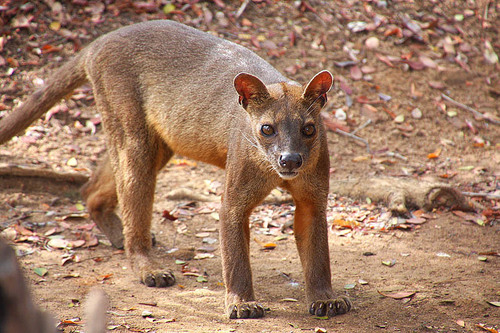
Natural predators include the fossa (Cryptoprocta ferox), birds of prey such as the Madagascar buzzard, and occasionally boa constrictors; sifakas often give alarm calls to warn group members of approaching predators.
Role in its ecosystem
Plays an important ecological role as a seed disperser and folivore, helping maintain forest regeneration and plant diversity within Madagascar's dry forest ecosystems.
Reproduction and lifecycle
Mating occurs once a year, typically in January-February, with a gestation period of about 130 days leading to births in June-July at the start of the dry season. Females usually give birth to a single offspring.
Raising the young
Mothers provide the primary care, carrying infants clinging to their belly initially and later on their back as they grow; weaning occurs around 5-6 months, though juveniles may remain closely associated with their mother for over a year.
Maturity and lifespan
Sexual maturity is typically reached at 2.5-3 years of age; lifespan in the wild is around 18 years, while individuals in captivity can live up to 23 years.
Taxonomy and naming of the Verreaux's Sifaka
Classification
Class Mammalia > Order Primates > Family Indriidae > Genus Propithecus > Species Propithecus verreauxi
Subspecies
Historically several subspecies (e.g., P. v. coquereli, P. v. deckenii, P. v. coronatus) were recognized, but most are now elevated to full species status; P. verreauxi sensu stricto is generally considered monotypic today.
Scientific synonyms
Propithecus verreauxii (alternate spelling); formerly included several taxa now recognized as separate species such as Propithecus coquereli and Propithecus deckenii.
What research says
Recent studies
Recent research has focused on cognitive abilities, social learning, and vocal communication complexity in Verreaux's Sifaka, as well as genetic studies clarifying species boundaries within the Propithecus genus.
Genome and DNA
Propithecus verreauxi has a diploid chromosome number of 2n=48; genetic studies have been used to clarify taxonomic boundaries between sifaka species within the genus.
Compared with similar species
Compared to Coquerel's sifaka (Propithecus coquereli), Verreaux's Sifaka has less maroon coloring and a more uniformly white coat; it is also similar in ecology to the crowned sifaka (Propithecus coronatus) but occupies a more southern and western range.
The Verreaux's Sifaka and people
Verreaux's Sifakas are famous for their unique sideways 'dancing' leap when crossing open ground, an adaptation to their inability to walk quadrupedally like most primates. They are also known for social 'sunbathing,' sitting upright with arms outstretched to absorb morning sun.
Where and how to see it
Best observed in reserves such as Berenty, Kirindy Forest, or Zombitse-Vohibasia National Park in southwestern Madagascar, particularly during early morning hours when they are most active and often seen sunbathing.
Risks to humans
No notable risk to humans; sifakas are shy and non-aggressive toward people.
Human uses
Aside from ecotourism value, Verreaux's Sifaka has no significant direct commercial use, though it holds cultural importance and is a flagship species for Madagascar conservation efforts.
Myths and legends
In Malagasy culture, sifakas are sometimes considered 'fady' (taboo) to hunt in certain regions due to traditional beliefs linking lemurs to ancestral spirits, providing some cultural protection in specific communities.
Countries where the Verreaux's Sifaka is recorded
The 1 countries named in the range description of its IUCN Red List assessment.
Questions about the Verreaux's Sifaka
Where does the Verreaux's Sifaka live?
The Verreaux's Sifaka is recorded in Madagascar across Africa. These countries come from the range description of its IUCN Red List assessment, and they are what place the species on the interactive map.
Is the Verreaux's Sifaka endangered?
Yes. The IUCN Red List assesses the Verreaux's Sifaka as Critically Endangered, one of the three threatened categories. The species faces an extremely high risk of extinction in the wild. This is the last category before extinction, and it is reached through a very small or steeply declining population, a tiny range, or both.
How many are left in the wild?
Population estimates are uncertain but believed to be in the low tens of thousands, with a continuing declining trend due to ongoing habitat loss. This figure comes from the species assessment on the IUCN Red List; population estimates for wild mammals are ranges, not counts, and are revised at each assessment.
What habitat does the Verreaux's Sifaka live in?
Inhabits deciduous dry forests, spiny (thorn) forests, and gallery forests along riverbanks in western and southern Madagascar.
What is the scientific name of the Verreaux's Sifaka?
The Verreaux's Sifaka is Propithecus verreauxi, in the family Indriidae, order Primates.
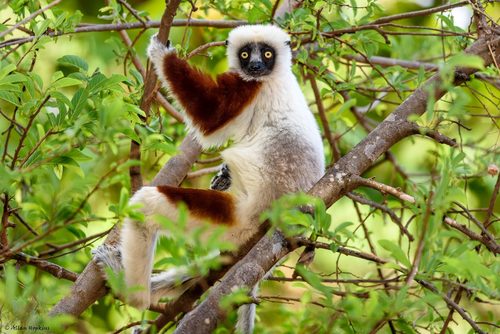
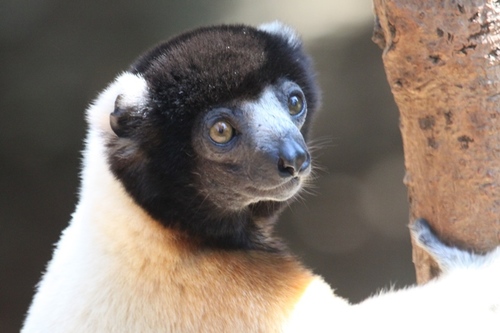
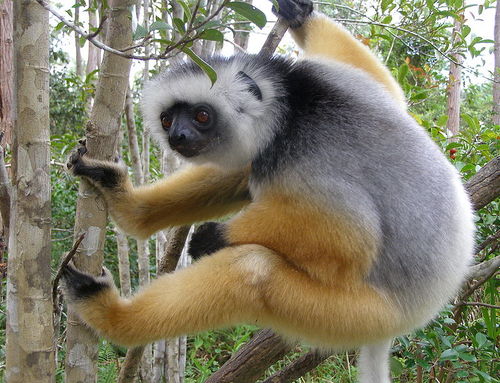
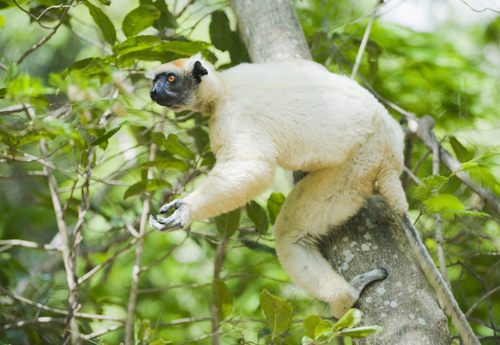
Other species in the genus Propithecus
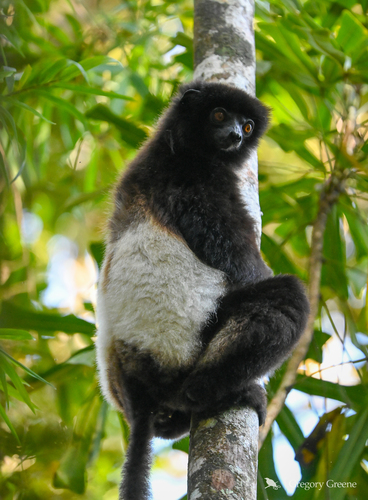
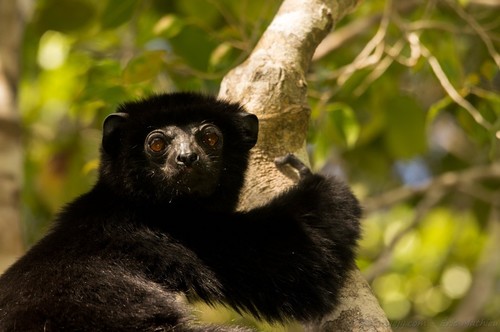
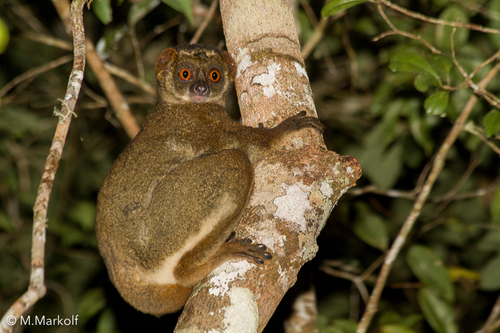
Other species in the family Indriidae
Species that share its range

Sources
Conservation status, range description and population estimate come from the IUCN Red List assessment for Propithecus verreauxi. Countries are derived from that range description, not from a mapped country list. Last refreshed on .
The distribution map is drawn from the IUCN Red List spatial data compiled in 2020. IUCN (International Union for Conservation of Nature)