
Western Woolly Lemur
Avahi occidentalis
Red List assessment
Vulnerableon the IUCN Red List
- EXExtinct
- EWExtinct in the Wild
- CRCritically Endangered
- ENEndangered
- VUVulnerable
- NTNear Threatened
- LCLeast Concern
The Western Woolly Lemur is recorded in one country, Madagascar across Africa. The IUCN Red List assesses the Western Woolly Lemur as Vulnerable. No precise global population estimate is available.
- Family
- Indriidae
- Order
- Primates
- Genus
- Avahi
- Countries recorded
- 1
- Continents
- Africa
- Red List category
- Vulnerable
- Data updated
- August 9, 2026
What is the Western Woolly Lemur?
Avahi occidentalis is a small nocturnal primate and one of the few strictly folivorous (leaf-eating) primates in the world. It inhabits the dry deciduous forests of northwestern Madagascar, making it ecologically distinct from its eastern relatives which occupy humid rainforests. It is remarkable for sleeping upright in tight family clusters during the day and for its highly specialized digestive system adapted to a diet of tough, low-nutrient leaves. The genus Avahi is collectively known as woolly lemurs due to their dense, soft, curly fur.
Where does the Western Woolly Lemur live?
Northwestern Madagascar, primarily in the Mahajanga (Majunga) region and surrounding dry deciduous forests
Endemic to Madagascar; restricted to the northwestern region roughly between the Betsiboka and Maevarano river systems in Mahajanga Province. Key areas include forests near Ankarafantsika and surrounding lowland zones.
Altitude and depth
Typically found at low to moderate altitudes, from near sea level up to approximately 800 meters, consistent with the lowland dry forest zone of northwestern Madagascar.
Seasonal movements
No long-distance migration. Activity and foraging may shift seasonally with the marked wet/dry seasons of northwestern Madagascar; food availability is more constrained during the dry season (May–October) when deciduous trees shed leaves. No true hibernation, though activity may decrease.
Habitat of the Western Woolly Lemur
Primarily dry deciduous tropical forests, including gallery forests and transitional forest patches in northwestern Madagascar. It tolerates some forest degradation but requires areas with sufficient canopy cover and leaf availability year-round.
Adaptations to its environment
Possesses an enlarged cecum and slow gut passage rate to maximize nutrient extraction from fibrous, tannin-rich leaves. Its large eyes are adapted for low-light nocturnal foraging. Dense woolly fur provides insulation during the cool dry season nights. Cryptic coloration helps avoid predators during daytime rest.
Conservation status and numbers
Vulnerable (VU) on the IUCN Red List. The population is estimated to be declining due to ongoing habitat destruction. The species qualifies as Vulnerable under criterion A2c, reflecting substantial reduction of suitable forest habitat over the past three generations.
Estimated population
No precise global population estimate is available. The population trend is considered declining, with habitat loss being the main driver. Density estimates from suitable habitat suggest low densities typical of folivorous primates.
What threatens the Western Woolly Lemur?
Primary threats include slash-and-burn agriculture (tavy), illegal logging, charcoal production, and land conversion for cattle grazing. Hunting for bushmeat, though less prevalent than for larger lemurs, represents a secondary threat. Forest fragmentation isolates populations and reduces genetic exchange.
Diseases and parasites
Susceptible to intestinal helminths and ectoparasites (mites, ticks) common to Malagasy primates. Specific disease studies for this species are limited; broader research on lemur health has documented protozoan and nematode infections across Indriidae.
What is being done to protect it?
Partially protected within Ankarafantsika National Park and surrounding protected areas in northwestern Madagascar. Listed under CITES Appendix I (all Malagasy lemurs), prohibiting international commercial trade. Madagascar's national lemur conservation action plan includes Avahi species.
Recommended actions
Expansion and better enforcement of protected areas in its range; restoration of degraded forest corridors to reconnect fragmented populations; community-based conservation programs to reduce slash-and-burn agriculture; long-term population monitoring; and continued taxonomic research to clarify species boundaries within the western Avahi complex.
What the Western Woolly Lemur looks like
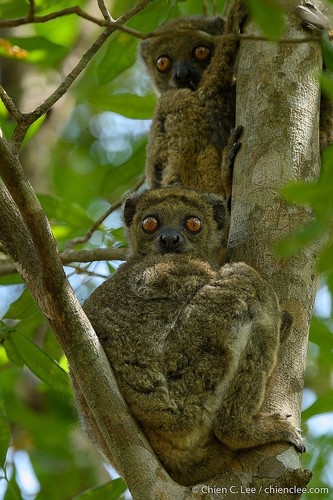
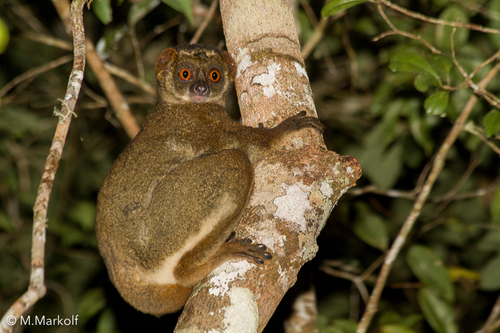
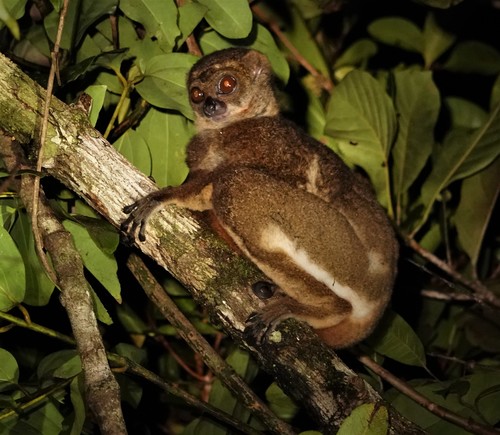
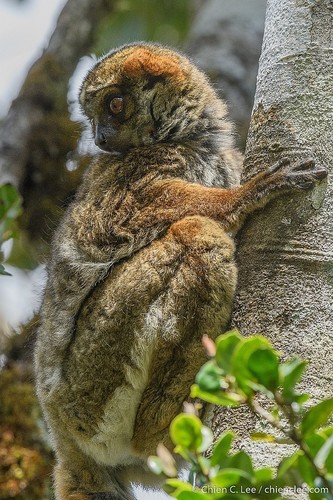
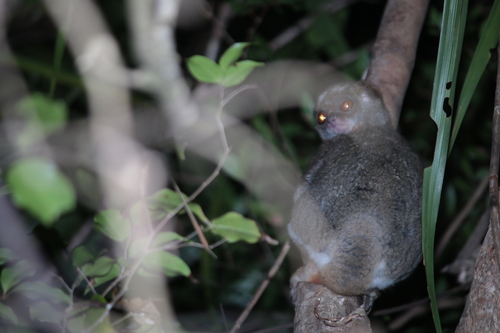
Covered in dense, woolly grayish-brown to reddish-brown fur. The face is rounded with large, forward-facing orange to reddish eyes, a short snout, and small ears partially hidden in fur. The underparts are paler. The tail is often rusty-orange or reddish in coloration, contrasting with the dorsal fur.
Size
Head-body length approximately 25–30 cm; tail length 30–37 cm; relatively compact body with large rounded head.
Weight
Approximately 800–1,200 grams; sexual size dimorphism is minimal.
Distinctive features
Distinguished from eastern woolly lemurs (e.g., Avahi laniger) by its geographic distribution in dry northwestern forests and slightly paler, more grayish dorsal fur. Compared to Avahi unicolor (Sambirano Woolly Lemur) of the northwest, it differs in fur coloration and geographic range. Its reddish tail and grayish back are useful field marks.
Differences between males and females
Minimal sexual dimorphism in size and coloration; males and females are broadly similar in appearance and weight.
Behaviour and diet of the Western Woolly Lemur
Lives in small, stable family groups typically consisting of a monogamous pair and one or two offspring. Groups are territorial and use vocalizations to defend their home range. During the day, group members huddle together, sleeping in dense vegetation.
When it is active
Strictly nocturnal. Daytime is spent sleeping in tight clusters in vine tangles, dense foliage, or tree forks. Foraging activity begins after dark and continues through much of the night.
Diet
Highly specialized folivore (leaf-eater), with leaves constituting the vast majority of the diet year-round. Also consumes buds, flowers, and occasionally unripe fruit. Preferentially selects younger, more digestible leaves when available.
How it feeds and hunts
Not applicable; strictly herbivorous. Foraging involves slow, deliberate movement through the canopy to locate and consume leaves, with selection based on leaf maturity and chemical composition.
Communication
Communicates primarily through loud, repetitive vocalizations (calls) used to advertise territory and maintain contact between family members at night. Scent marking using ano-genital glands is used to delineate territories. Visual signals and body postures are used during close social interactions.
Interactions with other species
Primary predators include the Fossa (Cryptoprocta ferox), large owls such as the Madagascar Long-eared Owl (Asio madagascariensis), and diurnal raptors. Competes indirectly with other leaf-eating primates and herbivores. May play a minor role in seed dispersal of ingested plant material.
Role in its ecosystem
Plays a role as a herbivore in dry deciduous forest ecosystems; contributes to nutrient cycling through leaf consumption and waste deposition. Its strict folivory makes it a relatively specialized ecological niche player within the Malagasy primate community.
Reproduction and lifecycle
Breeding is seasonal; mating typically occurs around April–May during the dry season, with a single offspring born after a gestation of approximately 4.5–5 months (around August–September). Single births are the norm; twins are extremely rare in the genus.
Raising the young
The infant is initially carried clinging to the mother's ventrum, then transferred to her back as it grows. Both parents may participate in infant care within the family group. Juveniles remain with the family group for an extended period before dispersing.
Maturity and lifespan
Sexual maturity is likely reached at approximately 2–3 years of age, consistent with related Avahi species. Lifespan in the wild is estimated at 10–15 years; captive individuals of related species have lived beyond 15 years.
Taxonomy and naming of the Western Woolly Lemur
Classification
Mammalia > Primates > Indriidae > Avahi > Avahi occidentalis
Subspecies
No formally recognized subspecies; historically considered a subspecies of Avahi laniger (Avahi laniger occidentalis) before being elevated to full species status following molecular phylogenetic analyses.
Scientific synonyms
Lichanotus laniger occidentalis Lorenz, 1898; Avahi laniger occidentalis. Named in honor of Josef Ritter von Lorenz-Liburnau, Austrian zoologist.
What research says
Recent studies
Recent phylogeographic studies have refined the species boundaries within the western Avahi complex, clarifying the distinction between Avahi occidentalis and Avahi unicolor. Ongoing camera-trap and acoustic monitoring surveys in Mahajanga Province contribute updated distribution data. Microbiome research on Indriidae, including Avahi, has begun to shed light on gut adaptations for folivory.
Genome and DNA
Karyotype studies on Avahi occidentalis indicate a diploid chromosome number (2n) in the range typical for the genus; molecular phylogenetic studies using mitochondrial and nuclear markers have confirmed its status as a distinct species separate from Avahi laniger. Genomic data remain limited for this species specifically.
Compared with similar species
Closely related to Avahi unicolor (Sambirano Woolly Lemur) of the Sambirano region and more distantly to the eastern species Avahi laniger. Unlike the eastern woolly lemurs which inhabit humid rainforest, Avahi occidentalis is adapted to drier, more seasonal forest. All Avahi species share the distinctive nocturnal, folivorous lifestyle and monogamous social system, which is unusual among primates globally.
The Western Woolly Lemur and people
Woolly lemurs are among the only nocturnal primates in the world that are strict leaf-eaters, an unusual ecological strategy. Family members sleep huddled together in a tight vertical stack on a tree branch during the day, sometimes resembling a single furry ball. Despite being closely related to the diurnal, highly social sifakas (Propithecus), woolly lemurs have evolved a completely opposite lifestyle—nocturnal, quiet, and living in tiny family units.
Where and how to see it
Best observed at night with a red-light headlamp to minimize disturbance, in the dry deciduous forests near Ankarafantsika National Park in Mahajanga Province. The dry season (May–October) offers clearer sightlines when many deciduous trees have shed leaves. Listen for their characteristic repetitive whistling calls at dusk and early night to locate groups before using a spotlight.
Risks to humans
No notable risk to humans. Avahi occidentalis is a shy, non-aggressive primate that will retreat or freeze when encountered. There are no known venomous, aggressive, or disease-transmitting risks to humans from this species.
Human uses
Occasionally hunted for bushmeat in rural areas despite legal protections. Not used significantly in traditional medicine. Subject of ecotourism interest in Madagascar's national parks. Held rarely in captivity; not a common zoo or research animal.
Myths and legends
Like many nocturnal lemurs in Madagascar, Avahi species may be associated with local Malagasy taboos (fady) in some communities, where nocturnal animals are sometimes considered bad omens or linked to ancestral spirits. However, specific cultural beliefs about Avahi occidentalis in its northwestern range are not well-documented in the scientific literature.
Countries where the Western Woolly Lemur is recorded
The 1 countries named in the range description of its IUCN Red List assessment.
Questions about the Western Woolly Lemur
Where does the Western Woolly Lemur live?
The Western Woolly Lemur is recorded in Madagascar across Africa. These countries come from the range description of its IUCN Red List assessment, and they are what place the species on the interactive map.
Is the Western Woolly Lemur endangered?
Yes. The IUCN Red List assesses the Western Woolly Lemur as Vulnerable, one of the three threatened categories. The species faces a high risk of extinction in the wild. It is the first of the three threatened categories: numbers are falling, the range is shrinking, or the population is small enough that a single bad event could do lasting damage.
How many are left in the wild?
No precise global population estimate is available. This figure comes from the species assessment on the IUCN Red List; population estimates for wild mammals are ranges, not counts, and are revised at each assessment.
What habitat does the Western Woolly Lemur live in?
Primarily dry deciduous tropical forests, including gallery forests and transitional forest patches in northwestern Madagascar.
What is the scientific name of the Western Woolly Lemur?
The Western Woolly Lemur is Avahi occidentalis, in the family Indriidae, order Primates.
Other species in the genus Avahi

Other species in the family Indriidae

Species that share its range

Sources
Conservation status, range description and population estimate come from the IUCN Red List assessment for Avahi occidentalis. Countries are derived from that range description, not from a mapped country list. Last refreshed on .
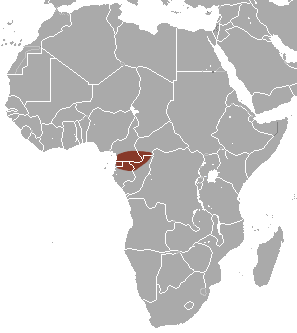
The distribution map is drawn from the IUCN Red List spatial data compiled in 2020. IUCN (International Union for Conservation of Nature)