
Hairy Fruit-eating Bat
Artibeus hirsutus
Red List assessment
Least Concernon the IUCN Red List
- EXExtinct
- EWExtinct in the Wild
- CRCritically Endangered
- ENEndangered
- VUVulnerable
- NTNear Threatened
- LCLeast Concern
The Hairy Fruit-eating Bat is recorded in one country, Mexico across North America. The IUCN Red List assesses the Hairy Fruit-eating Bat as Least Concern. No precise global population estimate exists.
- Family
- Phyllostomidae
- Order
- Chiroptera
- Genus
- Artibeus
- Countries recorded
- 1
- Continents
- North America
- Red List category
- Least Concern
- Data updated
- August 9, 2026
What is the Hairy Fruit-eating Bat?
Artibeus hirsutus, the Hairy Fruit-eating Bat, is a medium-sized leaf-nosed bat (family Phyllostomidae) endemic to the Pacific slope of western Mexico. It is named for its noticeably dense, shaggy fur compared to closely related species in the genus. It inhabits tropical dry forests and thorn scrub habitats and plays a significant ecological role as a seed disperser and occasional pollinator. Like other Artibeus, it is highly adapted for a frugivorous lifestyle centered on fig consumption.
Where does the Hairy Fruit-eating Bat live?
Endemic to western Mexico, found along the Pacific slope in states including Sinaloa, Nayarit, Jalisco, Colima, Michoacán, Guerrero, and Oaxaca.
Strictly endemic to western Mexico. Its range extends along the Pacific slope from Sinaloa southward through Nayarit, Jalisco, Colima, Michoacán, Guerrero, and into Oaxaca. It does not occur outside Mexican territory.
Altitude and depth
Typically recorded from sea level up to approximately 1,500–2,000 m in the foothills and lower montane zones of western Mexico's Sierra Madre Occidental and associated ranges.
Seasonal movements
No long-distance seasonal migrations are documented. Local movements likely track seasonal fruit availability between dry and wet seasons. Reproductive cycles are linked to seasonal peaks in food abundance rather than to temperature-driven hibernation.
Habitat of the Hairy Fruit-eating Bat
Primarily occupies tropical dry forests, thorn scrub, and subtropical deciduous forests along Mexico's Pacific coastal plain and adjacent foothills. It also uses forest edges, gallery forests, and secondary vegetation. Roosts are typically found in tree hollows, dense foliage, rock crevices, or occasionally caves.
Adaptations to its environment
Possesses echolocation calls adapted for navigating dense tropical forest vegetation. Its relatively dense fur may provide thermal insulation during cool dry-season nights at higher elevations. Robust, broad molars are well suited for crushing tough-skinned fruits, especially figs. White facial stripes may serve as camouflage, breaking up the bat's outline while roosting among leaves.
Conservation status and numbers
Listed as Least Concern (LC) by the IUCN. The population is considered stable within its endemic Mexican range, with no documented significant long-term decline. Its ability to exploit disturbed habitats such as forest edges and secondary vegetation contributes to its relative resilience.
Estimated population
No precise global population estimate exists. The population trend is considered stable, with no documented significant decline, though localized pressures from habitat loss may affect regional subpopulations.
What threatens the Hairy Fruit-eating Bat?
Deforestation and habitat degradation from agricultural expansion, logging, and human settlement along Mexico's Pacific slope are the main threats. Burning of tropical dry forests during land-clearing destroys roost sites and foraging habitats. Pesticide use in agricultural zones may reduce fruit quality and contaminate food sources.
Diseases and parasites
Like other phyllostomids, likely hosts ectoparasites including streblid bat flies (family Streblidae) and various mite species. Internal helminths have been documented in related Artibeus. Bats of this genus can harbor coronaviruses and other RNA viruses, though specific pathogen studies on A. hirsutus are limited.
What is being done to protect it?
The species falls under Mexico's national wildlife protection framework (NOM-059-SEMARNAT). Some portions of its range overlap with protected areas such as biosphere reserves along the Pacific coast. General bat conservation initiatives in Mexico provide indirect benefit.
Recommended actions
Priority actions include preservation and restoration of tropical dry forest corridors along Mexico's Pacific slope, reduction of pesticide use near roosting areas, and education campaigns highlighting the ecological value of frugivorous bats for forest regeneration.
What the Hairy Fruit-eating Bat looks like
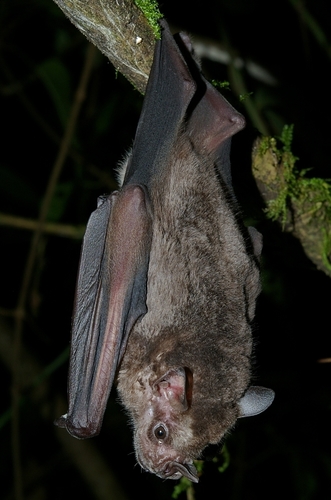
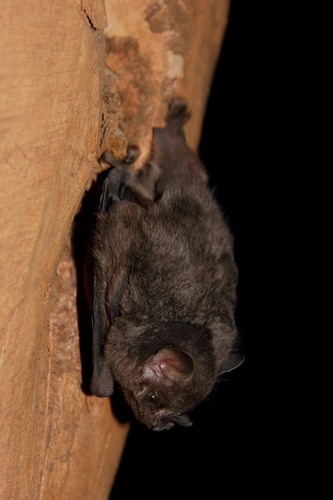
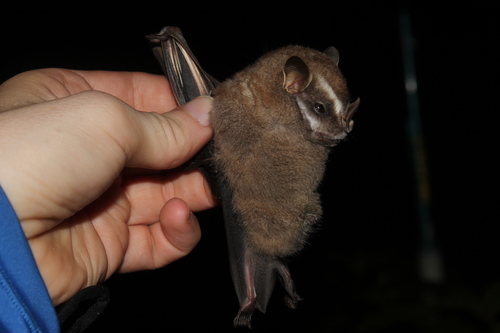
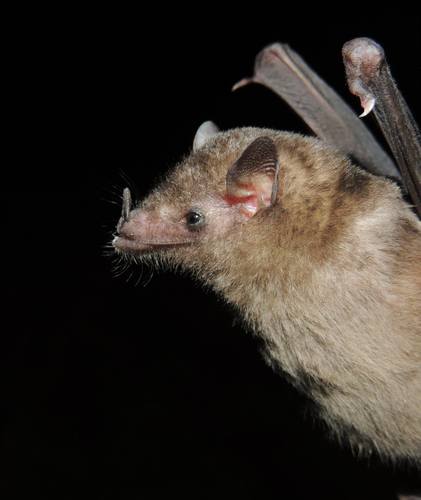
A medium-sized bat with dense, shaggy grayish-brown to dark brown dorsal fur and paler, sometimes whitish underparts. It bears the characteristic two pale white stripes on each side of the face (above and below the eye) shared by most Artibeus. Wing membranes are dark brown and the short triangular noseleaf is well developed.
Size
Forearm length approximately 55–65 mm; body length approximately 75–95 mm; wingspan roughly 35–40 cm. Tail is absent or vestigial, as typical of Artibeus.
Weight
Approximately 25–45 g. Females may be slightly heavier during pregnancy. Sex-specific weight data specific to this species remain limited in the literature.
Distinctive features
Distinguished from the closely related Artibeus jamaicensis by its notably denser, shaggier pelage (the defining trait giving it its common name), slightly different cranial proportions, and its restricted distribution on Mexico's Pacific slope. Facial stripes may appear slightly less vivid in some individuals compared to A. jamaicensis.
Differences between males and females
Sexual dimorphism is minimal. Females may be marginally heavier during gestation and lactation. No notable differences in coloration, wing shape, or other external features are documented between sexes.
Behaviour and diet of the Hairy Fruit-eating Bat
Roosts in small groups; males of related Artibeus species often establish harem-based social structures in which a dominant male defends a cluster of females. Colony sizes at a single roost are generally small, typically fewer than 20–30 individuals.
When it is active
Strictly nocturnal, beginning foraging activity shortly after sunset. Peak foraging often occurs in the early to middle part of the night when fruiting trees are visited. Individuals return to their roost before dawn.
Diet
Primarily frugivorous. Figs (Ficus spp.) constitute a dietary staple, consistent with the broader Artibeus feeding strategy. Other soft tropical fruits, nectar, and pollen are consumed seasonally. Occasional insect intake may supplement protein needs.
How it feeds and hunts
Uses echolocation and olfaction to locate ripe fruit in the forest canopy. Once a fruit is detected, it is bitten off and carried in the mouth to a separate feeding roost where pulp is consumed and seeds are discarded or deposited through feces at distance from the parent tree.
Communication
Employs ultrasonic echolocation for navigation and foraging. Social communication includes audible squeaks and chirps used in roost interactions and during mother–pup recognition. Scent glands may play a role in social and reproductive signaling, as observed in congeners.
Interactions with other species
Natural predators include barn owls (Tyto alba), other raptors, and snakes that may raid roosts. Competes with other frugivorous bats and birds for fig and fruit resources. Functions as a critical mutualist with plants, dispersing seeds of tropical dry forest trees over significant distances.
Role in its ecosystem
Serves as an important seed disperser in the tropical dry forests of western Mexico, contributing to forest regeneration and maintaining plant species diversity. Its consumption of figs and deposition of seeds far from parent trees helps sustain the forest structure. May also act as a minor pollinator when consuming nectar from flowers.
Reproduction and lifecycle
Likely exhibits bimodal polyestry, with two reproductive peaks per year timed to seasonal pulses of fruit abundance, as documented in many tropical Artibeus. Gestation lasts approximately 3.5–4 months and typically produces a single pup. Weaning occurs at roughly 1–2 months of age.
Raising the young
Maternal care dominates; the mother nurses the pup and carries it clinging to her body during early weeks of life. Males provide no direct parental care. Pups develop rapidly and achieve flight and independent foraging within a few months after weaning.
Maturity and lifespan
Sexual maturity is likely attained within the first year of life, consistent with other tropical Artibeus species. Wild lifespan is estimated at 5–10 years; captive individuals of closely related species have exceeded 10 years.
Taxonomy and naming of the Hairy Fruit-eating Bat
Classification
Mammalia > Chiroptera > Phyllostomidae > Artibeus > Artibeus hirsutus
Scientific synonyms
Described by W. Peters in 1869. No widely recognized taxonomic synonyms, though earlier broad treatments of the genus Artibeus may have grouped it differently within large Artibeus assemblages.
What research says
Recent studies
Molecular phylogenetic studies of the genus Artibeus have refined the evolutionary placement of A. hirsutus within the large Artibeus species group. Distributional surveys of Mexican bat diversity have periodically updated knowledge of its range boundaries in Sinaloa and Oaxaca. No landmark biological discovery unique to this species has been widely reported.
Genome and DNA
Diploid chromosome number in Artibeus is typically 2n = 30–31, with variation linked to sex chromosome systems. No published genomic study focused exclusively on A. hirsutus is widely available as of 2024; molecular phylogenetic analyses of the genus have confirmed its placement within the large Artibeus clade.
Compared with similar species
Most closely related to other large Artibeus such as Artibeus jamaicensis and Artibeus intermedius. Differs from A. jamaicensis primarily in its denser, shaggier pelage, slightly smaller average body size, and strictly western Mexican range. Compared to the larger Artibeus lituratus, A. hirsutus is noticeably smaller and more restricted geographically.
The Hairy Fruit-eating Bat and people
1) Its scientific epithet 'hirsutus' is Latin for 'hairy' or 'shaggy', directly inspired by the unusually dense fur that sets it apart from its congeners. 2) Like other Artibeus, it carries ripe figs to a dedicated feeding roost before eating them, inadvertently acting as a long-distance seed courier for tropical trees. 3) Its white facial stripes are believed to function as disruptive camouflage, breaking up the bat's outline while it roosts among leaves to confuse visually hunting predators.
Where and how to see it
Best observed at dusk near fruiting Ficus trees in tropical dry forests along Mexico's Pacific coast, particularly within biosphere reserves in Nayarit, Jalisco, and Oaxaca. Using a heterodyne bat detector will help confirm echolocation calls. The dry season (November–April) can offer clearer viewing conditions as vegetation is less dense.
Risks to humans
No notable risk to humans under normal circumstances. As with all wild bats, direct handling should be strictly avoided due to the theoretical risk of rabies transmission. The species is not aggressive and will not approach humans voluntarily.
Myths and legends
Bats in general hold deep symbolic significance in Mesoamerican traditions; the bat deity Camazotz featured prominently in Maya mythology as a death-associated underworld creature. Indigenous communities in Guerrero and Oaxaca, within this bat's range, maintain traditions in which bats are linked to nocturnal spirits. No myths specifically referencing A. hirsutus by species have been documented.
Countries where the Hairy Fruit-eating Bat is recorded
The 1 countries named in the range description of its IUCN Red List assessment.
Questions about the Hairy Fruit-eating Bat
Where does the Hairy Fruit-eating Bat live?
The Hairy Fruit-eating Bat is recorded in Mexico across North America. These countries come from the range description of its IUCN Red List assessment, and they are what place the species on the interactive map.
Is the Hairy Fruit-eating Bat endangered?
The IUCN Red List assesses the Hairy Fruit-eating Bat as Least Concern. The species is widespread and abundant enough not to qualify for any threatened category. It does not mean the species is safe forever, only that nothing in the current data raises an alarm.
How many are left in the wild?
No precise global population estimate exists. This figure comes from the species assessment on the IUCN Red List; population estimates for wild mammals are ranges, not counts, and are revised at each assessment.
What habitat does the Hairy Fruit-eating Bat live in?
Primarily occupies tropical dry forests, thorn scrub, and subtropical deciduous forests along Mexico's Pacific coastal plain and adjacent foothills.
What is the scientific name of the Hairy Fruit-eating Bat?
The Hairy Fruit-eating Bat is Artibeus hirsutus, in the family Phyllostomidae, order Chiroptera.
Other species in the genus Artibeus
Other species in the family Phyllostomidae
Sources
Conservation status, range description and population estimate come from the IUCN Red List assessment for Artibeus hirsutus. Countries are derived from that range description, not from a mapped country list. Last refreshed on .
The distribution map is drawn from the IUCN Red List spatial data compiled in 2008. IUCN (International Union for Conservation of Nature)