
Greater Bandicoot Rat
Bandicota indica
Red List assessment
Least Concernon the IUCN Red List
- EXExtinct
- EWExtinct in the Wild
- CRCritically Endangered
- ENEndangered
- VUVulnerable
- NTNear Threatened
- LCLeast Concern
The Greater Bandicoot Rat is recorded in 11 countries across Asia. The IUCN Red List assesses the Greater Bandicoot Rat as Least Concern. Population size is not precisely quantified but is considered large and stable to increasing due to its commensal relationship with agriculture.
- Family
- Muridae
- Order
- Rodentia
- Genus
- Bandicota
- Countries recorded
- 11
- Continents
- Asia
- Red List category
- Least Concern
- Data updated
- August 9, 2026
What is the Greater Bandicoot Rat?
The Greater Bandicoot Rat is one of the largest murid rodents in Asia, notorious for its burrowing habits and association with agricultural land. It thrives in close proximity to human settlements and farmland across South and Southeast Asia. Its large size and destructive burrowing make it a significant agricultural pest, while its adaptability has made it one of the most widespread commensal rodents in the region.
Where does the Greater Bandicoot Rat live?
South and Southeast Asia, primarily India, Sri Lanka, Bangladesh, Nepal, Myanmar, Thailand, and parts of Indochina
Widely distributed across the Indian subcontinent (India, Sri Lanka, Nepal, Bangladesh, Pakistan) and Southeast Asia including Myanmar, Thailand, Laos, Cambodia, Vietnam, and parts of southern China.
Altitude and depth
Sea level up to approximately 2000 meters elevation
Seasonal movements
Breeding activity often peaks during and after the monsoon season when food availability increases, though breeding can occur year-round in favorable conditions.
Habitat of the Greater Bandicoot Rat
Found in agricultural fields (especially rice paddies), grasslands, gardens, and urban/peri-urban areas; commonly burrows in embankments, field edges, and near water sources.
Adaptations to its environment
Possesses strong forelimbs and claws adapted for extensive burrowing, and a robust body suited to a fossorial lifestyle. Its omnivorous diet and tolerance of disturbed habitats allow it to exploit human-modified landscapes effectively.
Conservation status and numbers
Listed as Least Concern by the IUCN due to its wide distribution, large population, and adaptability to human-altered environments; the species faces no major range-wide threats.
Estimated population
Population size is not precisely quantified but is considered large and stable to increasing due to its commensal relationship with agriculture.
What threatens the Greater Bandicoot Rat?
Considered a pest rather than threatened; localized control efforts (poisoning, trapping) by farmers and agricultural authorities represent the main pressure on populations, though these do not threaten overall survival.
Diseases and parasites
Known to carry parasites such as fleas and mites, and can act as a reservoir for diseases including leptospirosis and potentially plague-related pathogens.
What is being done to protect it?
No specific conservation programs exist as the species is abundant and often targeted for population control rather than protection.
Recommended actions
Monitoring is recommended mainly for agricultural pest management rather than conservation; research into sustainable rodent control methods could reduce collateral ecological impacts.
What the Greater Bandicoot Rat looks like
Robust body with coarse brownish-grey to dark brown fur on the back, paler grey-white underparts, a scaly naked tail, and small rounded ears. The muzzle is blunt and the incisors are notably large and strong.
Size
Head-body length typically 195-310 mm, with tail length roughly equal to or slightly longer than body length (200-260 mm).
Weight
Adults typically weigh between 250 and 700 grams, with some large individuals exceeding 1 kg.
Distinctive features
Distinguished from the Lesser Bandicoot Rat (Bandicota bengalensis) by its considerably larger size and longer tail relative to body length, as well as a more robust skull structure.
Differences between males and females
Minimal external sexual dimorphism; males may be slightly larger than females but the difference is not pronounced.
Behaviour and diet of the Greater Bandicoot Rat
Generally solitary or found in loose colonies near burrow systems; individuals may share complex burrow networks but do not exhibit strong social hierarchies.
When it is active
Primarily nocturnal, though may show some crepuscular activity, especially in areas with less human disturbance.
Diet
Omnivorous, feeding on rice and other cereal crops, tubers, vegetables, insects, and occasionally small invertebrates; heavily reliant on agricultural produce.
How it feeds and hunts
Not a hunter in the traditional sense; forages opportunistically by digging up roots and tubers and gnawing through crop stems and stored grain.
Communication
Communicates through scent marking of burrows and trails, along with various squeaks and vocalizations during social or aggressive encounters.
Interactions with other species
Preyed upon by owls, snakes, mongooses, and other carnivores; competes with other rodent species such as Bandicota bengalensis for burrow space and food resources in shared habitats.
Role in its ecosystem
Plays a role in soil aeration through burrowing and serves as prey for various predators, but is primarily notable as a significant agricultural pest affecting rice and grain crops.
Reproduction and lifecycle
Breeds year-round in favorable climates with peaks after monsoon; gestation lasts approximately 21-23 days, producing litters of 4-12 young, with females capable of multiple litters per year.
Raising the young
Females provide all parental care, nursing and protecting young in burrow nests until weaning at around 3-4 weeks of age.
Maturity and lifespan
Reaches sexual maturity at around 3 months of age; lifespan in the wild is typically 1-2 years, potentially longer in captivity.
Taxonomy and naming of the Greater Bandicoot Rat
Classification
Class Mammalia > Order Rodentia > Family Muridae > Genus Bandicota > Species Bandicota indica
Subspecies
Several subspecies have been proposed across its range (e.g., B. i. indica, B. i. mordax, B. i. nemorivaga), but taxonomy remains debated and many are considered synonyms rather than valid subspecies.
Scientific synonyms
Mus indicus, Nesokia indica (in part, historically confused), Bandicota nemorivaga
What research says
Recent studies
Recent studies have focused on its role as an agricultural pest and reservoir for zoonotic diseases, as well as genetic studies clarifying its taxonomic relationships within the Bandicota genus.
Genome and DNA
Diploid chromosome number reported as 2n=60; limited detailed genomic studies exist compared to model rodent species.
Compared with similar species
Larger and with a proportionally longer tail than the closely related Lesser Bandicoot Rat (Bandicota bengalensis), and generally more robust than other murid rodents sharing its range such as Rattus species.
The Greater Bandicoot Rat and people
It is one of the largest rat species in Asia, with some individuals reaching nearly the size of a small cat when tail length is included. Its burrows can be extensive, sometimes causing structural damage to field embankments and irrigation channels.
Where and how to see it
Best observed at night in rural agricultural areas, particularly rice paddies, using a flashlight near burrow entrances or field edges during evening hours.
Risks to humans
Can pose a risk through crop damage and potential disease transmission (e.g., leptospirosis), but poses no direct physical threat to humans under normal circumstances.
Human uses
In some regions of South and Southeast Asia, it is hunted and consumed as a food source, and its control is economically important due to significant crop damage it causes.
Countries where the Greater Bandicoot Rat is recorded
The 11 countries named in the range description of its IUCN Red List assessment.
Questions about the Greater Bandicoot Rat
Where does the Greater Bandicoot Rat live?
The Greater Bandicoot Rat is recorded in Bangladesh, Cambodia, China, India and Laos, among 11 countries in total across Asia. These countries come from the range description of its IUCN Red List assessment, and they are what place the species on the interactive map.
Is the Greater Bandicoot Rat endangered?
The IUCN Red List assesses the Greater Bandicoot Rat as Least Concern. The species is widespread and abundant enough not to qualify for any threatened category. It does not mean the species is safe forever, only that nothing in the current data raises an alarm.
How many are left in the wild?
Population size is not precisely quantified but is considered large and stable to increasing due to its commensal relationship with agriculture. This figure comes from the species assessment on the IUCN Red List; population estimates for wild mammals are ranges, not counts, and are revised at each assessment.
What habitat does the Greater Bandicoot Rat live in?
Found in agricultural fields (especially rice paddies), grasslands, gardens, and urban/peri-urban areas; commonly burrows in embankments, field edges, and near water sources.
What is the scientific name of the Greater Bandicoot Rat?
The Greater Bandicoot Rat is Bandicota indica, in the family Muridae, order Rodentia.
Other species in the genus Bandicota
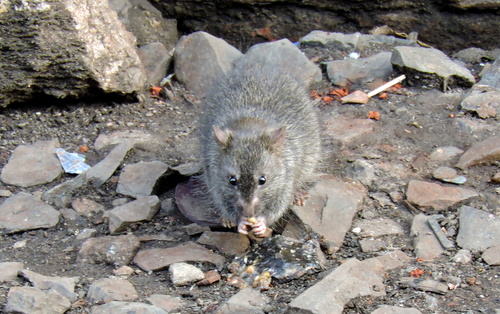
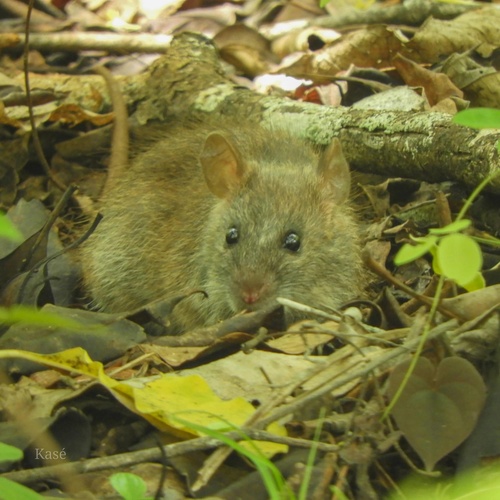
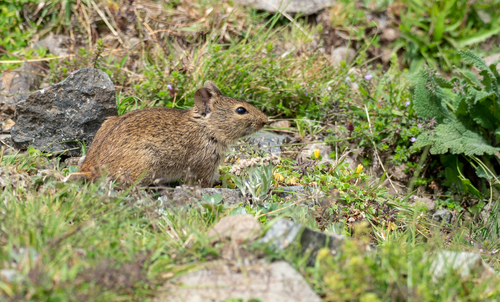
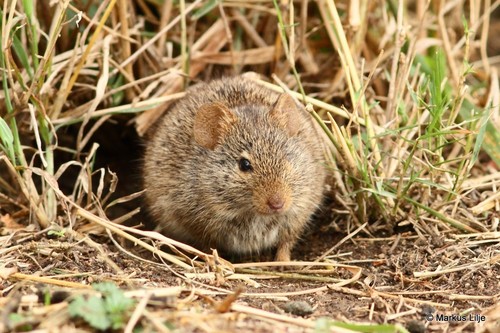
Other species in the family Muridae
Species that share its range
Sources
Conservation status, range description and population estimate come from the IUCN Red List assessment for Bandicota indica. Countries are derived from that range description, not from a mapped country list. Last refreshed on .
The distribution map is drawn from the IUCN Red List spatial data compiled in 2008. IUCN (International Union for Conservation of Nature)